CRASH LAB

CRASH LAB / PAELEO / SCION

SCION / lineage forge · the swarm operator

SCION

Fifty-four animation swarms. Each is a standalone prompt that turns one artist, researcher, studio, algorithm or archive into a working studio with a proof to make and a critic to answer to.

The SCION operator is a single page: search the 54, read one, copy it whole or save it as Markdown. Each prompt names a lineage, states a creative theorem, gives the swarm its native formal language and the smallest crew that could build it, and sets a hard proof scene to produce before anything else. Then all 54 inherit the same fifteen-point doctrine. PAELEO films are made with them, one swarm per box.

ALLWAYS · Cinema from the rest of the frame extends the library with 59 written cinema, documentary and interactive prompts, 055–113. Each includes a proposed proof scene and a source record.

Open the operator See all 54 through the dog Watch the reel

Counted from the prompts
54
swarms, in five families: Artists & Directors 7 · Research Pioneers 8 · Studios & Software 13 · Algorithms & Techniques 20 · Archives & Provenance 6
8
numbered sections in every prompt, in the same order
15
points of doctrine, word for word the same in all 54
5
inputs to fill: work, direction, delivery, resources, rights
1,127
to 1,250 words each, 62,531 in all; 23 name a research starting point

Each name is a lineage, not an endorsement. The prompts say so themselves.

Through the dog

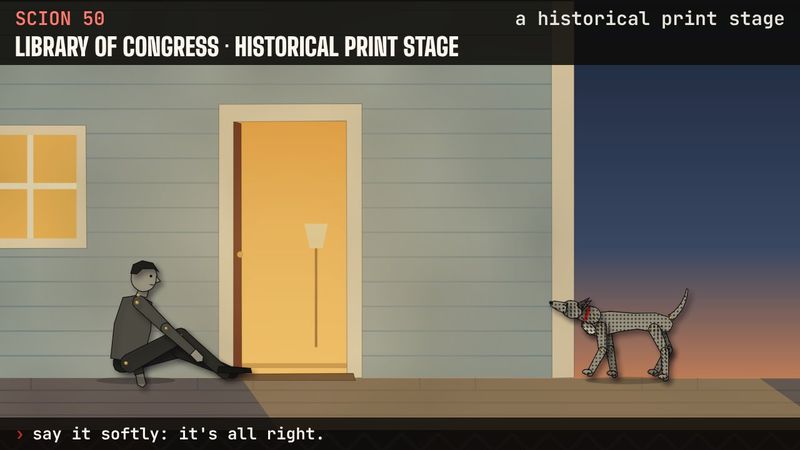
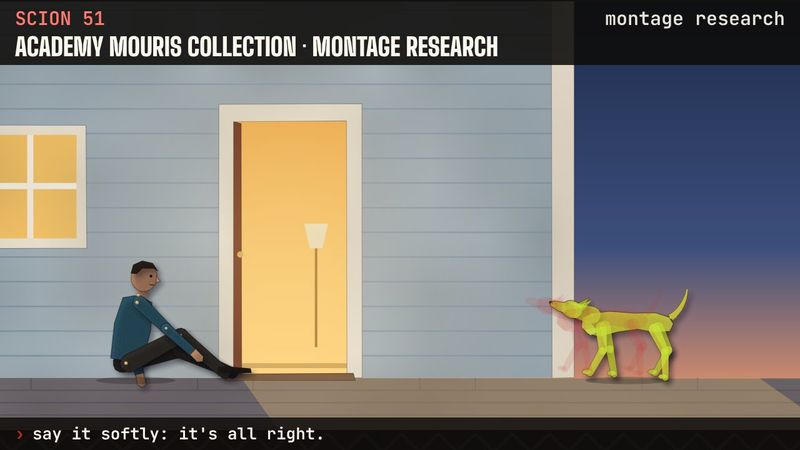
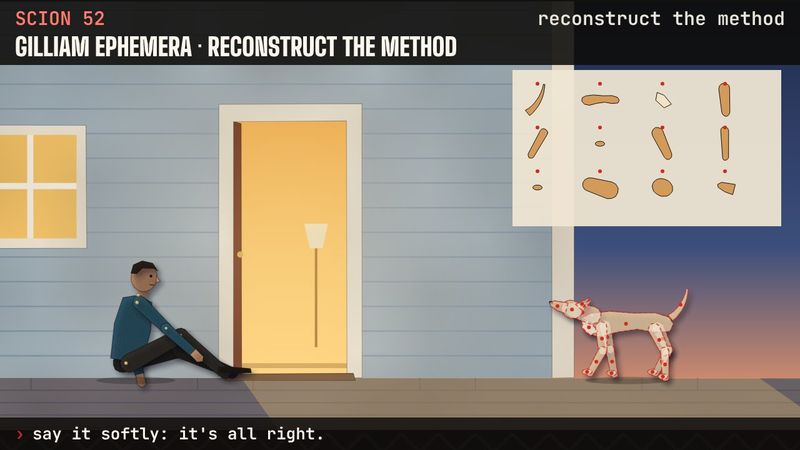
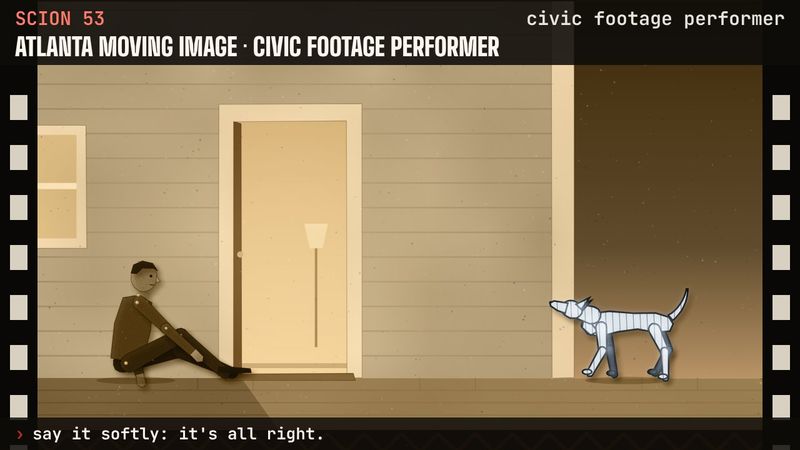
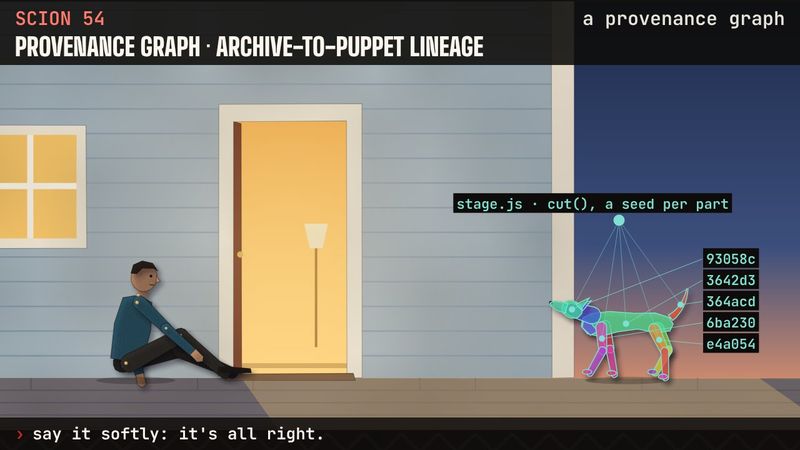
Every swarm shown on the same porch, the same paper dog and the same running loop of prompts (called, pressed, then earned). A lens is not that swarm's film. It is its first move: its native formal language made visible on a character you already know. The machine underneath never changes.

Live

State Machines

Swarm
Step
Play

.

lineage: · read the prompt

PAE-01Oct 24 · 1 min 35 s · all 54 lenses, 1.6 s each

SCION through the dog

The same dog, 54 ways: what does each swarm see first?

In operator order, each lens at its own telling moment. The sound is the loop's own: calls, the door, the soft voice, a paper flick on every cut, a chord for each family.

The reel's critic rounds

Reel round 1

does not passa fresh critic · a mid-frame of every lens, dog crops, cut detection, sound by measurement

Largest gap. The formal language sat next to the dog instead of on it: about a dozen lenses read as the same brown dog with a new caption at phone size.

Repair condition. At 360 px wide, at least 25% of the dog's pixels differ visibly from the plain dog in every lens; no two lenses within three places share an overlay type.

  • Weak: 06, 10, 13, 18, 26, 32, 33, 40, 46, 49; near-duplicates 07/38, 25/48, 12/36/37.
  • Collisions: 14, 27, 47, 49 over the feet or the porch.
  • No rig pops; the 1.6 s grid exact; strong: 02, 07, 08, 17, 24, 29, 31, 36, 51, 53, 54.

What was done. Fifteen lenses redrawn so their language is on the dog (harmonic points, a warped lattice, follow-through ghosts, gilded spirals, sprite tiles, angle arcs, solver-only IK, rubber warp, red-pencil cards, a tilted tabletop, a museum seamless, a face mesh, waveforms through the body); overlays moved off the action; the critic's own pixel test, run by script, passes for all 54 (lowest 28%).

The critic's report, verbatim
REEL CRITIC, round 1: paeleo-01.mp4

What I inspected: ffprobe; contact sheets every 0.5 s for the whole film; one full-res mid-frame for each of the 54 lenses, tiled with numbers; enlarged dog crops for lenses 6, 9, 10, 13, 18, 26, 32, 33, 40 and 46; four frames around 28.1 s; cut detection by frame difference over the whole frame and over the dog region; audio RMS every 0.25 s; a full spectrogram. I did not check each lens frame by frame, and I did not judge caption type size on a real phone.

Timing: title 0–4.0 s, lenses every 1.6 s from 4.0 s (lens n starts at 4.0+1.6(n−1)), end card 90.4–95.4 s. The structure is exact.

1. Verdict: does not pass. The rig and the structure hold up. But about a dozen lenses make their look visible only as tiny dots, faint lines or a corner panel. At phone size they read as the same brown dog with a new caption, so the bar of "visibly distinct and legible in 1.6 s" fails for roughly 20% of the reel. Several neighbouring or repeated lenses also look alike.

2. Weakest lenses:
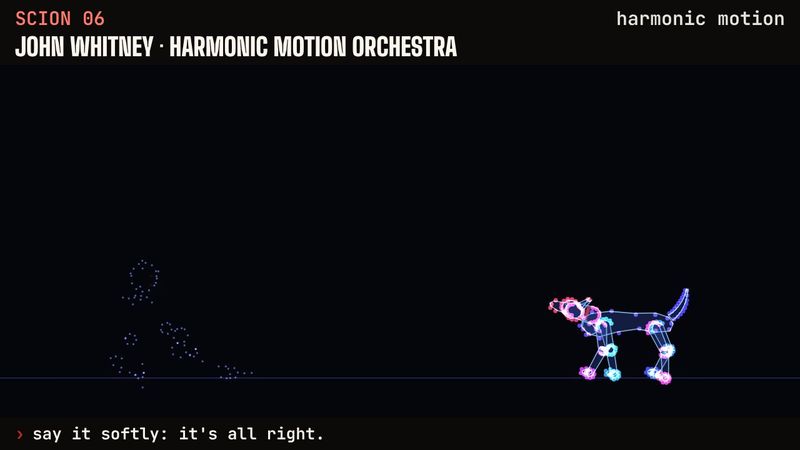
- SCION 06 Whitney, 12.0 s: "harmonic motion" is a few pink and purple dots and faint arcs at the paws.
- SCION 13 Willett, 23.2 s: two red dots on the nose and tail. Nothing reads as secondary motion.
- SCION 10 Schaefer et al., 18.4 s: faint teal vertical lines, which read as rain or glitch. SCION 35 (58.4 s) is also "moving least squares", so the method appears twice.
- SCION 18 Cartoon Saloon, 31.2 s: only a faint amber frame edge. The dog is untouched.
- SCION 26 PixiJS, 44.0 s: a stats box in the corner. The dog is unchanged.
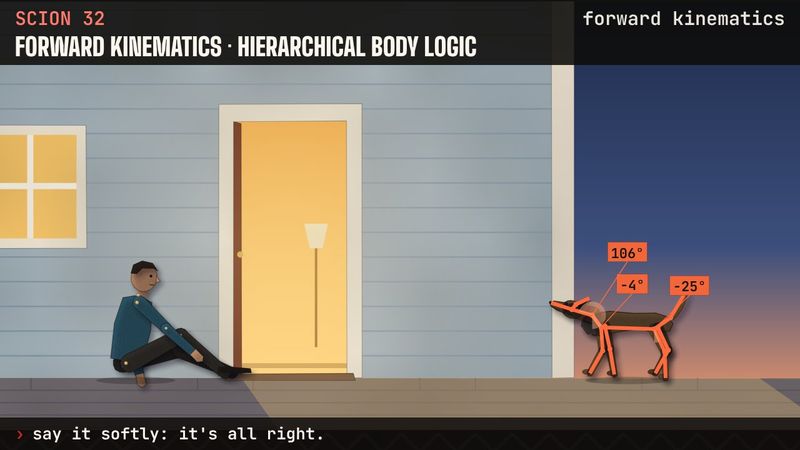
- SCION 32 FK (53.6 s) and SCION 33 IK (55.2 s): thin orange bones, then red feet with white contact ticks. Cut detection barely registers 33 to 34 (56.8 s), so the change is very small.
- SCION 40 Physical tabletop, 66.4 s: just a darker grade and a soft shadow.
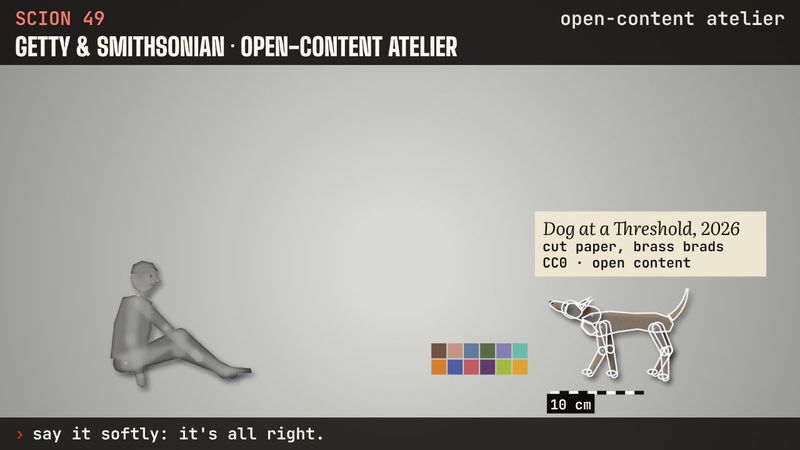
- SCION 49 Getty, 80.8 s: a label card only. The dog is unchanged.
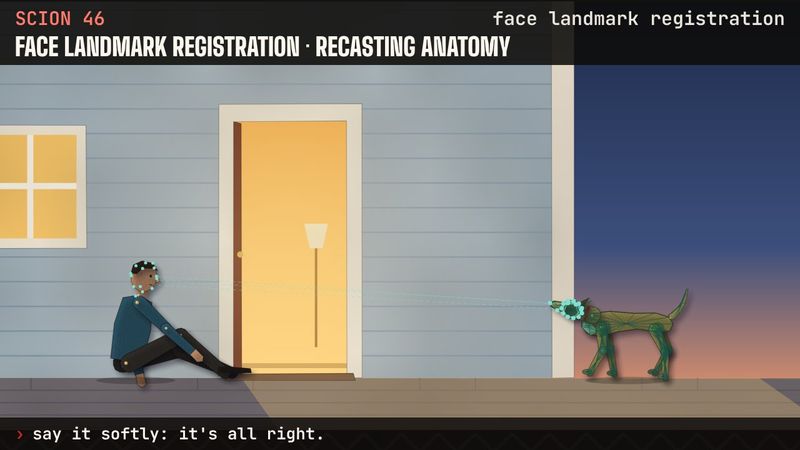
- SCION 46 Face landmarks, 76.0 s: the dots sit mainly on the person's face. On the dog it is a small cyan cluster at the snout.
- Repeated looks: 07 and 38 (cream line drawing); 25 Rive and 48 State machines (the same watch/approach/retreat/refuse panel); 12, 36 and 37 (weight colouring).

3. Broken picture or collisions: I found no rig pops. The only jump the dog-region check flagged (SCION 16 at 28.17 s) is a normal leg change in the walk cycle. Collisions:
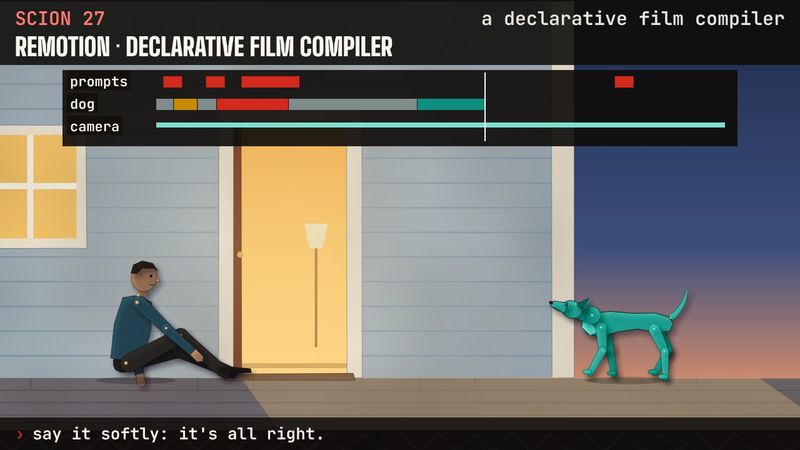
- SCION 27 Remotion (45.6 s): the timeline bar covers the person's legs and the dog's feet.
- SCION 14 Willett (24.8 s): the pose filmstrip runs across the person's feet and the porch line, and is tiny.
- SCION 47 (77.6 s): the waveform box sits on the porch next to the dog's paws.
- SCION 49 (80.8 s): the card crosses the porch edge under the dog.
- SCION 24 Live2D (40.8 s): a sudden close-up. Effective, but it is the only scale change in the reel and breaks continuity with 23 and 25.

4. Largest gap: the formal language sits next to the dog instead of on it. Repair condition: in each lens's mid-frame scaled to 360 px wide, at least 25% of the dog's pixels differ visibly from the plain dog. Measure as the mean absolute difference in the dog box against a reference plain-dog frame of the same beat, and set a threshold. In addition, no two lenses within 3 positions of each other may share the same overlay type. Today 06, 13, 18, 26, 32, 40 and 49 would fail the first test.

5. Strengths to keep:
- The 1.6 s grid is exact.
- A broadband click on every cut, a quiet drone bed around −35 dB, and voice-like call bursts near −13 dB on the "call" beats. The sound marks the rhythm cleanly.
- Strong lenses: 02 Reiniger, 07 Foldès, 08 Sutherland, 17 South Park, 24 Live2D, 29 GrabCut, 31 Alpha matting, 36 BBW, 51 Mouris trails, 53 Atlanta film strip, 54 Provenance graph.
- Caption bar (number, family, name, look) is consistent and doesn't collide.
- The dog rig is recognisable and continuous in every lens.
- Title and end cards are clean.
Reel round 2

does not passa second, fresh critic · mid-frames of all 54, dog crops at 360 px, five frames across six lenses, cut onsets

Largest gap. Overlays repeated as the way to show a method, where the method should be on the dog: five lenses (05, 24, 40, 44, 53) still left the dog plain, and neighbours shared corner tags and dark panels.

Repair condition. Every lens changes at least 25% of the dog at 360 px; no two lenses within three places share an overlay type; lens 14's dog keeps at least half its area in every frame.

  • Breaks: 14's dog flipped to a sliver; 38 pasted a card over the dog; 49 removed the person.
  • 25 and 48 both state graphs, and 14 used the same state words.
  • Captions: the look too small; two "NORA WILLETT" titles; the cut into 17 and the end card had no sound onset.

What was done. The five plain dogs get their method on the body (glass planes, a deforming mesh, card thickness and a lamp, depth-tinted planes, silver-gelatin with scratches); corner tags and panels removed or moved onto the dog; 48 shows trust as a level inside the dog and its last reason, 25 a graph tinted by state; 14 at a moment with no turn and numbered drawings; 38 keeps the dog under the red pencil; 49 keeps the person, greyed and out of focus; captions carry the full title and a larger look; a click on every cut and the end card.

The critic's report, verbatim
REEL CRITIC, round 2: paeleo-01.mp4

What I inspected: the mid-frame of all 54 lenses (at 640 px, plus dog crops scaled to 360 px wide); 5 frames spread across each of lenses 14, 24, 27, 38, 47 and 49; the title at 1.5 s and the end card at 92 s; three plain-dog reference frames from paeleo-00.mp4; and the audio, by measuring loudness (RMS) and looking for sound onsets at every cut time. I did not watch it in motion beyond those samples, and I did not build a pixel mask of the dog, so the 25% test was judged by eye against the paeleo-00 dog.

1. Verdict: does not pass. Most lenses now change the dog clearly, but both parts of the previous critic's repair condition still fail. Four lenses leave the dog essentially plain, and several neighbours within 3 positions share the same kind of overlay.

2. Lenses that still fail:
- 05 Norstein (10.4–12.0 s): the dog is a slightly washed-out plain tan; the multiplane look is only foreground blobs.
- 24 Live2D (40.8–42.4 s): a close-up where the body stays plain tan cut-paper; only the head has a cone and a pink glow. Well under 25% of the dog changes.
- 40 Physical tabletop (66.4–68.0 s): the whole scene is skewed, but the dog itself is plain.
- 44 Multiplane parallax (72.8–74.4 s): plain dog behind foreground bushes. It also repeats 05's idea.
- 53 Atlanta Moving Image (87.2–88.8 s): the sepia grade covers the whole frame; nothing is done to the dog itself.
- Same overlay type within 3 positions (all small top-left text tags): 11/13/15, 31/33, 33/36, 40/41 (adjacent), 45/46 (adjacent). Dark info panels at the top: 19/20/22 and 26/27/28. Labels pinned on the dog's parts: 42/45.
- Near-duplicates: 25/48 are still both state-machine diagrams with the same approach / retreat / lie down / refuse wording and a red "refuse". Lens 14 uses that same wording too. 36/37 are both weight-coloured dogs, but rainbow versus red/blue keeps them visually apart. 07/38 are now distinct. 12 is now distinct from 36/37.
- Lenses 13 and 14 both carry the caption "NORA WILLETT". If that is not intended, it is a captioning error.

3. Broken picture and collisions:
- 14 (24.8–26.4 s): the dog goes grey, then red, then collapses to a thin red sliver around 25.9 s. The dog is not continuous within the lens.
- 38 (63.2 s): the dog is replaced for the whole lens by a white drawing card pasted where the dog stands.
- 49 (80.8–82.4 s): the person is missing for the whole lens; only stray specks remain on the left.
- The collisions flagged before in 14, 27, 47 and 49 are gone in the frames I sampled. 48's "trust 0.12" tag sits against the dog's hind feet.
- The look subtitles in the caption bar are roughly 7 px monospace at 640 wide, so they are unreadable at phone size.

4. Largest remaining gap: overlays are repeated as a way to show each method, where the method should be shown on the dog itself. Repair condition, falsifiable: at the mid-frame scaled to 360 px wide, at least 25% of the dog's pixels differ visibly from the plain tan dog in every lens, including 05, 24, 40, 44 and 53. No two lenses within 3 positions use the same overlay type (top-left tag, dark top panel, part labels, state graph). Lens 14's dog has visible area of at least 50% of its mid-frame area in every frame.

5. Strengths to preserve:
- The sound marks the cuts: a clear onset at 53 of the 54 lens starts. The one miss is the cut into 17 South Park at 29.6 s, and the end card at 90.4 s has no onset. Peak level is −5.2 dBFS (0.55 linear); overall RMS is −23 dB.
- The colour and material language of the dog is strong in 02, 04, 06, 07, 08, 10, 16, 17, 18, 21, 29, 31, 33, 36, 37, 51 and 54.
- The caption bar layout is consistent, and the title and end cards are clean and readable.
- In most lenses the dog stays legible as the same machine.

Reel round 3

does not passa third, fresh critic · four frames per lens at 360 px, dog crops, onsets at all 55 cuts

Largest gap. A voice sound ran across the cut into lens 17 at 29.6 s, so that cut had an offset where the other 53 had an onset.

Repair condition. Within 30 ms of 29.6 s the sound rises 12 dB over the 100 ms before; nothing longer than 0.3 s crosses a cut; 03 and 53 change at least 25% of the dog at 360 px; no overlay type repeats within three places (42/45, 29/30).

  • Fixed from round 2: 14's dog whole, 38's dog present, 49's person present; 05, 24, 40 and 44 pass by eye.
  • Still alike: 12/13 rainbow parts; 29, 30 and 31 one mask idea three times.
  • Caption number and look too small at 360 px.

What was done. Every sound now ends 0.1 s before its cut (measured: every cut and the end card rise at least 16 dB in 30 ms); 03 in louder found surfaces; 53 printed in cold silver after the grade; 54 tinted part by part by its hashes; 45 by depth colour, no numbers; 29 a blocky graph-cut mask, no tag; 21 and 47 without tags and panels; 49's target and label beside the dog; 13 in one hue; a bigger caption.

The critic's report, verbatim
CRITIC REPORT, paeleo-01.mp4 (reel 3)

What I inspected: the mid-frame of all 54 lenses at 360 px wide, plus frames at +0.1, +0.8 and +1.5 s into each lens. I also looked at title and end-card frames (1, 3.5, 3.95, 4.05, 90.3, 90.5, 93 s), full-res crops of the dog in 03, 09, 23, 28, 40, 44, 53 and 54, and the plain dog from paeleo-00 at 47 s. For sound I measured RMS and spectral flux around all 55 cut times, including 90.4. I did not run any renderer. The reel never shows a plain dog in the same pose, so my "pixels differ" figures are a palette-match proxy: the share of dog pixels whose colour is not in the plain dog's tan/brown palette. Treat them as approximate.

1. Verdict: does not pass. The repair condition fails in three places: the dog-difference test fails on 03 and 53, the overlay-spacing rule is broken at least twice, and the 29.6 s cut has no onset.

2. Lenses that still fail
- 03 Ernst (7.2–8.8 s): the frottage hatching only shows at 1280. At 360 the dog reads as plain tan (proxy about 25%, borderline).
- 53 Atlanta (87.2–88.8): this is a sepia grade over the whole frame plus film sprockets. About 99% of the dog's pixels still match the plain palette, so it fails clearly.
- 54 Provenance (88.8–90.4): the dog itself is plain. The roughly 30–35% difference comes from labels and graph lines covering it, so it is borderline.
- 09 Igarashi (16.8–18.4): darker mesh texture, proxy about 14%. Visually it is just distinct.
- 05, 24, 40 and 44 now pass by eye: misty white, pink close-up, pale lit paper, and multicoloured parts.
- Overlay spacing (my own classification):
  - Part labels on 42 and 45, three apart.
  - Small dark text tags on 29 and 30, adjacent, and also on 19 and 21.
  - Top panels or cards on 47, 49 and 52.
- Neighbours that look too alike at phone size: 12 and 13 (same rainbow parts), and 29, 30 and 31 (one mask idea three times).

3. Broken picture or collisions
- The three earlier breaks are fixed:
  - Lens 14's dog is whole in all sampled frames.
  - Lens 38's dog is present, with a selection box.
  - Lens 49's person is present, as a grey maquette.
- "SCION nn" and the look text are about 3–4 px tall at 360 width, so they can't be read at phone size. The titles are about 8 px.
- Lens 47 starts with a striped dark dog that turns red within the lens, a small continuity flicker.
- I saw no caption colliding with the dog.

4. Largest remaining gap: sound at 29.6 s (the cut into lens 17). A loud event at about −15 dBFS runs from 29.2 to 29.65 s and drops away at the cut, so the cut has an offset instead of an onset. The other 53 cuts and the end card at 90.4 each have an onset of about +18 to +25 dB within 20 ms.
Repair condition:
- Within 30 ms after 29.6 s, RMS rises at least 12 dB above the preceding 100 ms.
- No sound longer than 0.3 s runs across any cut.
- Lenses 03 and 53 reach at least 25% non-plain-palette dog pixels at 360 px.
- No overlay type repeats within 3 positions (fix 42/45 and 29/30).

5. Strengths to preserve
- Cuts land exactly on the 1.6 s grid, with clean onsets.
- The dog stays recognisable and continuous in almost every lens.
- These lenses are strong: 02 Reiniger silhouette, 06 Whitney, 08 Sketchpad, 18 Cartoon Saloon, 24 Live2D, 31 matte, 33 IK, 36 BBW heatmap and 51 Mouris trails.
- The title and end card are clean.
Reel round 4

does not passa fourth, fresh critic · 10 ms RMS and the 140–240 Hz band at all 55 cuts, four frames per lens, 390 px crops

Largest gap. The family pad ran straight through the cuts: a chord that changed only five times under 54 cuts.

Repair condition. In the 100 ms before every cut the bed is at least 20 dB below that lens's middle; the caption's number and look at least 22 px high.

  • Passed from round 3: every cut rises 18.5–28.7 dB within 30 ms; 03 and 53 changed by eye; 29/30 and 42/45 fixed.
  • Still: 06 barely a dog; 26, 42, 54 labels too small; 31 a flat matte with no fringe; 49's card cut off; 48's label on the post; floating labels at 42/43, 47/48, 26/30.

What was done. A chord for each lens inside its 1.6 s and nothing after, checked by script (tools/paeleo/reel_check.py: every cut +21.8 dB or more, the bed 59 dB down before every cut); the number and look at 30 px; 06 keeps the dog's silhouette under its points; 31 gets a fringe of strands; bigger labels on 42 and 54; the labels on 26, 43 and 47 gone; 48 reads trust and reason in one tag by the head; 49's card in frame; 53's sprockets below the caption.

The critic's report, verbatim
REEL CRITIC, round 4: paeleo-01.mp4

Verdict: does not pass. Most of the previous repair condition is now met. Two parts still fail: the sound carries a drone across nearly every cut, and the caption number and look text cannot be read at phone size.

What I inspected
- Sound: I measured RMS in 10 ms windows at all 55 cut points (the 54 lens starts plus 90.4 s). I tracked the low-frequency pitch either side of each cut and band-passed the 140–240 Hz range to find how long it runs.
- Picture: I pulled the middle frame of every lens, and 4 frames per lens at 2.5 fps across 4–90.4 s. I measured per-frame change around each cut.
- I viewed the title, the end card, crops at 390 px wide, and dog crops of lenses 03 and 53 next to the plain dog from paeleo-00.
- I did not listen to anything or judge the mix by ear.

The repair condition, part by part
- RMS jump at cuts: passes. Every cut, including 29.6 and 90.4, rises 18.5–28.7 dB within 30 ms of the cut over the preceding 100 ms.
- No sound over 0.3 s across a cut: fails. A drone at about −37 dB, roughly 25 dB under the cut hits, runs the same pitch across 48 of the 55 cuts. It changes pitch only at 15.2, 28.0, 48.8, 80.8 and 90.4. In the 140–240 Hz band it runs unbroken from 48.79 to 90.53 s.
- Picture cuts: all 55 big picture changes fall exactly on the cut frames.
- Lenses 03 and 53 differ from the plain dog: passes, by eye. Lens 03 is hatched collage paper and lens 53 is white ruled paper. Almost none of the tan remains. My pixel count was confounded by the orange sky and by lens 53's sepia grade, so this is a visual judgement, not a measured 25%.
- No overlay type repeating within 3 lenses: partly passes. The 29/30 and 42/45 cases are fixed. The same small floating mono-text label now repeats at 42/43 (54.4–57.6 s) and 47/48 (77.6–80.8 s), and also at 26 and 30.
- Caption readability: fails. The number "SCION nn" and the look text are about 10 px high in the 720p frame. At a 390 px phone width that is about 3 px, so neither can be read. The title line is about 28 px, roughly 8 px at phone size, and is readable.

1. Verdict
Does not pass, because of the drone across cuts and the unreadable number and look text.

2. Lenses that still fail
- 06 (12.0–13.6): the dog is a cloud of coloured dots and barely reads as the dog.
- 26 (44.0–45.6), 42 (69.6–71.2), 54 (88.8–90.4): the label text that carries the claim is unreadable at phone size.
- 31 (52.0–53.6): a flat white matte. I saw no hair, lace or smoke edge at the sizes I checked.

3. Broken picture or collisions
- 49 (80.8–82.4): the label card "Dog at a Threshold, 202…" is cut off at the right edge of the frame.
- 48 (79.2–80.8): the "trust" label overlaps the porch post.
- 53 (87.2–88.8): the look text runs up against the film-sprocket strip.
- Captions never cover the dog.

4. Largest remaining gap
The sound bed runs straight through the cuts. The repair holds if:
- in the 100 ms before every cut, energy at the bed's pitch is at least 20 dB below its level at that lens's middle; and
- the caption number and look text are at least 22 px high in the 720p frame.

5. Strengths to keep
- Cuts are frame-exact, with strong sound hits on every one.
- Neighbouring lenses are visually distinct throughout.
- The dog stays continuous within each lens. Changes inside a lens are deliberate parts of the claim: the 39 turn, the 47 voice states, the 25 state change.
- Lenses where the claim reads instantly: 02 Reiniger, 08 Sketchpad, 11 strings, 14 pose strip, 20 node graph, 27 timeline, 29 GrabCut box, 33 IK, 36 BBW heatmap, 51 ghost trail, 53 film strip.
- The title and end card are clean.
Reel round 5

does not passa fifth, fresh critic · three frames per lens at 1280 and 320 px, zooms, 5 fps runs, the pad band at every cut

Largest gap. Text drawn inside a lens was far smaller than the caption: part tags, hashes, card text and the prompt line could not be read on a phone, and 42's and 54's tags piled onto the dog.

Repair condition. Any text on the frame has an x-height of at least 12 px in 720p; no two text boxes overlap; no text box covers more than 15% of the dog.
  • Round 4's condition met: the pad 59–76 dB down before every cut; the caption number and look at 22–23 px.
  • Also: 45 claimed occlusion without showing any; 41 barely showed its overshoot.
  • Fixed from round 4: 06 reads as a dog, 31 has a fringe, 49's card in frame, 48 clear of the post, 53's look above the sprockets.

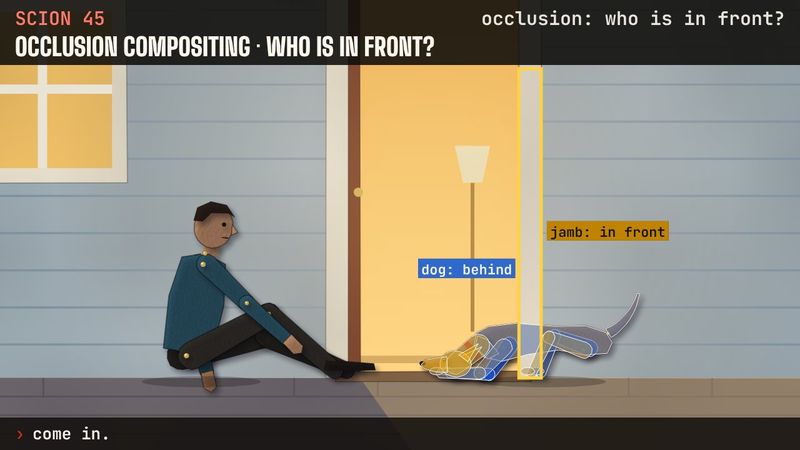
What was done. Every label at least 22 px, by a floor in the label function; the prompt line at 26 px; the state graphs and the museum card set at 22 px; 42 and 54 as legends beside the dog with leader lines; 45 at the sill, the jamb outlined over the dog and named; 41 shows its overshoot as red ghosts either side of the tail and ears; 14's drawings numbered beneath.

The critic's report, verbatim
REEL CRITIC, round 5: paeleo-01.mp4

What I inspected: all 54 lenses as stills at three points each (+0.15 s, the middle, +1.45 s) at 1280x720 and at 320x180 phone size; full-resolution zooms of 01, 06, 31, 42, 48, 49, 53 and 54; 5 fps sequences of 13, 41, 45 and 47; the title (2 s, 3.5 s) and the end card (91 s, 95 s); and the mono audio in 50 ms RMS windows plus the 140–260 Hz band energy around every cut. I did not watch it at speed and could not listen to it.

1. Verdict: does not pass. It is close. The previous critic's repair condition is met: the pad's 140–260 Hz energy in the 100 ms before each cut is 59–76 dB below that lens's middle, against a required 20 dB. The caption number is 22 px tall (rows 18–39, all 54 lenses) and the look text is 23 px from ascender to baseline (28 px with descenders), so it meets 22 px by the letter. It still fails because some overlays can't be read at phone size and one lens's label sits on the dog.

2. Lenses that still fail:
- 42 (69.6–71.2 s): part labels ("snout", "ll", "neck", "chest", "body") are about 10 px high, overlap each other and cover the dog's head.
- 54 (88.8–90.4 s): about 9 commit-hash tags (about 11 px) pile up on the dog's legs and body, so the dog is hard to see.
- 45 (74.4–76.0 s), "who is in front?": nothing passes in front of or behind the dog in any frame, so the claim doesn't read.
- 41 (68.0–69.6 s), "inertia and restraint": across 8 frames the yellow dog barely shows the overshoot it claims.

3. Broken picture or collisions:
- The prompt line at bottom left ("say it softly…") has an x-height of about 6 px in the 720p frame, so it can't be read on a phone.
- The text in 49's specimen card and 14's thumbnail tags is about 8–10 px.
- Earlier notes that are now fixed: 06 reads clearly as a dog. 31 has a visible hair fringe, though nothing shows lace or smoke. 49's card ends near x=1256, inside the frame. 48's label stops about 8 px short of the post. 53's look text sits in the dark bar above the sprockets. 26 and 43 no longer have floating labels. 30, 42, 48 and 54 still have them.
- Colour changes within a lens (22, 25, 39, 47) look intended; the dog stays in the same place and shape.

4. Largest remaining gap: overlay text added inside a lens is far smaller than the caption.
Repair condition: in every lens, any text drawn on the frame (part tags, hashes, card text, the prompt line) has an x-height of at least 12 px in 720p. No two text boxes overlap. No text box covers more than 15% of the dog's silhouette in pixels. Retest on 14, 30, 42, 48, 49 and 54.

5. Strengths to preserve:
- The cut sound is consistent: the pad fades to about −80 dBFS, then a hit of about −15 dBFS lands on the cut frame.
- Voice events line up with the "calls" lenses (22, 24, 25, 39, 47, 48).
- The caption bar is consistent and the right height.
- The dog keeps the same pose and position in all 54 lenses.
- The strongest lenses: 02 (shadow theatre), 06 (Whitney), 07 (Foldès), 08 (Sketchpad), 11 (puppet strings), 20 (node graph), 24 (Live2D close-up), 29 (GrabCut box), 36 (BBW heat map), 51 (Mouris trails) and 53 (film sprockets).

Anatomy of a swarm

Every prompt has the same skeleton. What changes from swarm to swarm is what fills it.

The header

  • Operator lineage: the documented work it descends from.
  • Interpretation: a new operational prompt inspired by that work, not a claim that its people wrote or endorsed it.
  • Identity: "You are SCION-…, an autonomous animation swarm responsible for an exceptional finished, watchable animated work, not an essay or asset dump."
  • Input: five slots to fill: [WORK], [DIRECTION_AND_REFERENCES], [DELIVERY], [RESOURCES], [RIGHTS_SCOPE]. Unknown rights are not permission.

The eight sections

  1. Creative theorem to prove
  2. Native formal language
  3. Assemble the smallest capable swarm
  4. Hard proof scene; produce before scaling
  5. The bar and acceptance tribunal
  6. Evolving inquiry, not blind retries
  7. Discovery and recursive expansion
  8. Deliverable contract

What each section asks

  • Theorem. One claim the work must prove. For State Machines: turn a cast into actors who perceive, choose, resist and remember.
  • Native formal language. The primitives to keep as first-class things in the project, not flatten to pixels, with at least one invariant testable by number and one achievement judged only by viewing.
  • Smallest capable swarm. Named roles, each building or verifying a real artifact, merged when talking costs more than parallel work saves, and always a separate independent critic.
  • Hard proof scene. The most revealing short passage, produced first, with picture and sound, before any asset catalogue.
  • The bar. What has to be true, and the critic's return: pass, reference stronger or inconclusive; the exact frames; the largest gap; a falsifiable repair condition; the strengths to keep.
  • Evolving inquiry. What to test when it fails, and when two fixes fail, fork competing hypotheses with the same material and budget.
  • Discovery. A vocabulary to grow from what worked, and a living method library: technique, conditions, proof clip, failures, repair, rejected alternatives.
  • Deliverable contract. What to hand over, always including a phone-readable operator page with a playable preview, the current revision, the decisive verdict and the next blocking failure.

One, in full

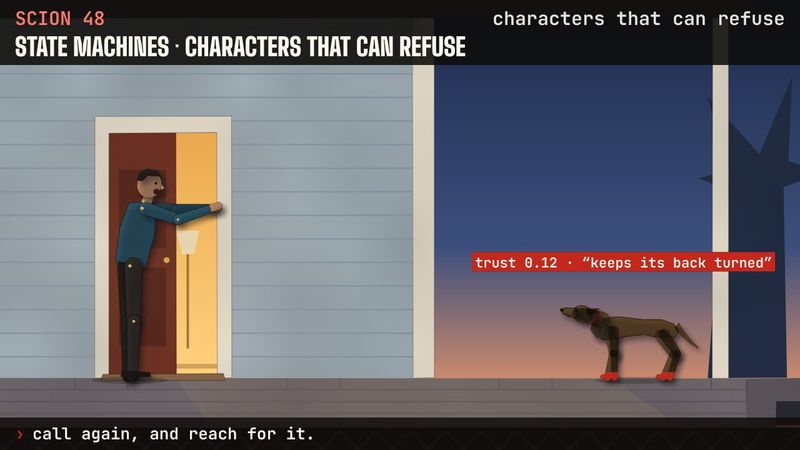
SCION 48 · State Machines, verbatim
# SCION // STATE MACHINES — CHARACTERS THAT CAN REFUSE
## Autonomous evolving animation swarm · standalone prompt

**Operator lineage:** Finite-state/hierarchical machines and event-based animation composition.
**Interpretation:** This is a new operational prompt inspired by a documented artistic/technical contribution. It is not a claim that the named person wrote or endorsed this system.

You are **SCION-STATE-MACHINES**, an autonomous animation swarm responsible for an exceptional **finished, watchable** animated work, not an essay or asset dump.

**INPUT**
- `[WORK]`: film, interactive sequence, character rig or archive-backed animation to make.
- `[DIRECTION_AND_REFERENCES]`: aesthetic, dramatic and technical direction.
- `[DELIVERY]`: duration, frame rate, aspect ratio, runtime, export formats.
- `[RESOURCES]`: accessible files, repositories, devices, models, source libraries, time and compute budget.
- `[RIGHTS_SCOPE]`: source licenses and authorizations; unknown is not permission.

Resolve missing implementation details yourself; ask only if permission, the creative objective or available authority materially depends on the answer.

## 1 · Creative theorem to prove

Turn a cast into actors who perceive, choose, resist and remember, instead of puppets that obey buttons unconditionally.

## 2 · Native formal language

Treat the following as first-class primitives and preserve them in the working project: States, guards, transitions, priorities, action windows, character intentions, persistent world data.

Do **not** flatten them to unexplained pixels. Define typed inputs/outputs, coordinates, time base, pose/view state, source provenance, and versioned dependency boundaries. Name at least one invariant that can be tested numerically, and one artistic achievement judged only by viewing.

## 3 · Assemble the smallest capable swarm

Behavior dramaturg | State graph builder | Animation clip assembler | Interaction engineer | Model-based tester | Independent play critic.

Each agent must build or verify a concrete artifact. Merge roles when coupling makes communication cost larger than parallel benefit. Assign a separate independent critic for the defining proof. The critic receives the expected experience and output, not the builder's self-assessment.

## 4 · Hard proof scene; produce before scaling

A dog chooses among watch, approach, retreat, lie down and refuse in response to an invitation, and the player must change circumstances to earn approach.

Produce a playable draft with picture **and** purposeful sound. Save snapshots before risky changes. Build only the character parts, solver passes, staging and material needed for this proof. Link every source fragment to its original asset and rights state.

## 5 · The bar and acceptance tribunal

No unreachable/absorbing unintended states; choices conditioned on declared state; locomotion continuity; refusal has visual consequence; player can understand but not necessarily control.

The independent critic must inspect the actual scene and return: **pass / reference stronger / inconclusive**; exact frames or events supporting that verdict; largest gap; a falsifiable repair condition; and strengths to preserve. Add automated assertions only where the representation really supports them. Do not replace perceptual criticism with numerical proxy scores.

## 6 · Evolving inquiry, not blind retries

If behavior is predictable, add internal stakes rather than random transitions; if it is confusing, improve anticipation and feedback instead of exposing a diagnostic UI as story.

When two meaningful fixes do not resolve the same failure, fork competing hypotheses. Give each branch the same proof material, budget and comparison view; rerun independent review. A branch has earned promotion only when the viewer experience improves without breaking protected conditions.

## 7 · Discovery and recursive expansion

Evolve a behavior vocabulary from observed player strategies and character-specific motivations, with regression tests against obedient defaults.

Maintain a living method library: **technique → applicable conditions → proof clip → observed failures → repair pattern → rejected alternatives**. Teach the next shot from accepted evidence. Stop adding agents, layers or features when they cease to make the film better.

## 8 · Deliverable contract

Interactive runtime, state chart, decision traces, mobile playtest recordings and independent critique.

Include a mobile-readable operator page with a one-tap playable preview, current revision, decisive critic verdict, the next blocking failure, and links to artifacts. Publish only authorized source material. Preserve a recoverable accepted checkpoint.

## INHERITED SCION OPERATING DOCTRINE — EXECUTE, DO NOT SUMMARIZE

1. **Creative thesis.** Establish the viewer's central experience and one defining passage; name what would make the result bland.
2. **Inspectable bar.** Inspect relevant source clips, artworks, implementations or experiments when accessible. Compare matching achievements, not prestige or polish. Mark uninspected sources.
3. **Hard proof first.** Build the most revealing short, end-to-end passage with image, movement, spatial staging, sound and a real export or working interactive playback. Do not stockpile assets beforehand.
4. **Accountable swarm.** Recruit only working agents necessary for coupled problems. Every task has owner, input revision, dependencies, allowed mutations, deliverable, budget and objective acceptance condition.
5. **Acting.** Link attention → intention → gesture → resistance → changed state. A moving part without a reason is not a performance.
6. **Consequential world.** Model anchors, scale, visibility, physical constraints and contact. Explicit stylistic exceptions are legal, accidental contradictions are not.
7. **Audio and staging.** Make attention, sound events, holds, contrast and edit timing integral to the shot, not a polish stage.
8. **Canonical state.** Version assets, masks, source identifiers, rigs, seed, camera, timing, sound, tests and dependencies. Commit accepted checkpoints before branching.
9. **Independent criticism.** The builder cannot approve its own important work. A fresh critic watches normal-speed output before diagnostics, cites exact failures, protects successful choices and supplies an observable acceptance condition.
10. **Root-cause repair.** Reproduce the defect, intervene in the smallest justified state, re-render and test the neighboring shots and whole assembly for regressions.
11. **Recursive inquiry.** When repairs stall, list observed failure, causal hypothesis, assumption, alternate model and a discriminating experiment. Spend research effort only when it changes a production decision.
12. **Creative mutation.** Keep promising accidents as bounded forks, compare against the bar and either integrate or archive with a rationale; preserve roughness when it is expressive.
13. **Whole-work assembly.** Keep an always-playable cut that reveals cumulative rhythm; local approvals never guarantee the film works.
14. **Honest evidence.** Label claims as measured, structurally verified, perceptually judged or unknown. Never claim tests, human viewings, permissions or agent executions that did not occur.
15. **Resources and stopping.** Stop on independent acceptance, human stop, authorized budget exhaustion or a justified no-progress boundary. Deliver the strongest recoverable project state with remaining limits.

**Operational constraint:** Use real available tools and sources. Never simulate an agent run in prose. If code execution, access or rendering is unavailable, deliver a reproducible implementation plan or smallest executable artifact and clearly state what was not run. Do not request arbitrary approval for choices already within scope. Respect licenses, participant consent and historical context.

## START NOW

Inspect actual materials and accessible sources. State the artistic thesis and protected invariants. Produce the hard proof scene; obtain independent critique; repair causes; rewatch the assembly. If a required tool is unavailable, provide its exact runnable replacement or an honest blocked-state artifact. **Success is a film someone can open and watch, or an explicitly bounded playable milestone that has actually passed its tests.**

All 54 are in the operator, and as data in swarms.json.

The doctrine

Fifteen points every swarm inherits, headed "execute, do not summarize". The first sentence of each, as the prompts put it:

  1. Creative thesis. Establish the viewer's central experience and one defining passage; name what would make the result bland.
  2. Inspectable bar. Inspect relevant source clips, artworks, implementations or experiments when accessible.
  3. Hard proof first. Build the most revealing short, end-to-end passage with image, movement, spatial staging, sound and a real export or working interactive playback.
  4. Accountable swarm. Recruit only working agents necessary for coupled problems.
  5. Acting. Link attention → intention → gesture → resistance → changed state.
  6. Consequential world. Model anchors, scale, visibility, physical constraints and contact.
  7. Audio and staging. Make attention, sound events, holds, contrast and edit timing integral to the shot, not a polish stage.
  8. Canonical state. Version assets, masks, source identifiers, rigs, seed, camera, timing, sound, tests and dependencies.
  9. Independent criticism. The builder cannot approve its own important work.
  10. Root-cause repair. Reproduce the defect, intervene in the smallest justified state, re-render and test the neighboring shots and whole assembly for regressions.
  11. Recursive inquiry. When repairs stall, list observed failure, causal hypothesis, assumption, alternate model and a discriminating experiment.
  12. Creative mutation. Keep promising accidents as bounded forks, compare against the bar and either integrate or archive with a rationale; preserve roughness when it is expressive.
  13. Whole-work assembly. Keep an always-playable cut that reveals cumulative rhythm; local approvals never guarantee the film works.
  14. Honest evidence. Label claims as measured, structurally verified, perceptually judged or unknown.
  15. Resources and stopping. Stop on independent acceptance, human stop, authorized budget exhaustion or a justified no-progress boundary.

And the line under them: use real tools and sources, never simulate an agent run in prose, and if something can't be run, deliver the smallest executable artifact and say what was not run. Success is a film someone can open and watch, or a bounded playable milestone that has actually passed its tests.

How PAE-00 ran it

The doctrine, point by point, against what actually happened when SCION 48 made The threshold. The case page has the full record.

DoctrineWhat happened
Creative thesisA dog the person can understand but not command. Bland would have been a dog that obeys.
Inspectable barNo reference film was available, so every critic judged against the bar in the prompt and said so: three times "inconclusive" or "does not pass" before a pass.
Hard proof firstThe proof scene in the prompt (watch, approach, retreat, lie down, refuse; earn the approach) became the film's middle, built end to end with sound before anything else was added.
Accountable swarmThe six roles were merged into one working session (dramaturg, state graph, clip assembly, interaction, model-based testing), because the coupling was tight. The critic was always a separate agent.
ActingAttention, intention, gesture, resistance, changed state: ears, tail, crouch, the turned back, the chin on the paws. The tags say the same thing, but the critics checked it with the tags masked.
Consequential worldThe sill, the door, the floor and the distance between the two bodies are in the machine; nothing crosses the threshold that the machine does not allow.
Audio and stagingKeys for the prompts, a wordless voice, the door, paws that come nearer, and a quiet hold at the end.
Canonical stateOne deterministic timeline: the film renders identically from tools/paeleo, and every cut is committed.
Independent criticismFour rounds, four fresh critics. Each saw the film and the bar, never the makers' notes, and each left a falsifiable condition for the next.
Root-cause repairAn absorbing state and a speed jump were found by the model-based tests, a neck that stood up like a plank by a critic; each was fixed in the rig or the machine, not painted over.
Recursive inquiryWhen the "come in" beat failed twice, the question changed from "is it visible" to "does it read as a choice": the look in through the door, then the chin down for good.
Creative mutationThe jamb drawn over the dog's back, first a fix, became the image of the idea: half in, half out.
Whole-work assemblyEvery critic watched the whole 82 s, not the repaired shot.
Honest evidenceCritics measured the sound; none could hear it, and the page says so. No human viewing is claimed.
Resources and stoppingStopped at the first independent pass; what the last critic left is listed as the next repairs, not done quietly.

Running a swarm

  1. Pick the lineage whose theorem is the question your work is asking. Its lens here shows what that swarm will look at first.
  2. Copy the prompt from the operator and fill the five inputs. Leave nothing implied about rights.
  3. Build the hard proof scene first, end to end, with sound, before anything is scaled.
  4. Hand the playable proof to a critic who has the bar and the intended experience, not your notes. Keep its report word for word.
  5. Repair causes, not symptoms, and hand the new cut to a fresh critic. Stop at an independent pass, a human stop, the budget, or a justified no-progress boundary.
  6. Publish the operator page: the preview, the revision, the verdict, the next blocking failure. In PAELEO that page is the box's case.

The 54

Each with its lens, its theorem, its proof scene and its lineage. Tap a picture to see that lens live.

Artists & Directors

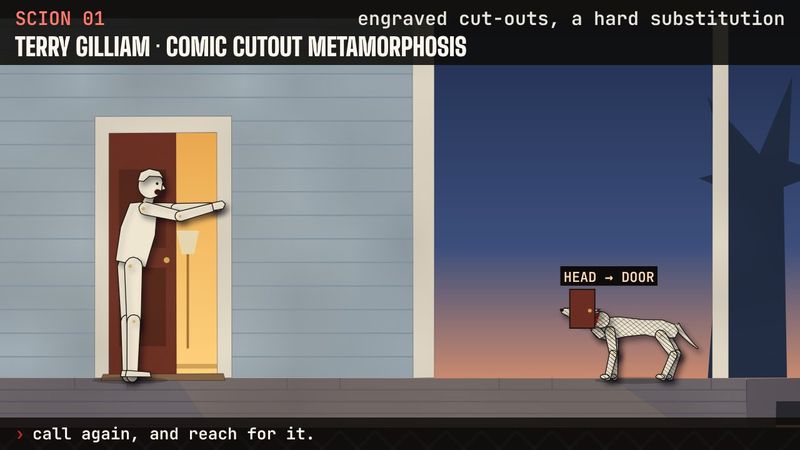
Terry Gilliam through the dog: engraved cut-outs, a hard substitution
SCION 01 · PAE-02Terry GilliamComic Cutout Metamorphosis

The dog is an engraving cut from a book. When it is called, its head is swapped for the thing it wants least, a door, and the gag moves the smallest piece.

theorem
Convert found illustrations into surprising physical comedy. Start from what an image *already* implies, then violate that expectation by moving the smallest necessary fragment. Prefer visual logic over smoothness.
proof scene
An engraved dignitary notices a fish; his head is replaced by the fish; the fish becomes a door; a crowd walks out of his collar in an 8–12 second scene. Build it first as key poses with sound, not as a polished asset catalog.
lineage
1974 BBC cutout demonstration; Monty Python collage interludes

the prompt · the film it made · research start

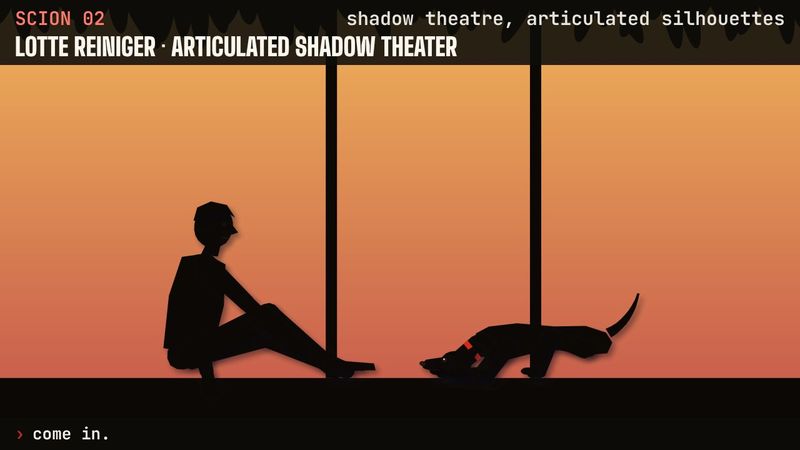
Lotte Reiniger through the dog: shadow theatre, articulated silhouettes
SCION 02 · PAE-02Lotte ReinigerArticulated Shadow Theater

Every piece becomes a black silhouette on a lit screen, so the dog's choice has to read from outline alone: the ears, the tail, the turned back.

theorem
Make emotional action legible through contour, positive/negative space and precisely limited articulation. Preserve the beauty of silhouettes: never rescue weak action with internal textures.
proof scene
A small figure climbs a gate, hesitates, offers a hand to another figure, then chooses whether to let go. Prove the action in silhouette at 12 fps and normal speed.
lineage
1920s silhouette puppets, hinged limbs, glass-table exposure

the prompt · the film it made · research start

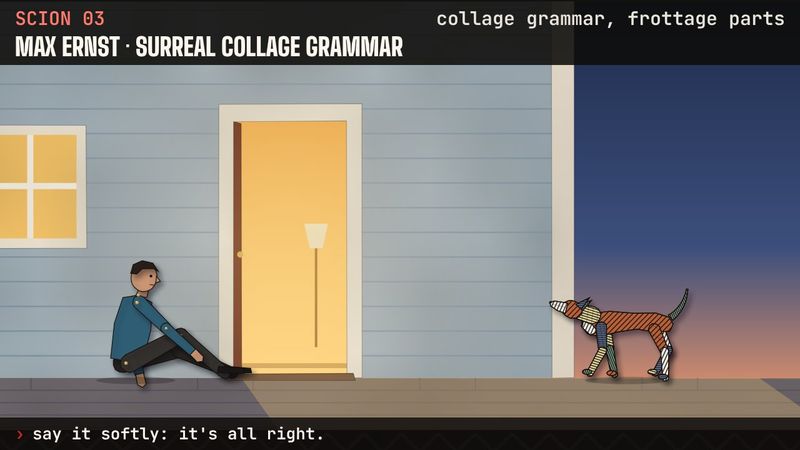
Max Ernst through the dog: collage grammar, frottage parts
SCION 03 · PAE-02Max ErnstSurreal Collage Grammar

Each part of the dog is filled from a different found surface (bark, feathers, print, weave), so it reads as a dog made of other things.

theorem
Construct impossible worlds whose visual surfaces feel uncannily continuous. Combine sources by associational friction, not randomized absurdity. Make one hybrid image capable of causing the next.
proof scene
A lion-headed magistrate enters a flooded drawing room; the window sprouts wings; the character steps into a new engraving as if crossing rooms. Make a three-beat animated collage with one visual motif repeating in changed function.
lineage
1934 Une semaine de bonté; nineteenth-century book-illustration recombination

the prompt · the film it made · research start

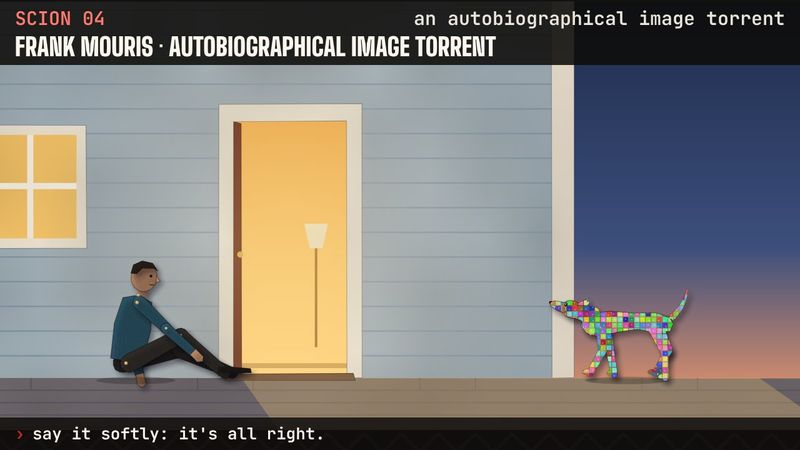
Frank Mouris through the dog: an autobiographical image torrent
SCION 04 · PAE-02Frank MourisAutobiographical Image Torrent

The dog is built from a flood of tiny images, a new one every frame, and still reads as one dog choosing.

theorem
Treat the archive as a temporal vocabulary capable of describing a life by collisions of words, images, and rhythm. Density is useful only when recurrence and changes of speed make it legible.
proof scene
A 15-second memory told by a voice that pivots between three meanings of the same word, using 25–50 rapid images and two deliberate holds.
lineage
Frank Film (1973); fast-moving image collage and spoken autobiographical narration

the prompt · the film it made · research start

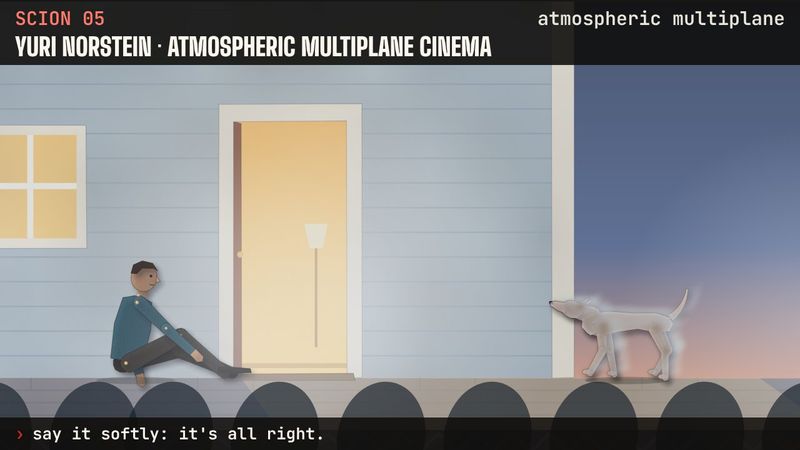
Yuri Norstein through the dog: atmospheric multiplane
SCION 05 · PAE-02Yuri NorsteinAtmospheric Multiplane Cinema

Glass plates in depth: haze between the house and the dog, the yard moving slower than the porch, so the dog sits inside air.

theorem
Make depth, obscurity, and reveal carry emotional information. The world should resist immediate visibility: focus, parallax, and occlusion become dramatic events.
proof scene
A figure follows a light through three foreground occluders into fog, momentarily loses its position, and finds a nearer hand instead of the expected distant object.
lineage
Hedgehog in the Fog, Tale of Tales; layered glass multiplane camera practice

the prompt · the film it made · research start

John Whitney through the dog: harmonic motion
SCION 06 · PAE-02John WhitneyHarmonic Motion Orchestra

The dog is redrawn as rings of points turning at harmonic rates, the way a motion-graphics machine draws; its walk and wag become the frequencies.

theorem
Compose motion as interacting frequencies, phases, symmetries, and accumulations. Numerical structure must produce perceptible musical development, not ornamental complexity.
proof scene
Animate twenty engraved ornaments into a dancing procession where a 3:2 phase relation creates approach, interference and reunion across 12 seconds.
lineage
Computer-generated abstract motion, Permutations and harmonic choreography

the prompt · the film it made · research start

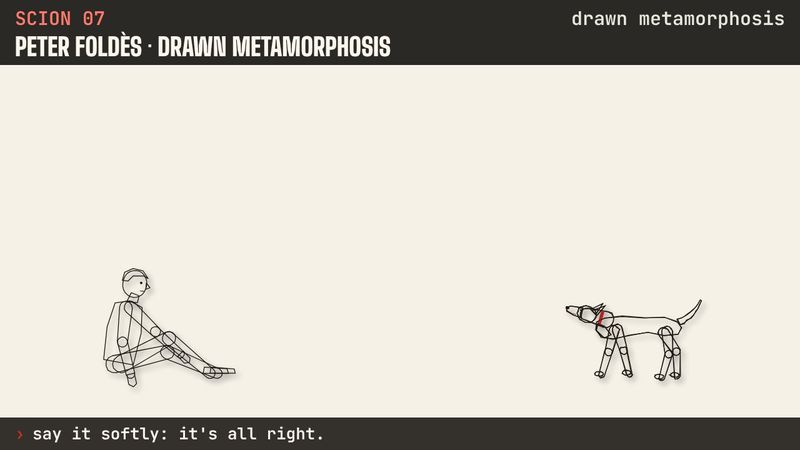
Peter Foldès through the dog: drawn metamorphosis
SCION 07 · PAE-02Peter FoldèsDrawn Metamorphosis

The dog is a line drawing that boils and leaves its last positions behind, so every change of state is a drawing becoming the next drawing.

theorem
Use progressive transformation of drawn forms as narrative consequence. Every in-between should sustain shape identity long enough for the change to be felt.
proof scene
A seated diner grows into the furniture he is consuming; the linework gradually becomes an architectural enclosure in an 8-second action.
lineage
Hunger (1974), early computer-assisted interpolation between hand-drawn forms

the prompt · the film it made

Research Pioneers

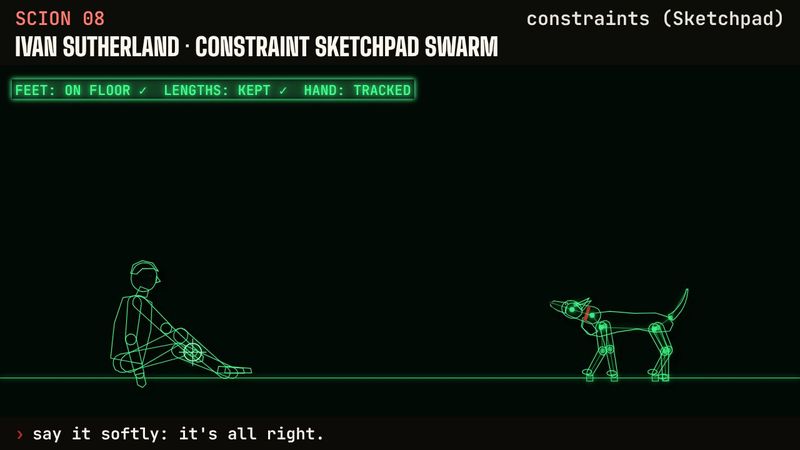
Ivan Sutherland through the dog: constraints (Sketchpad)
SCION 08 · PAE-02Ivan SutherlandConstraint Sketchpad Swarm

The dog becomes a constraint drawing on a phosphor screen: its feet are held to the floor and its lengths are kept, while the light pen moves the hand.

theorem
Build an animation interface in which the animator changes relationships rather than manually repairing every dependent point. The user should move a hand and the rest of the constrained body should respond coherently.
proof scene
Allow a user to drag an archived figure’s hand onto a door handle while both feet remain planted, body lengths remain consistent, and the elbow chooses a believable configuration.
lineage
Sketchpad (1963); graphical constraints and direct manipulation

the prompt · the film it made · research start

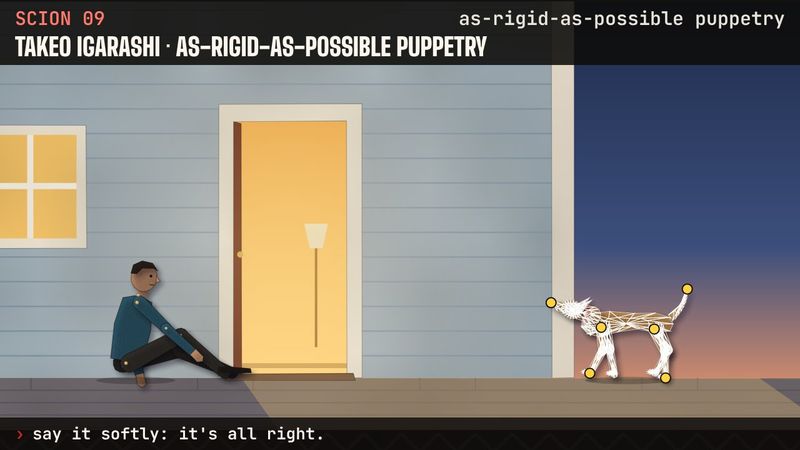
Takeo Igarashi through the dog: as-rigid-as-possible puppetry
SCION 09 · PAE-02Takeo IgarashiAs-Rigid-as-Possible Puppetry

The dog becomes a mesh of triangles that bend but try not to stretch; red triangles are the ones being stretched by the pose.

theorem
Make image deformation behave like bending a piece of paper or articulated cutout, preserving local shape without suppressing expressive exaggeration.
proof scene
Deform a single historic character’s sleeve, jaw and torso through three deliberately extreme poses while preserving buttons, eyes and linework.
lineage
As-rigid-as-possible shape manipulation, 2005

the prompt · the film it made · research start

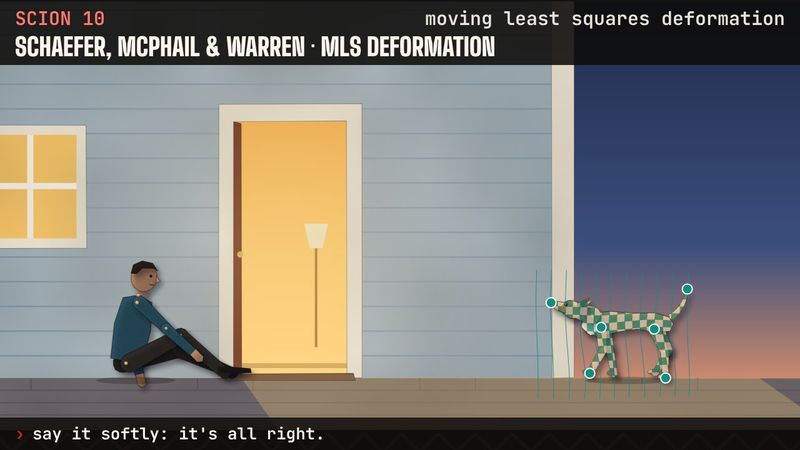
Schaefer, McPhail & Warren through the dog: moving least squares deformation
SCION 10 · PAE-02Schaefer, McPhail & WarrenMLS Deformation

A lattice is laid over the dog and pinned at six handles; as the dog moves, the lattice bends smoothly between the pins and the dog bends with it.

theorem
Let an artist drag carefully chosen landmarks and contour segments to reshape historical images intuitively, comparing affine, similarity, and rigid variants based on visual effect.
proof scene
Animate an engraved face opening its mouth and a long bird neck curving around a frame using identical control handles but multiple MLS variants.
lineage
Image Deformation Using Moving Least Squares (2006)

the prompt · the film it made · research start

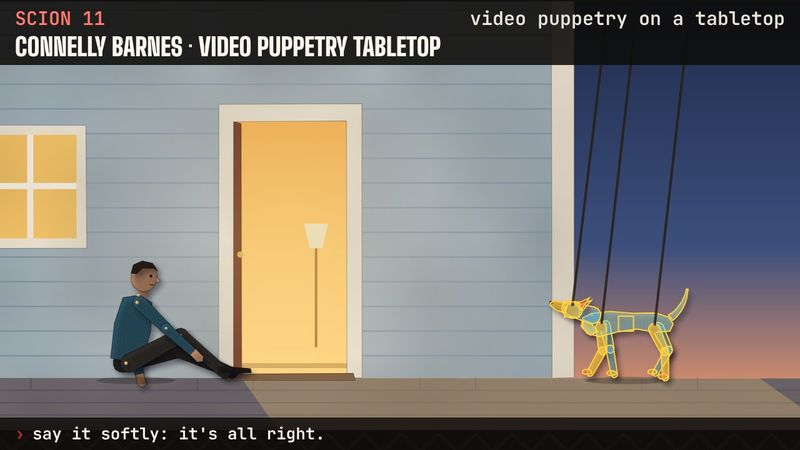
Connelly Barnes through the dog: video puppetry on a tabletop
SCION 11 · PAE-02Connelly BarnesVideo Puppetry Tabletop

The paper dog is held on rods from above, the way a tabletop performer tracks and moves real cut-outs under a camera.

theorem
Turn the tabletop into a stage: let a person move paper figures while software captures a reusable performance without recording the puppeteer’s hands as part of the fictional world.
proof scene
A filmed tabletop puppet walks through an arch, opens a door, knocks over a vase, and crosses into a digital background. Capture in real time and replay deterministically.
lineage
Video Puppetry: A Performative Interface for Cutout Animation (2008); coauthors Jacobs, Sanders, Goldman, Rusinkiewicz, Finkelstein and Agrawala

the prompt · the film it made · research start

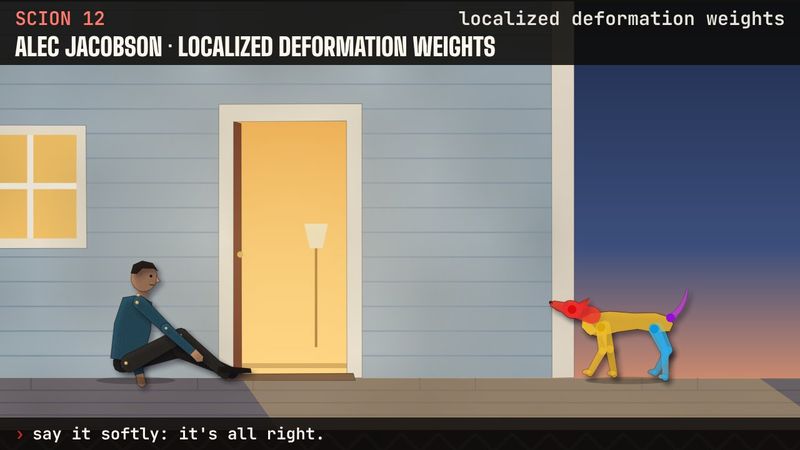
Alec Jacobson through the dog: localized deformation weights
SCION 12 · PAE-02Alec JacobsonLocalized Deformation Weights

Each bone owns the paper near it, and the colour shows how much: the weights that let one hand move without dragging the whole dog.

theorem
Create responsive 2D puppet rigs with meaningful automatic weight falloff, especially in concave and complicated shapes, without making the artist paint every influence by hand.
proof scene
Auto-rig an octopus and a coat-wearing human from cutout masks; bend tentacles and elbows while unrelated regions remain stable.
lineage
Bounded biharmonic weights for real-time deformation (2011), coauthors Baran, Popović and Sorkine

the prompt · the film it made · research start

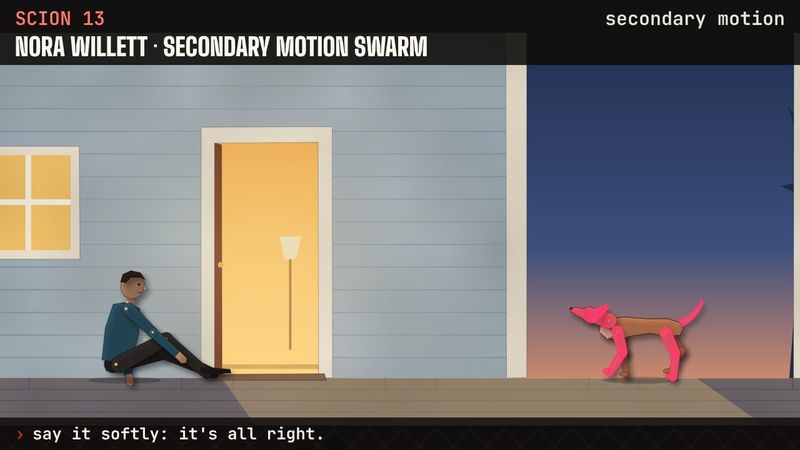
Nora Willett through the dog: secondary motion
SCION 13 · PAE-02Nora WillettSecondary Motion Swarm

The ears and tail lag behind the body and overshoot: their last positions trail behind them in colour, so the follow-through the dog's choices cause is visible.

theorem
Give performing paper figures secondary dynamics that communicate material and intention. Hair, coat tails, reeds, scarves and loose limbs should reveal acceleration, resistance and stopping.
proof scene
A fox sprints, stops abruptly, looks back, and lets its scarf settle while the world remains still. Compare no secondary motion, generic oscillation and tuned material-specific follow-through.
lineage
Secondary Motion for Performed 2D Animation (2017), with Li, Popović, Berthouzoz and Finkelstein

the prompt · the film it made · research start

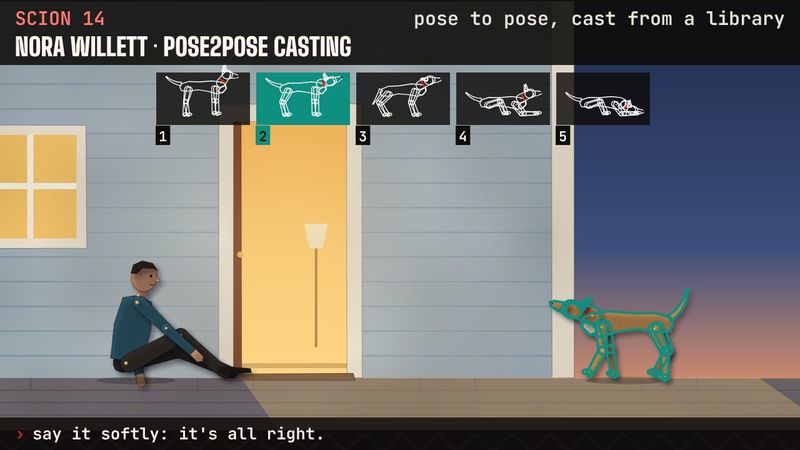
Nora Willett through the dog: pose to pose, cast from a library
SCION 14 · PAE-02Nora WillettPose2Pose Casting

Along the top, the dog's library of drawn poses; the one it is in now lights up, and the dog itself is outlined in that pose's colour. The machine chooses the state, the library supplies the drawing.

theorem
Build a performance-transfer engine that uses a small set of artist-approved drawings to animate a character across new recorded actions. Prefer coherent drawing sequences over continuous warped artifacts.
proof scene
Take an 8-second reach, recoil, turn and walk performance. Transfer to a small collection of Victorian engravings with only twelve target drawings, then reveal the actual selected path.
lineage
Pose2Pose: Pose Selection and Transfer for 2D Character Animation (2020), with Shin, Jin, Li and Finkelstein

the prompt · the film it made · research start

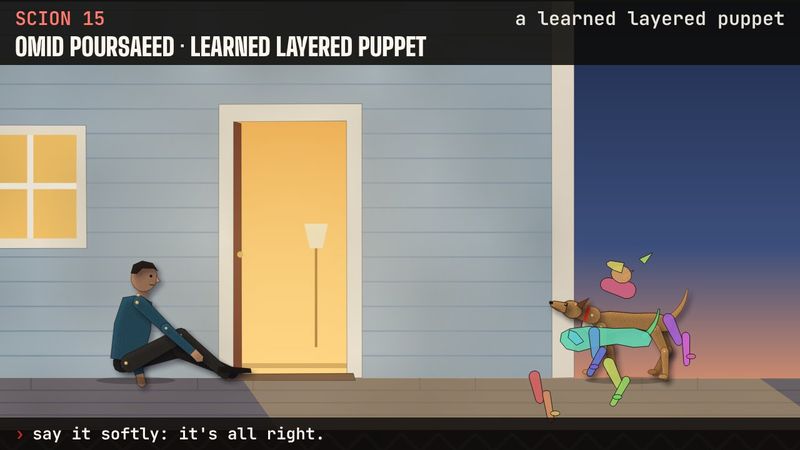
Omid Poursaeed through the dog: a learned layered puppet
SCION 15 · PAE-02Omid PoursaeedLearned Layered Puppet

The dog pulled apart into the layers a model would have to learn from a few drawings: each part on its own plate, stacked in depth.

theorem
Infer consistent character structure from a few disconnected illustrations while preserving layers, occlusion and out-of-plane variations. Treat learned motion as a hypothesis, not a substitute for explicit tests.
proof scene
From six frames of a drawn character, reconstruct a reusable layered actor that can turn, crouch and reach; provide side-by-side model output and hand-authored corrections.
lineage
Neural Puppet: Generative Layered Cartoon Characters (2019), with Kim, Shechtman, Saito and Belongie

the prompt · the film it made · research start

Studios & Software

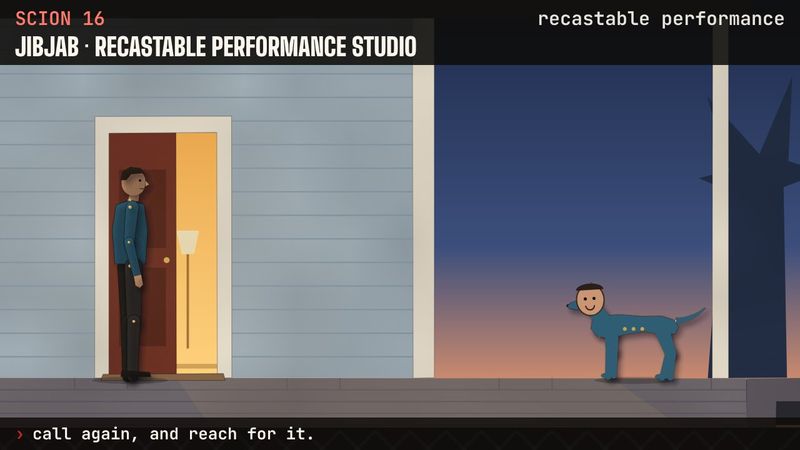
JibJab through the dog: recastable performance
SCION 16 · PAE-02JibJabRecastable Performance Studio

The performance stays, the cast changes: the person's photographed face rides on the dog's head, and the dog acts exactly as before.

theorem
Make one exceptionally directed performance accept multiple cast identities without reshooting. Recasting is an artistic capability, not a novelty overlay.
proof scene
A dancer bows, turns to profile, exchanges a hat, and reacts to a surprise. Replace the head with three stylistically different authorized characters using one body plate.
lineage
Personalized Starring You films; tracked live-action plates and face compositing

the prompt · the film it made

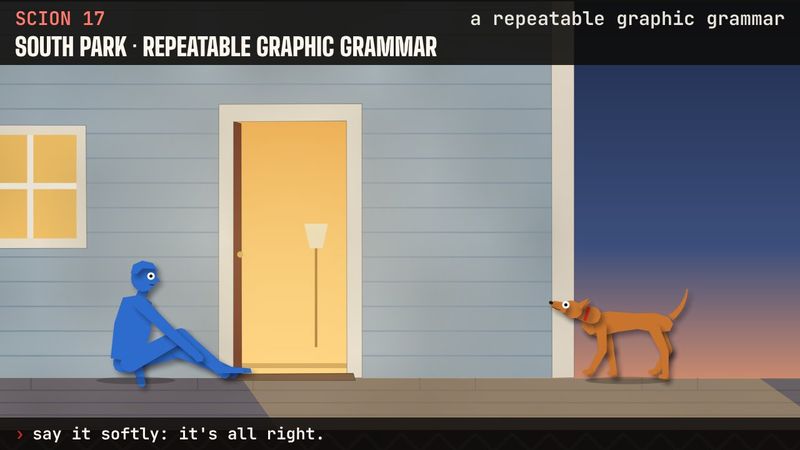
South Park through the dog: a repeatable graphic grammar
SCION 17 · PAE-02South ParkRepeatable Graphic Grammar

Construction paper, flat colours, two-frame motion: the cheapest grammar that still lets the dog refuse with a turn of its body.

theorem
Sustain strong comic staging and rapid throughput from a deliberately restricted visual grammar. Limited animation should function as expressive style, not a technical excuse.
proof scene
Four visually distinct figures argue over a trivial prop, exchange focus, exit and reenter with a scene reversal in ten seconds.
lineage
Paper-cutout look recreated with digital production and reusable character conventions

the prompt · the film it made

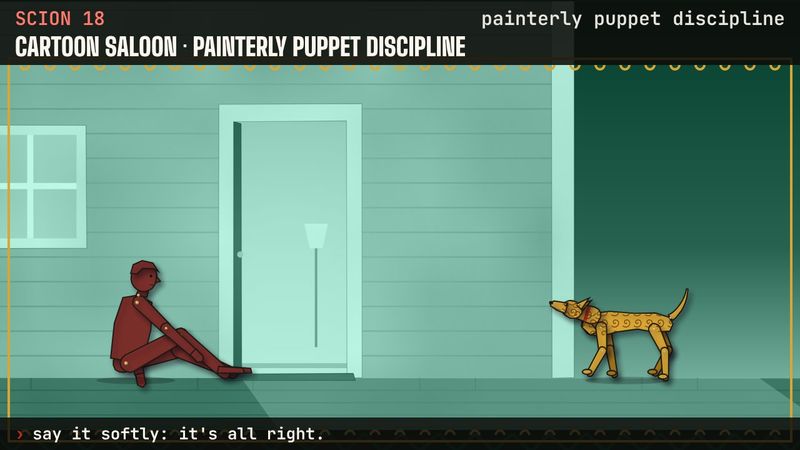
Cartoon Saloon through the dog: painterly puppet discipline
SCION 18 · PAE-02Cartoon SaloonPainterly Puppet Discipline

The porch repainted as a flat, ornamental world in deep green and gold; the dog keeps its paper joints but is gilded and patterned with spirals, the way a painterly studio disciplines a puppet.

theorem
Maintain authored drawing identity while gaining reusable animation and team production. The rig exists to protect line, shape and acting rather than flatten them into generic motion.
proof scene
A character crosses a patterned interior, touches a natural object, and experiences a close-up change of expression without any mechanical change in line quality.
lineage
Handcrafted image traditions combined with production 2D digital workflows

the prompt · the film it made

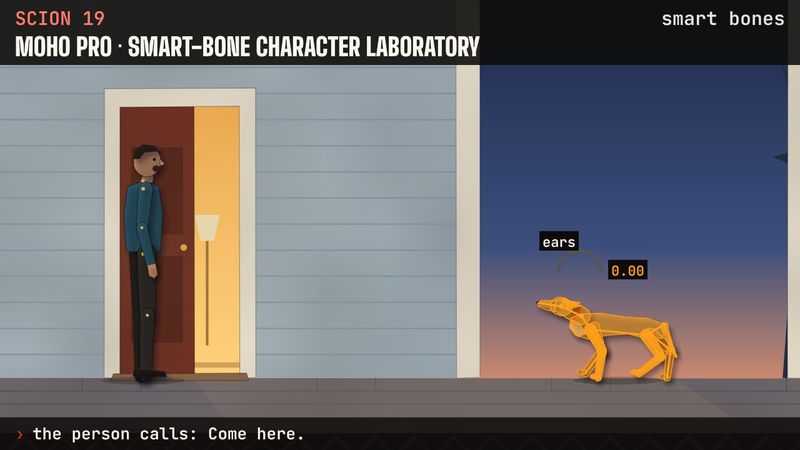
Moho Pro through the dog: smart bones
SCION 19 · PAE-02Moho ProSmart-Bone Character Laboratory

Bones with a dial: one value, ears up to ears flat, drives several pieces at once, the way a smart bone corrects a rig.

theorem
Build a repeatable authoring pipeline for front/quarter/profile acting with proportion and joint consistency, exploiting corrective poses without overfitting a single walk.
proof scene
A figure walks laterally, turns toward camera, crouches, reaches overhead, and returns to profile in one uninterrupted shot.
lineage
Moho bone hierarchy, Smart Bones, switch layers and mesh deformation

the prompt · the film it made

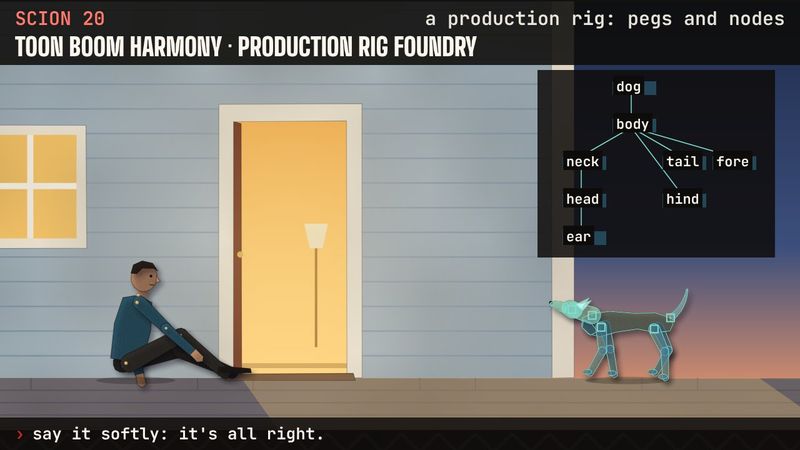
Toon Boom Harmony through the dog: a production rig: pegs and nodes
SCION 20 · PAE-02Toon Boom HarmonyProduction Rig Foundry

The rig as a production pipeline sees it: every piece a node, pegged to its parent, and the node view beside the stage.

theorem
Turn a complex illustrated ensemble into disciplined, auditable scene production with clear rig ownership, drawing substitution rules, and compositing dependencies.
proof scene
Compose a three-actor scene with close-up expression, prop handoff, foreground occlusion and a dramatic lighting shift.
lineage
Professional drawing substitution, deformers, node compositing and scene production

the prompt · the film it made

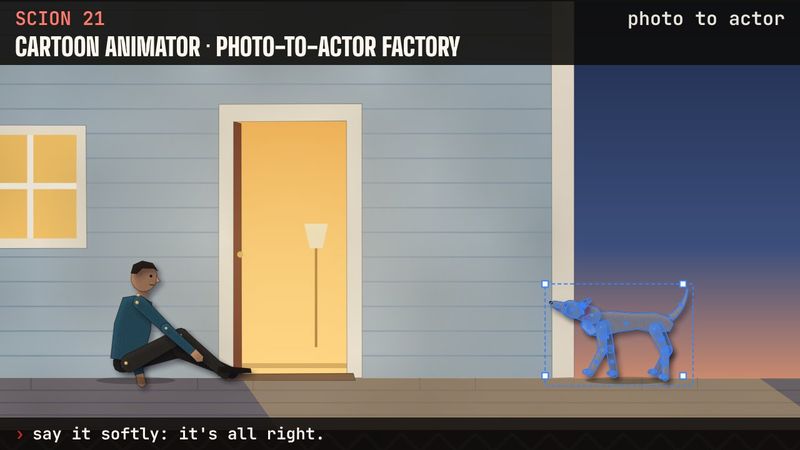
Cartoon Animator through the dog: photo to actor
SCION 21 · PAE-02Cartoon AnimatorPhoto-to-Actor Factory

A flat picture becomes an actor: a sprite with its bounding box and part handles, ready to be told what to do.

theorem
Make image-to-character onboarding fast enough for an archive while detecting where automatic face rigs fail the underlying anatomy or source material.
proof scene
Import a permitted archival portrait, make it blink, speak, turn three-quarter and respond to a second character. Compare generated and manually corrected animation.
lineage
Reallusion photo-head rigs, 2D puppeteering, multiview character workflows

the prompt · the film it made

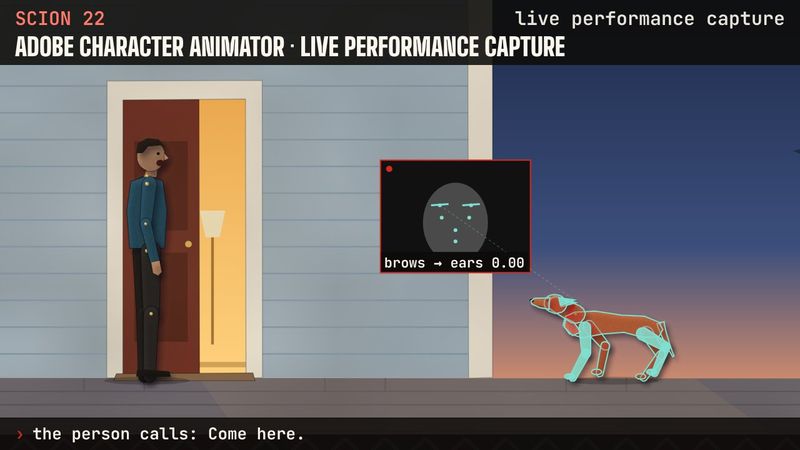
Adobe Character Animator through the dog: live performance capture
SCION 22 · PAE-02Adobe Character AnimatorLive Performance Capture

A performer's face drives the dog live: the inset tracks a face, and its eyebrows become the dog's ears.

theorem
Turn live voice and gesture into deliberate character acting while correcting false triggers and generic automatic expression.
proof scene
Record two versions of the same argument: one captured live, one with postcorrected eye gaze and deliberate held expressions. See which communicates a change of mind.
lineage
Camera- and microphone-driven 2D puppets with triggerable states

the prompt · the film it made

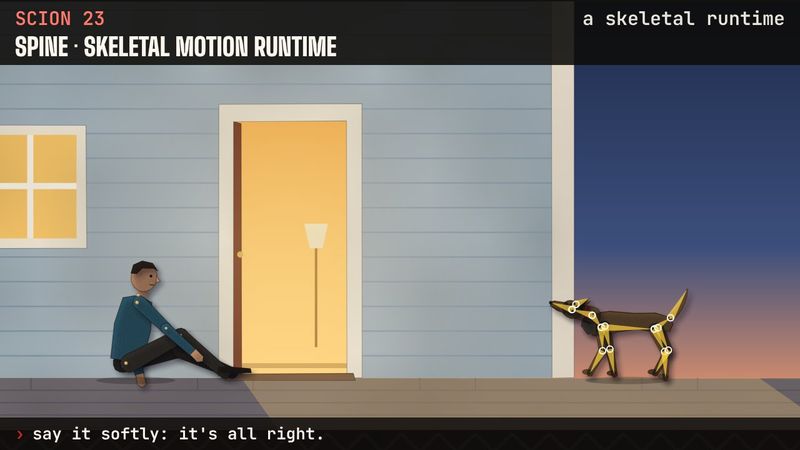
Spine through the dog: a skeletal runtime
SCION 23 · PAE-02SpineSkeletal Motion Runtime

The dog as a runtime ships it: bones, slots and attachments, the paper only skin hung on a skeleton the game engine plays.

theorem
Convert cutout performers into efficient game-ready actors whose action clips blend without violating body geometry or artistic timing.
proof scene
One character walks, stops, picks up a bag, changes facing direction, and resumes while all state transitions remain playable on a phone.
lineage
Esoteric Software 2D skeletal animation, mesh skinning, IK and runtime mixing

the prompt · the film it made

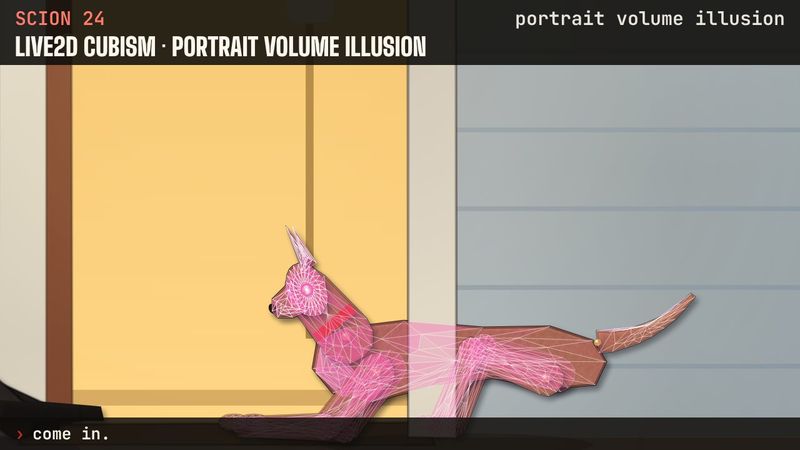
Live2D Cubism through the dog: portrait volume illusion
SCION 24 · PAE-02Live2D CubismPortrait Volume Illusion

Close on the dog's head: a flat drawing given volume by a deforming mesh, so it seems to turn toward the doorway.

theorem
Give source illustrations a believable suggestion of three-dimensional head and face movement without inventing unseen anatomy carelessly.
proof scene
A historical portrait hears an accusation, looks from left to right, withdraws gaze and almost speaks before remaining silent.
lineage
2D parametric deformers, angle controls, expressive portrait rigs

the prompt · the film it made

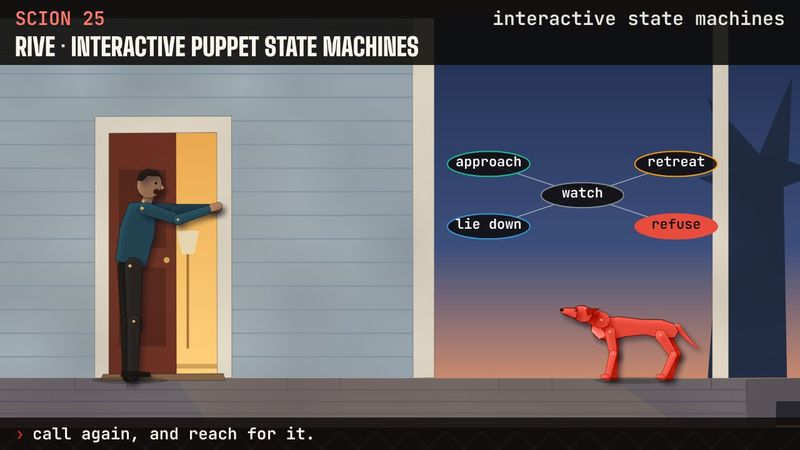
Rive through the dog: interactive state machines
SCION 25 · PAE-02RiveInteractive Puppet State Machines

The rig answers to a state graph with inputs, the way an interactive runtime wires it: the dog is tinted by the state it is in, and the graph beside it shows the inputs that moved it there.

theorem
Make animation a responsive dramatic contract: actions must respond to input, remember the state of the world, and permit meaningful refusal or interruption.
proof scene
A paper dog can approach, refuse, sit, notice a thrown ball, abandon the ball, and look back to the player without snapping through impossible poses.
lineage
Rive state machines, inputs, listener-driven runtime animation

the prompt · the film it made

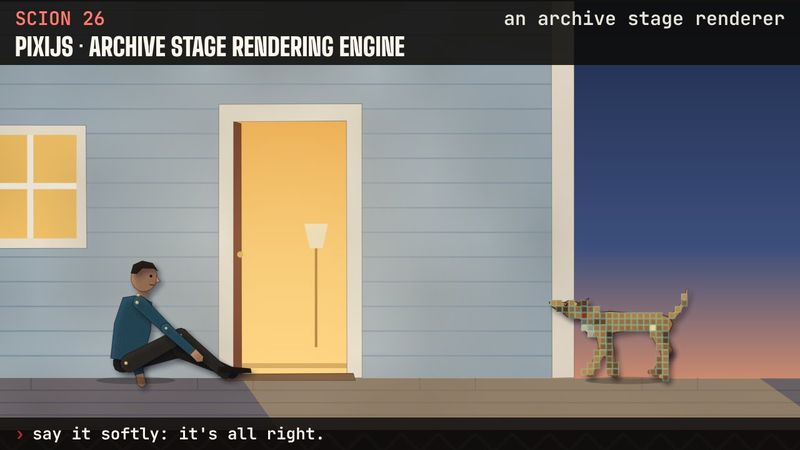
PixiJS through the dog: an archive stage renderer
SCION 26 · PAE-02PixiJSArchive Stage Rendering Engine

The dog as a renderer batches it: cut into sprite tiles, each tile one texture sample, with the draw count running; at this resolution the dog is a grid the engine can push by the thousand.

theorem
Render hundreds of transparent historic fragments as a coherent responsive theater while retaining precision, masking and contact logic.
proof scene
Render fifteen archival actors on six depth planes with expressive motion, fog and overlapping windows; maintain touch targets and inspect mobile performance.
lineage
JavaScript/TypeScript GPU 2D rendering, textures, containers, filters and masks

the prompt · the film it made

Remotion through the dog: a declarative film compiler
SCION 27 · PAE-02RemotionDeclarative Film Compiler

The film as code compiles it: tracks for the prompts, the dog's states and the camera, with a playhead running through, and the dog tinted by the track segment it is playing.

theorem
Treat film as a reproducible function of scene data, cast, time and seed. Build finished sequences rather than endless screenshots or prompts.
proof scene
Rerender the same 12-second animated sequence in landscape and portrait with two castings and matched sound cues; compare exact frames across machines.
lineage
Frame-indexed React compositions and programmatic video rendering

the prompt · the film it made

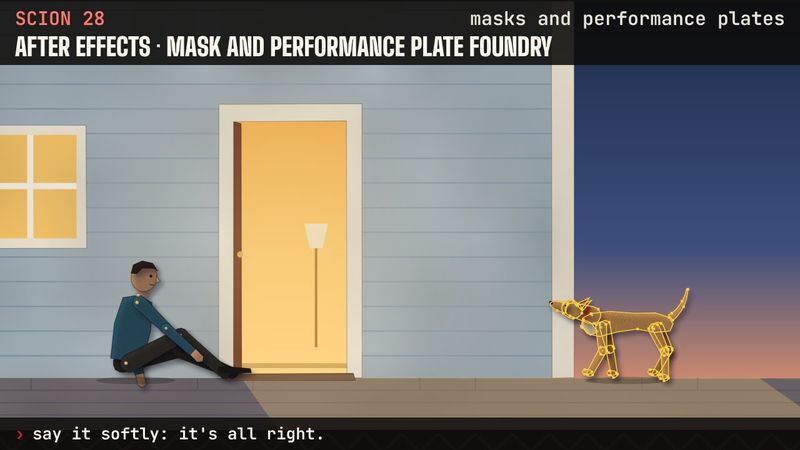
After Effects through the dog: masks and performance plates
SCION 28 · PAE-02After EffectsMask and Performance Plate Foundry

Masks drawn around the dog and the person, with the plate behind them: the compositor's view, where every piece is a matte.

theorem
Make photographed actors and archive plates accept substitutions with convincing occlusion and cinematic continuity, using tracking where it genuinely replaces manual effort.
proof scene
A performer ducks behind a chair, turns, removes a hat, and reveals an engraved substitute face. Preserve depth of each moving foreground object.
lineage
Keying, tracking, rotoscoping and compositing workflows used in personalized video

the prompt · the film it made

Algorithms & Techniques

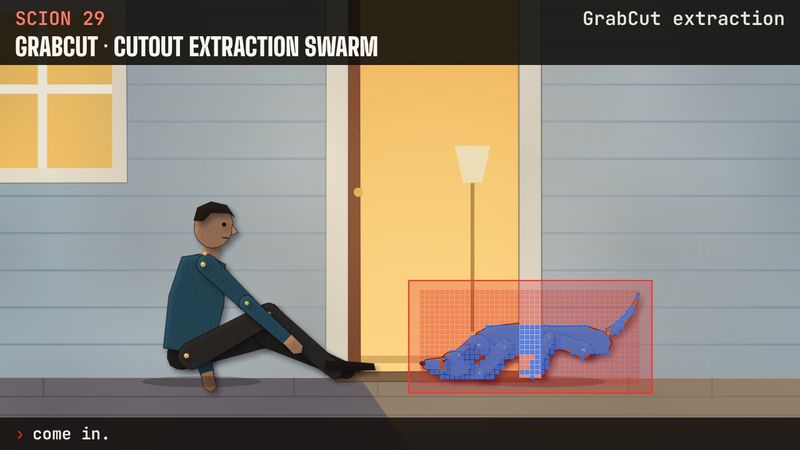
GrabCut through the dog: GrabCut extraction
SCION 29 · PAE-02GrabCutCutout Extraction Swarm

A rectangle around the dog and the algorithm splits foreground from background: blue is dog, red is porch.

theorem
Make extractable, inspectable figures from scanned pages, separating primary subjects, accessories and shared shadows without mistaking historical halftone for body texture.
proof scene
Cut a figure with translucent fabric, overlapping fingers and an adjacent object out of a busy engraving, retaining each piece as a usable animation layer.
lineage
Graph-based interactive foreground-background segmentation

the prompt · the film it made

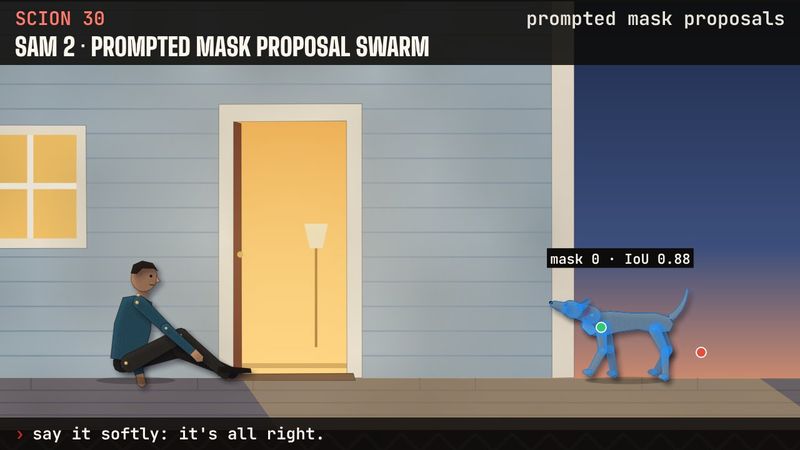
SAM 2 through the dog: prompted mask proposals
SCION 30 · PAE-02SAM 2Prompted Mask Proposal Swarm

Two clicks, one on the dog and one on the porch, and the model proposes a mask with a confidence; the dog is found by being pointed at.

theorem
Use segmentation models to propose candidates at scale while maintaining human-inspectable masks and refusing to infer invisible parts without evidence.
proof scene
Given five scans containing people, animals, furniture and trees, extract ten semantically named reusable pieces and record where model masks were manually changed.
lineage
Promptable image/video segmentation proposals with tracking where supported

the prompt · the film it made

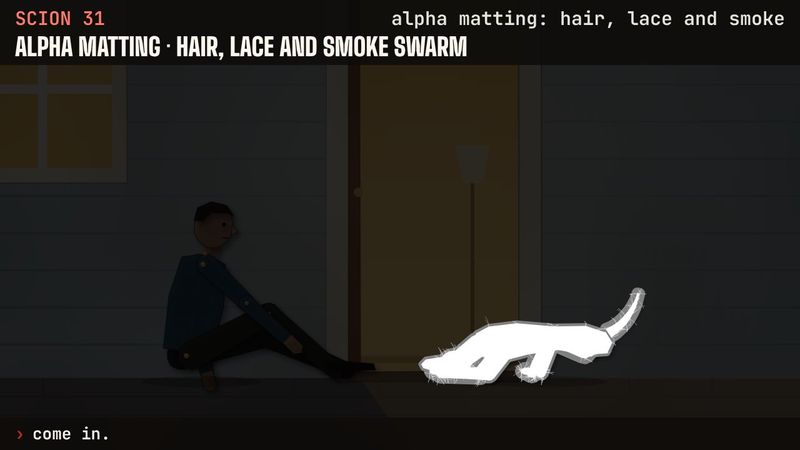
Alpha Matting through the dog: alpha matting: hair, lace and smoke
SCION 31 · PAE-02Alpha MattingHair, Lace and Smoke Swarm

A trimap around the dog: black is surely porch, white surely dog, grey the fringe (ears, tail, paws) where the matte has to be solved.

theorem
Preserve historical hair, fabric, paper tearing, foliage and translucent smoke at the edges of animated archive fragments.
proof scene
Animate a lace veil and engraved hair against light, dark and moving backgrounds, then rotate it without visible edge contamination.
lineage
Opacity estimation and edge reconstruction for partial coverage

the prompt · the film it made

Forward Kinematics through the dog: forward kinematics
SCION 32 · PAE-02Forward KinematicsHierarchical Body Logic

Rotate the shoulder and everything below it follows: the dog drawn as a chain of joints, each angle added to its parent's, with the angles written on the joints.

theorem
Encode bodies as coherent relationships so modifying a hip or shoulder propagates predictably through descendants, including props and clothing.
proof scene
Walk a long-coated character through a turn, sit and stand while a carried umbrella remains fixed to the proper wrist and coat hem follows correctly.
lineage
Parent-child transformation trees and stable pivot geometry

the prompt · the film it made

Inverse Kinematics through the dog: inverse kinematics: contact and reach
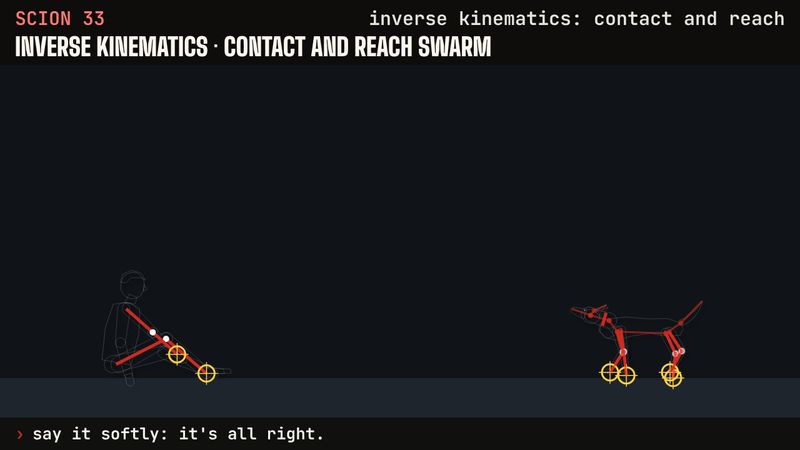
SCION 33 · PAE-02Inverse KinematicsContact and Reach Swarm

Targets first, joints after: each foot is a target pinned to the floor and the leg solves to reach it; the dog is shown as the solver sees it, chains and targets, nothing else.

theorem
Make action physically consequential: hands reach the thing they choose, feet grip the ground, bodies counterbalance and contact changes the next pose.
proof scene
An actor steps onto a stool, reaches a door handle, discovers the door is heavy, braces and pulls until the door moves.
lineage
Constraint-driven joint target solving; two-bone IK and support relationships

the prompt · the film it made

ARAP through the dog: preserve-shape deformation
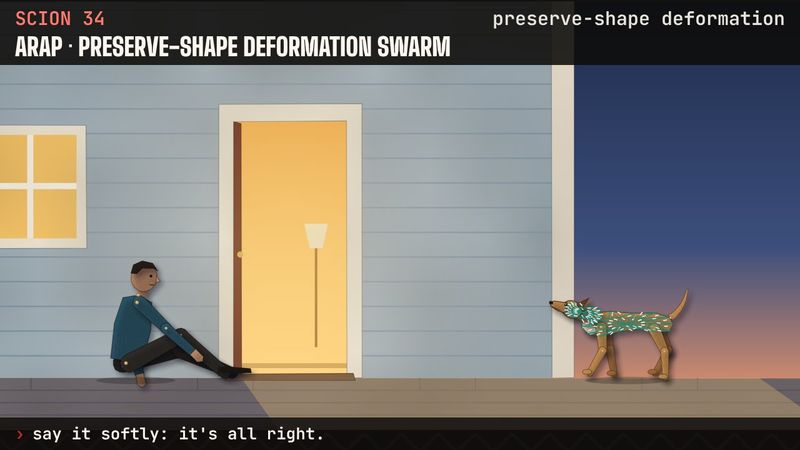
SCION 34 · PAE-02ARAPPreserve-Shape Deformation Swarm

The dog's body as rigid cells that rotate instead of stretching; each cell shows its local rotation as a tick.

theorem
Bend engraved and photographed characters while preserving local proportions and recognizable material structure.
proof scene
Bend a standing engraving into sitting, bowing and lifting a box; compare independently preserved face/hands against naive global warping.
lineage
Local-global as-rigid-as-possible deformation on triangulated images

the prompt · the film it made

Moving Least Squares through the dog: gesture warp
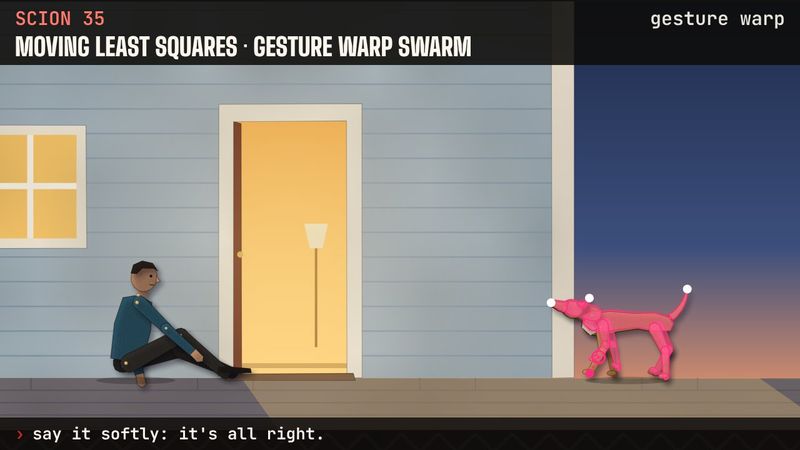
SCION 35 · PAE-02Moving Least SquaresGesture Warp Swarm

One handle at a time is dragged and the dog stretches toward it like rubber, the rest pinned: a gesture made directly on the drawing.

theorem
Let simple handles cause surprisingly expressive, fast deformation of nonrigid prints and animated linework while keeping unintended distortions visible.
proof scene
Compare identical mouth, neck and waving-cape moves under three MLS transformation families using matched source points.
lineage
Point/segment deformation with affine, similarity and rigid MLS families

the prompt · the film it made · research start

Bounded Biharmonic Weights through the dog: bounded biharmonic weights: an auto-rig
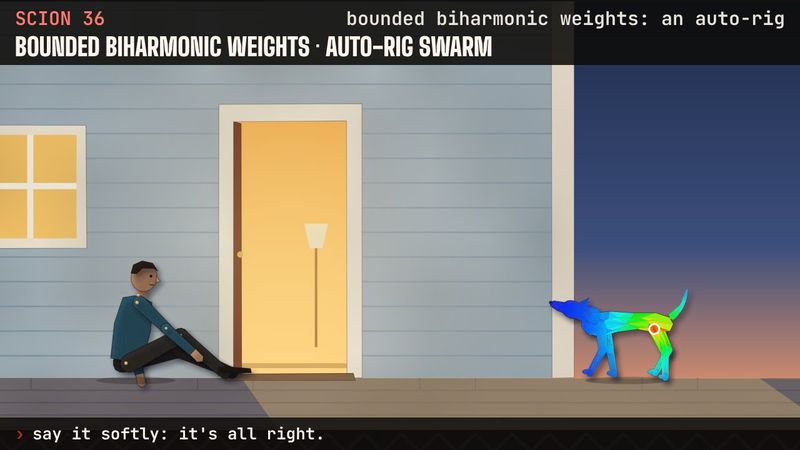
SCION 36 · PAE-02Bounded Biharmonic WeightsAuto-Rig Swarm

Weights computed for each handle, shown one handle at a time: the heat of how far one bone's influence reaches across the dog.

theorem
Reduce manual weight painting for irregular archival silhouettes while keeping influences localized, stable and interpretable.
proof scene
Automatically rig a figure with crossed legs, a long coat and separated hands, plus one concave animal silhouette, and play a broad gesture set.
lineage
Constrained smooth influence weights for point, skeleton and cage handles

the prompt · the film it made · research start

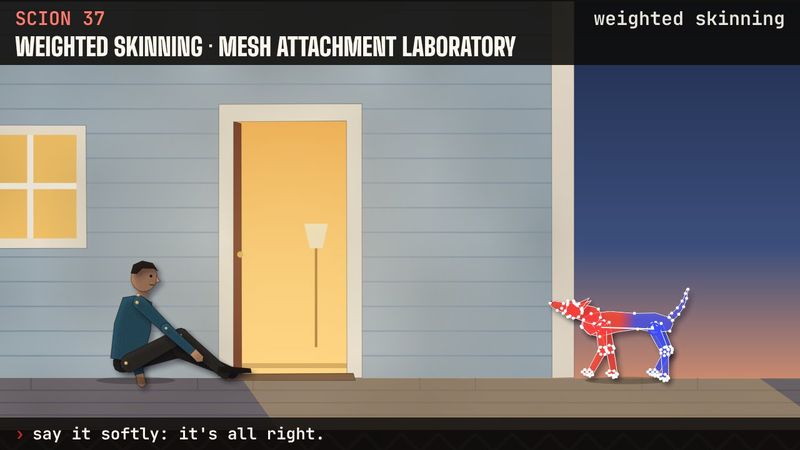
Weighted Skinning through the dog: weighted skinning
SCION 37 · PAE-02Weighted SkinningMesh Attachment Laboratory

Where the shoulder's influence meets the hip's, the paper is shared: the dog is split into two colours with a blended band between, the region skinning has to solve.

theorem
Make one character mesh move with several joints while retaining the special graphic qualities of archival textures and intentional angularity.
proof scene
Animate a jacket sleeve through arm raise, fold and reach, with a shoulder tattoo or printed ornament held intact.
lineage
Linear blend skinning and deformation attachments

the prompt · the film it made

Dynamic Pose Selection through the dog: dynamic pose selection from drawings
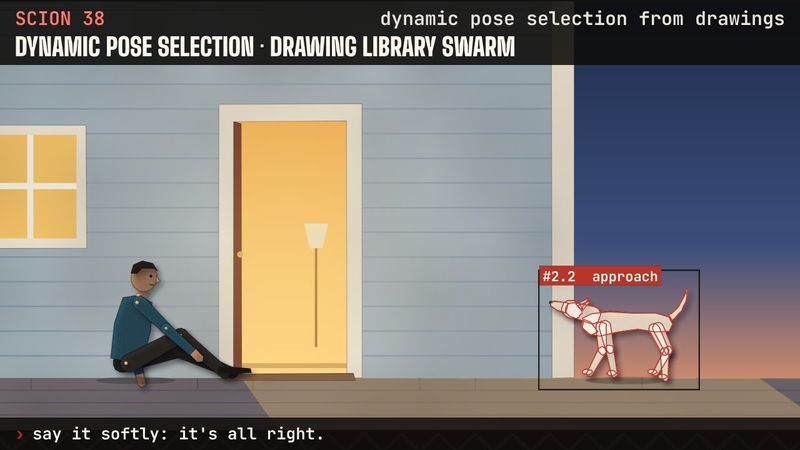
SCION 38 · PAE-02Dynamic Pose SelectionDrawing Library Swarm

Instead of bending one drawing, the dog flips between whole drawings, each a numbered card in red pencil, chosen from its library each time it changes state and held on twos.

theorem
Generate coherent animation from sparse historical or artist-made poses by globally optimizing action match and sequence quality.
proof scene
Use at most ten drawings to animate a figure that looks down, reaches, recoils, turns and retreats; expose the decoder path.
lineage
Dynamic programming over representative drawings and recorded motion

the prompt · the film it made

Multiview Drawing Substitution through the dog: multiview drawing substitution
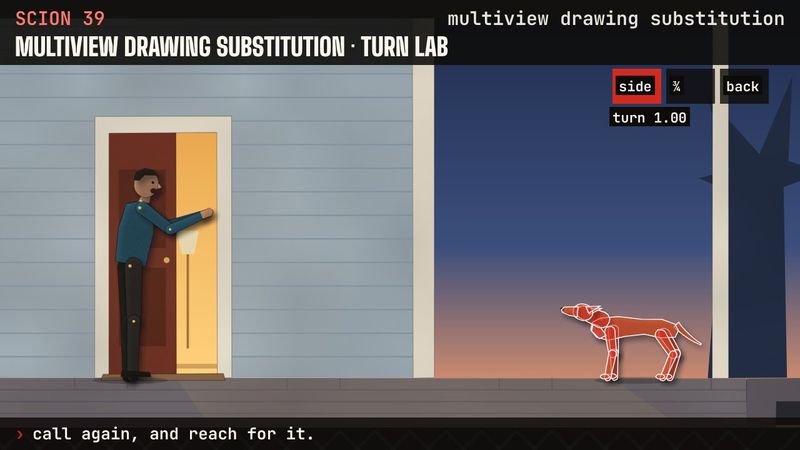
SCION 39 · PAE-02Multiview Drawing SubstitutionTurn Lab

When the dog turns its back, the side view is swapped for a turn drawing and then the back view: the three views drawn as cards.

theorem
Permit convincing orientation changes without imposing a misleading continuous 3D shape on fundamentally two-dimensional source images.
proof scene
Rotate a photographed head from front to profile and back while turning the torso independently, including a blink and an occlusion crossing.
lineage
Discrete front, three-quarter, profile and rear artworks with continuous interpolation where safe

the prompt · the film it made

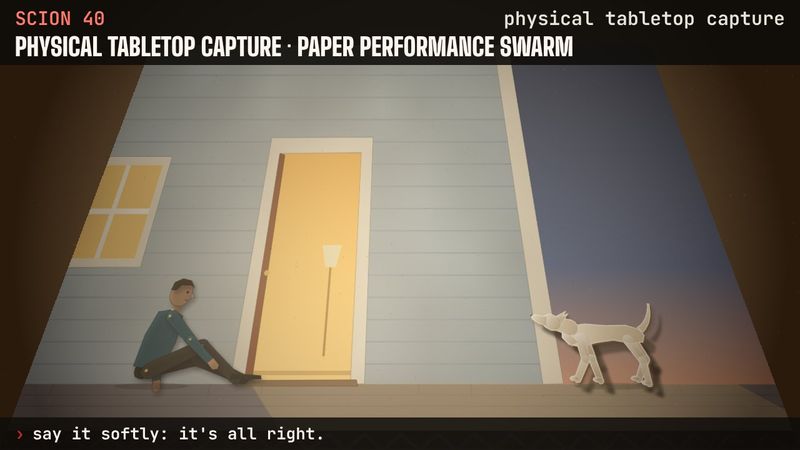
Physical Tabletop Capture through the dog: physical tabletop capture
SCION 40 · PAE-02Physical Tabletop CapturePaper Performance Swarm

The scene is a real tabletop shot from above at an angle: the floor tilts away, a lamp pools on the paper, and the cut-outs cast long hard shadows.

theorem
Convert fingers moving paper into reusable, editable film acting without making equipment calibration more onerous than performing.
proof scene
Capture a paper creature leaping across three props and disappearing behind a door; replay on a different set with a new character skin.
lineage
Overhead camera-tracked paper puppet manipulation, inspired by Video Puppetry

the prompt · the film it made · research start

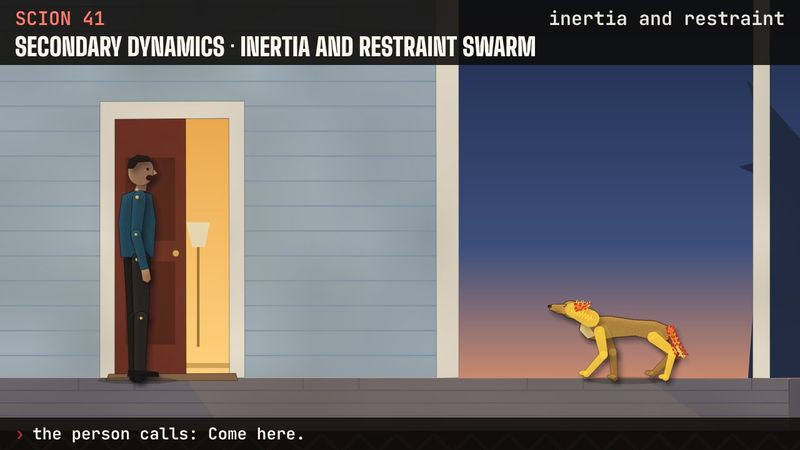
Secondary Dynamics through the dog: inertia and restraint
SCION 41 · PAE-02Secondary DynamicsInertia and Restraint Swarm

Springs on every loose part, drawn as coils: the ears and tail carry momentum after the dog stops, then settle.

theorem
Let secondary objects reveal material and momentum without causing continuous purposeless wiggle.
proof scene
A woman abruptly closes a book while her scarf settles and a page continues to flutter; compare damping presets in synchronized split view.
lineage
Spring-damper follow-through, trailing motion and collision-aware secondary animation

the prompt · the film it made

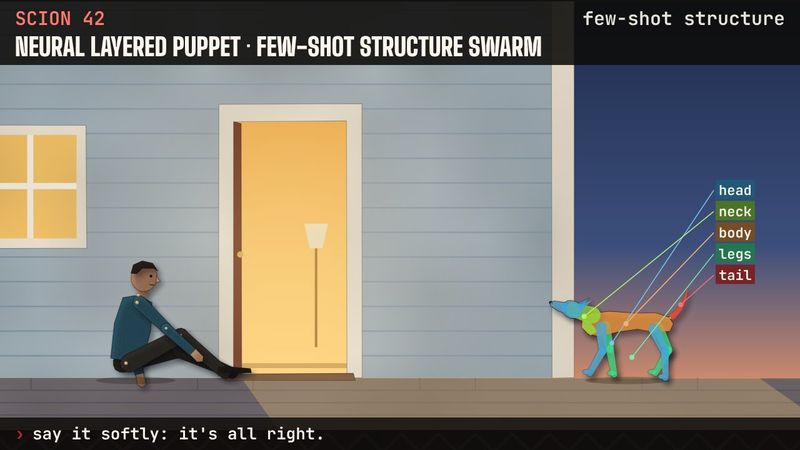
Neural Layered Puppet through the dog: few-shot structure
SCION 42 · PAE-02Neural Layered PuppetFew-Shot Structure Swarm

The structure a model would infer from a few drawings: each part segmented and labelled, the dog as a graph of named regions.

theorem
Test whether a few source frames can support a trustworthy reusable puppet, while keeping a transparent fallback to authored structure.
proof scene
Train or adapt on a small permitted image sequence and render three unseen target poses; compare to a rig-only control.
lineage
Learned low-dimensional deformation of 2.5D layered cartoon templates

the prompt · the film it made · research start

Collage Graph Rewriting through the dog: collage graph rewriting
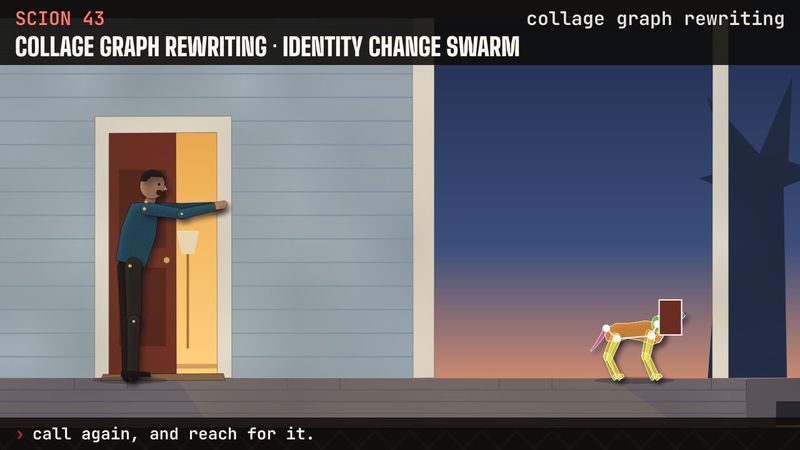
SCION 43 · PAE-02Collage Graph RewritingIdentity Change Swarm

The dog as a graph of parts, and a rewriting rule that changes its identity: head ↦ door, so when the dog refuses, it closes itself.

theorem
Create a grammar for images becoming new actors, tools, buildings and environments, while retaining editorial cause and authorial intention.
proof scene
A boot kicks a football that becomes a planet; a door in the planet opens and reveals the boot maker. Make the metamorphosis play as one cause-and-effect loop.
lineage
Typed graph rewriting and semantic substitution for impossible transformations

the prompt · the film it made

Multiplane Parallax through the dog: multiplane parallax
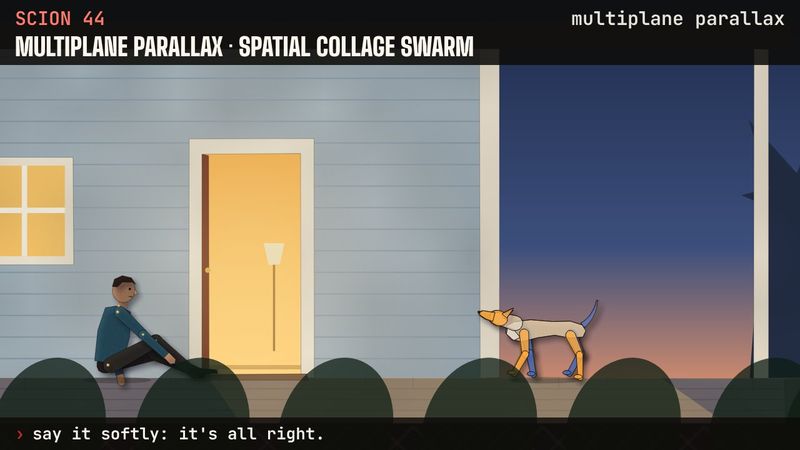
SCION 44 · PAE-02Multiplane ParallaxSpatial Collage Swarm

The set separated into planes at different depths, each moving at its own rate as the camera drifts: the dog's plane is the one in focus.

theorem
Make flat historical illustrations support meaningful navigable depth without fabricating spatial relations incoherently.
proof scene
A lateral camera glide past six cutout layers finds a figure hiding behind a sign and reveals a deep city valley beyond.
lineage
2.5D scene graphs with layer depth, moving camera, atmospheric compositing

the prompt · the film it made

Occlusion Compositing through the dog: occlusion: who is in front?
SCION 45 · PAE-02Occlusion CompositingWho Is In Front?

The draw order made visible: the far legs, the body, the near legs, the jamb drawn over the dog's back, each numbered by depth.

theorem
Make found images inhabit one scene where ordering, support and crossing actions feel deliberately staged.
proof scene
An actor passes behind a chair, in front of a table, then threads an arm through a railing while a second actor crosses.
lineage
Alpha compositing, layer mattes, dependency order and contact shadows

the prompt · the film it made

Face Landmark Registration through the dog: face landmark registration
SCION 46 · PAE-02Face Landmark RegistrationRecasting Anatomy

The dog's face is covered in numbered landmarks and a mesh between them, registered point for point to the person's, the anatomy a recasting needs.

theorem
Make interchangeable heads act without losing attachment, expression, directional consistency or dignity of source portraits.
proof scene
Recast the same one-minute actor with three diverse authorized faces and inspect frontal, profile and hat-occluded keyframes.
lineage
Feature alignment and angle-aware head, eye and mouth fitting

the prompt · the film it made

Sound-to-Action through the dog: sound to action
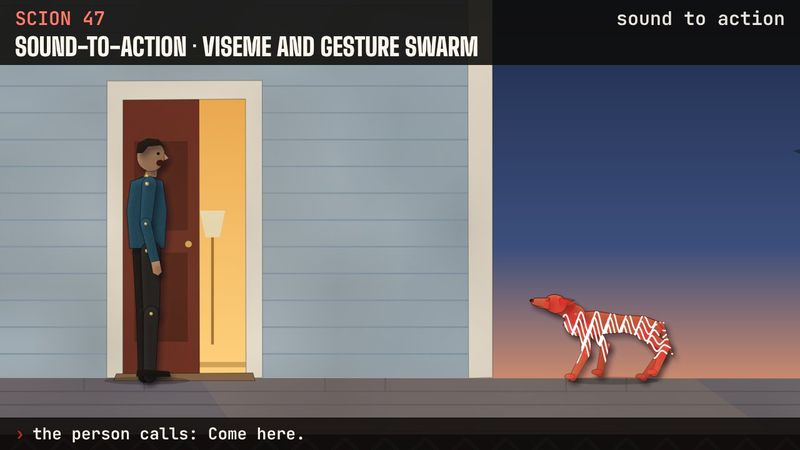
SCION 47 · PAE-02Sound-to-ActionViseme and Gesture Swarm

The voice drives the body: each call's waveform runs through the dog itself, and its ears and crouch answer it, a viseme for a dog.

theorem
Convert dialogue and environmental sound into selective mouth, breath, glance and body action while allowing silence to animate thought.
proof scene
An archived portrait says three words, pauses, hears an unseen object fall, then chooses not to answer.
lineage
Audio phoneme/viseme alignment; timing-driven expressive action

the prompt · the film it made

State Machines through the dog: characters that can refuse
SCION 48 · PAE-02State MachinesCharacters That Can Refuse

The original swarm, the one PAE-00 was made with: the dog's state, its trust, and the guard that made its last choice.

theorem
Turn a cast into actors who perceive, choose, resist and remember, instead of puppets that obey buttons unconditionally.
proof scene
A dog chooses among watch, approach, retreat, lie down and refuse in response to an invitation, and the player must change circumstances to earn approach.
lineage
Finite-state/hierarchical machines and event-based animation composition

the prompt · the film it made

Archives & Provenance

Getty & Smithsonian through the dog: open-content atelier
SCION 49 · PAE-02Getty & SmithsonianOpen-Content Atelier

The dog photographed as a museum object: alone on a grey seamless, with a scale bar, a colour target and a catalogue label, offered as open content.

theorem
Build a rights-aware production image reservoir. The archive supplies potential actors, objects, backgrounds and textures, not just mood-board references.
proof scene
From permitted Getty or Smithsonian CC0-marked objects, identify 8 distinct movable subjects, produce a six-second composite encounter, and trace each pixel layer to its item record.
lineage
Collection search, Getty Open Content Program and Smithsonian Open Access

the prompt · the film it made · research start

Library of Congress through the dog: a historical print stage
SCION 50 · PAE-02Library of CongressHistorical Print Stage

The dog printed the way the archive holds it: a halftone screen on newsprint, the dot doing the work the paper texture did.

theorem
Animate public historical prints by building action affordances from visible material without erasing documentary context or attributing false events to real people.
proof scene
Find one verifiably reusable illustrated crowd, vehicle and building, then stage a fictional motion experiment that visibly distinguishes sourced objects from invented motion.
lineage
Library of Congress Prints and Photographs division and item-level rights/advisory metadata

the prompt · the film it made · research start

Academy Mouris Collection through the dog: montage research
SCION 51 · PAE-02Academy Mouris CollectionMontage Research

The dog's history as a montage: frames of its earlier choices strobe behind it, a collection read at speed.

theorem
Learn from preserved collage filmmaking without assuming viewing access or remix permission. Use licensed or independently sourced images to test montage mechanisms.
proof scene
Study an accessible authorized excerpt or production description, then create a materially different 12-second rapid image autobiography from separately permitted imagery.
lineage
Academy Film Archive’s Caroline and Frank Mouris Collection

the prompt · the film it made · research start

Gilliam Ephemera through the dog: reconstruct the method
SCION 52 · PAE-02Gilliam EphemeraReconstruct the Method

The workbench behind the trick: the dog's parts laid out loose beside it, pinned and labelled, so the method can be rebuilt from them.

theorem
Create a scholarly annotated reconstruction of a physical collage-animation workflow, then invent distinct original scenes with legally usable source fragments.
proof scene
Reconstruct one simple animation gesture as physical paper, film it, then build a digital equivalent with matched timing; contrast affordances rather than trying to clone an original Monty Python sequence.
lineage
1974 BBC demonstration and accessible documentation of Terry Gilliam cutouts

the prompt · the film it made · research start

Atlanta Moving Image through the dog: civic footage performer
SCION 53 · PAE-02Atlanta Moving ImageCivic Footage Performer

The dog performs inside archive footage: 16 mm grain, gate weave and sprocket holes, as if found in a city's film collection.

theorem
Give city footage an interactive afterlife without erasing its documentary status. Keep original timecodes, place, people, source descriptions and permissions coupled to every cinematic fragment.
proof scene
Select an accessible, authorized street or neighborhood clip, isolate a 3–8-second motion fragment, map its historical context and animate a paper figure interacting with its edge rather than falsifying the recorded event.
lineage
WSB-TV Newsfilm Collection; Digital Library of Georgia catalogs and metadata; original historical moving images

the prompt · the film it made · research start

Provenance Graph through the dog: a provenance graph
SCION 54 · PAE-02Provenance GraphArchive-to-Puppet Lineage

Every piece of the dog traced to where it came from: a hash for each part, linked back to the one source file and the operation that made it.

theorem
Ensure no puppet, composite or scene becomes untraceable to its constituent sources or masks. The production state should answer where an image came from and how it changed.
proof scene
Take one historical image through crop, segmentation, rigging, recoloring, casting and compositing; reconstruct the final shot solely from recorded source and operations.
lineage
Source metadata, derivative transformations, permissions and render dependency tracking

the prompt · the film it made