79 s · ends with a 5 s card naming every source. I cannot hear; neither could the critics. Sound is unjudged until a person listens.
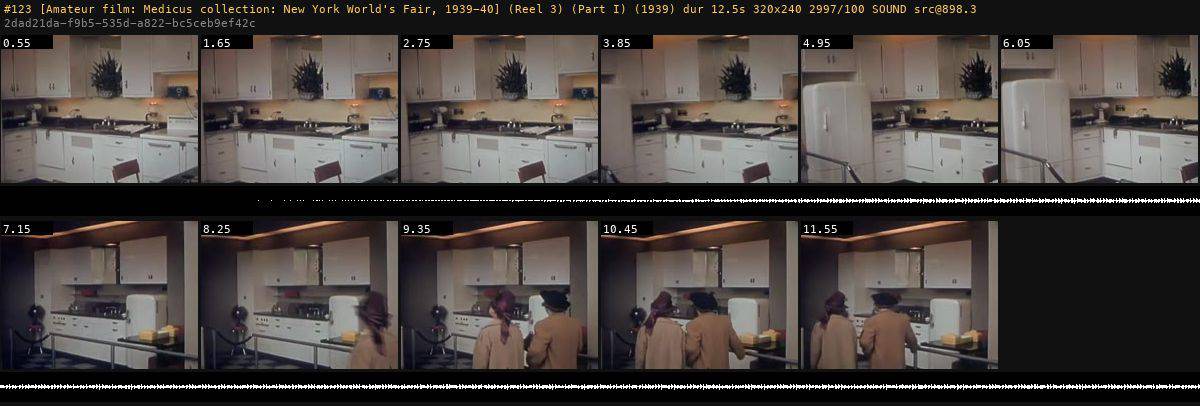
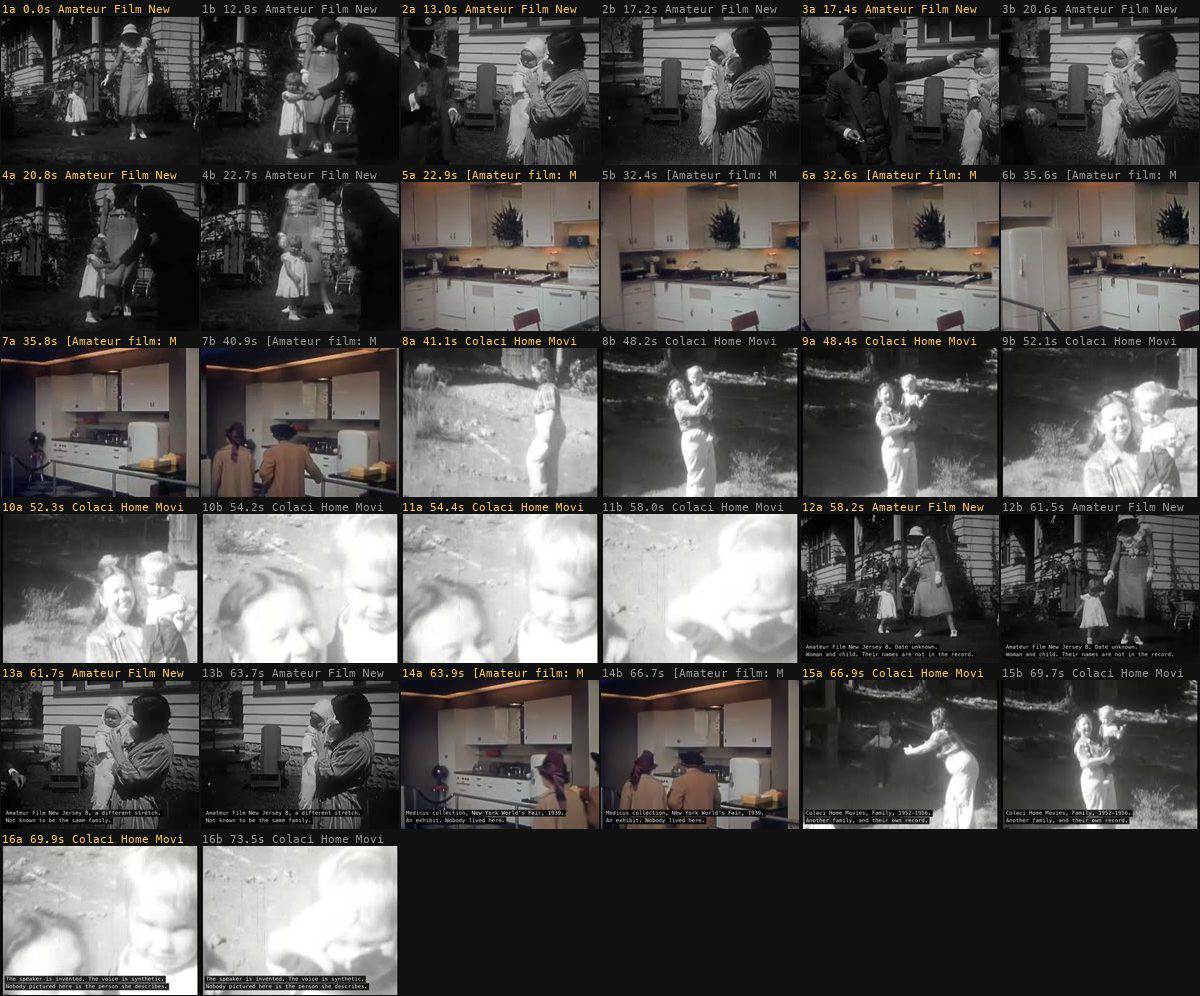
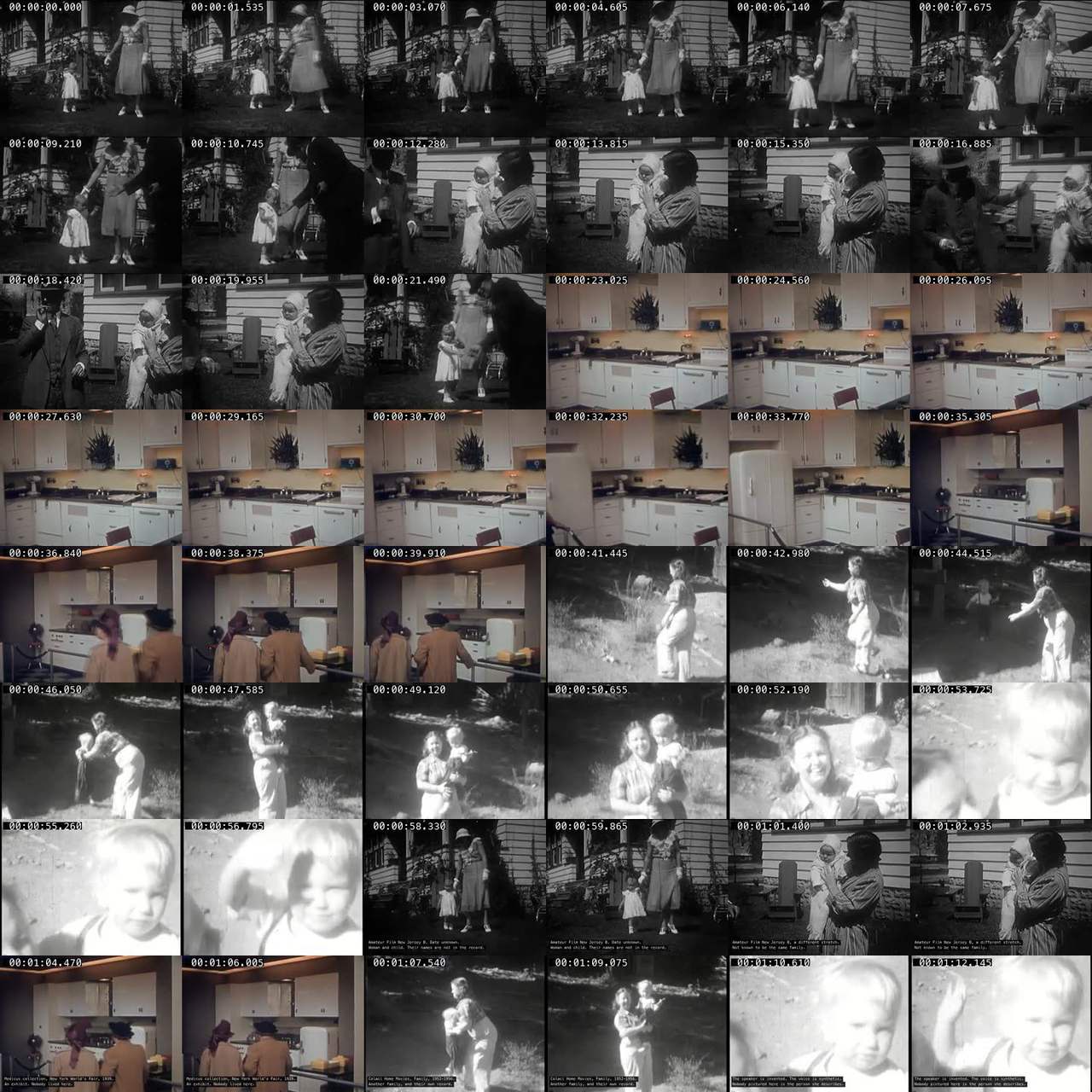
An invented narrator describes her mother in a yard, a kitchen and a field, and the footage does not agree: a different woman, a man in a hat, a roped-off exhibit kitchen at the 1939 World's Fair. The last fifteen seconds name every source and say the speaker is invented.
10searches
7filmstrips looked at
16shots
1review rounds
1 The brief
A life story assembled from home movies begins to contradict itself: familiar rooms, gestures, and recollections belong to different people.
First proof. Create a two-minute fictional composite from four clearly attributed source passages and original narration. Begin with an apparently coherent account of returning to a room. Introduce a second recording that resembles the room but contradicts a concrete detail. Let a later voice or image expose the difference rather than repairing it. Finish by showing how the sequence borrowed its continuity. Keep actual testimony separate from invented biography, and retain the identities of the underlying source records.
Development boundary. The Library of Congress setting remains an earlier fictional proposition, not a claim of institutional involvement or an established source collection.
The operator’s acceptance criteria
The records produce a shared world without requiring a separate exposition scene.
At least two cross-references reward the viewer's memory.
An omission has a consequence beyond creating an air of mystery.
The recurring format permits variation in duration, image and tone.
The final schema change follows from the cases rather than an arbitrary twist.
2 The prompt
The method prompt for this run, followed by this film's inputs. Paste it into an agent with a shell, ffmpeg, a speech recognizer and image reading. It is a reconstruction of what the run did, written afterwards; the run itself began from a short request.
1,150 words
You are making one proof film for ALLWAYS (a cinema practice within PAELEO) from the Moving Image Archive (movingimagearchive.com; public-domain films, which the site says are free to reuse). You work as a hand editor.

"By hand" means: you search, you look at what came back, you listen, and you write every in-point, out-point, order, gain and reason yourself, in an edit list. Software renders the list; it never chooses a shot, a trim or a sound. Do not generate footage. Do not pick shots by similarity score. Do not run a pipeline that edits for you.

## Input

- `[FILM]` the title, concept, first proof and development boundary (below).
- `[OPERATOR]` the primary SCION operator and its acceptance criteria (below; the full prompt is at `operator.html#s<N>`).
- `[SOURCE SET]` the archive's search API: `POST https://www.movingimagearchive.com/api/search` with `{"query": "..."}` returns clips with `videoUrl`, `thumbnailUrl`, `startSeconds`, `endSeconds`, `sourceTitle`, `sourceYear`, `sourceSlug`. One request at a time, about 1.4 s apart; it rate-limits.
- `[DELIVERY]` one film, 4:3, with sound, no longer than the proof asks, plus the case-study folder described in `RUNS.md`.

## Process (do all of it, in order; keep what you make, including what fails)

1. **Read the proof.** Write the three to six specific things a viewer must be able to notice. These are what you will judge your own cut against.
2. **Forage.** Write 8 to 14 searches in plain visible-action language ("a woman adjusts her hat, looking at herself"), not themes. Run each, save the results, and make one numbered contact sheet per query (thumbnail, #number, duration, year, title). Look at every sheet.
3. **Look closer.** For each candidate, fetch the clip and make a time-coded filmstrip with its waveform. Find where the action starts, completes, and what follows it. Note the native size and whether it has sound.
4. **Listen.** Transcribe candidates with word timings. Speech recognition invents words in hiss ("Thank you."). Check against the waveform and loudness before believing a word. An invented word is never evidence. If you cannot hear audio, say so in the case study and treat sound decisions as unverified.
5. **Write the edit list.** For each shot: clip number, in, out, gain, any sound taken from another clip (with its source), speed, hold, caption, and one sentence of reason that a reader could disagree with. Sound or captions from another source go in the ledger as such.
6. **Render, then check the render.** Make a contact sheet of every shot's head, middle and tail; transcribe the render; measure loudness per shot. Fix what you find. Known traps: a clip's closing cut can show up in your trim; holding a last frame can freeze the next shot of the source.
7. **Disclose derived layers.** If you remove, extend, generate, retime, mirror, or re-voice anything: keep the original, mark the derived layer on screen or in the ledger, and say what is unknown. Authored narration is labelled invented and synthetic.
8. **Blind critic.** Give a fresh agent only: a timecoded contact sheet of the final film, a transcript with loudness per 2 s, and the film's brief and acceptance criteria. Not your edit list, ledger, reasons or summaries. It names one specific event before it reads the brief. It returns a verdict (pass / reference stronger / inconclusive), the largest gap, up to three repairs each with a timecode and a checkable condition, and one strength to protect. It cannot hear: take no sound verdicts from it, and check its claims against the cut before obeying them.
9. **Repair what is true; leave what is wrong and say so.** If you changed the film, ask a new critic. Stop when you can say honestly what still falls short of the brief.
10. **Package** the case study per `RUNS.md`: searches and sheets, strips, the edit list with reasons, the ledger, the critic packets and verbatim reports, repairs, and what is open.

## Rules

- Status is not self-awarded. A film is "proof in progress" unless a blind critic passed it; "released" is for a person to say.
- Unknown dates and names stay unknown. Never imply two clips recorded the same event.
- Do not make assembled speech look like a speaker's own statement.
- Say what you could not perceive. A maker that cannot hear, or cannot see motion, must say so, because it changes what the cut proves.

## Tools (in `tools/`; Python 3, ffmpeg, Pillow, numpy)

- `forage.py <film> "query" ...` runs searches one at a time, writes `forage.json` and a contact sheet per query.
- `look.py <film> <n>[:step[:in:out]] ...` makes a time-coded filmstrip with waveform for clip #n.
- `hear.py <film> <n> ...` word timings (needs `mlx_whisper`, Apple silicon; substitute any word-timing ASR).
- `beats.py <film> <n> <in> <out>` motion-energy peaks, a helper for the eye.
- `cut.py <film>` renders `edl.json`; it chooses nothing. `pairs.py <film>` renders side-by-side pairs from `pairs.json`.
- `reel.py <film>` contact sheet of the rendered film, shot by shot.
- `packet.py <film>` builds what the critic gets.
- `erase.py` + `erase_plate.py` person removal for NOBODY HOME (SAM 2.1 tracked mask; replacement pixels from the same shot; unknowns listed). Set `SAM2_ROOT` to a folder with `models/sam2.1_hiera_small.pt`.
- `speak.py` authored narration with Kokoro-82M. `adopt.py` brings clips found in a local word index into a film's forage (set `CINEOSIS_LAB`).

---

## This film

**Title:** MNEMONIL (A borrowed life)

**Concept:** A life story assembled from home movies begins to contradict itself: familiar rooms, gestures, and recollections belong to different people.

**First proof:** Create a two-minute fictional composite from four clearly attributed source passages and original narration. Begin with an apparently coherent account of returning to a room. Introduce a second recording that resembles the room but contradicts a concrete detail. Let a later voice or image expose the difference rather than repairing it. Finish by showing how the sequence borrowed its continuity. Keep actual testimony separate from invented biography, and retain the identities of the underlying source records.

**Development boundary:** The Library of Congress setting remains an earlier fictional proposition, not a claim of institutional involvement or an established source collection.

**Primary operator:** SCION 74 · The Falls — A World Emerging From a Directory. Full operator prompt: https://hartswf0.github.io/bolas/paeleo/allways/operator.html#s74
**Supporting:** SCION 67 · (nostalgia) — Anticipated Image, Vanishing Evidence, SCION 97 · Welcome to Pine Point — Remembered Place Scrapbook

**Operator's creative theorem:** Make a coherent strange world emerge through a finite sequence of records whose omissions and cross-references matter. The directory's rules should create narrative pressure while individual cases keep exceeding their categories.

**Acceptance criteria (from the operator):**
- The records produce a shared world without requiring a separate exposition scene.
- At least two cross-references reward the viewer's memory.
- An omission has a consequence beyond creating an air of mystery.
- The recurring format permits variation in duration, image and tone.
- The final schema change follows from the cases rather than an arbitrary twist.
3 What was searched
One search at a time, in plain visible-action language. Each sheet is what came back: numbered thumbnails with duration, year and title. These are the images the maker looked at (or, where it could not, see the note below).
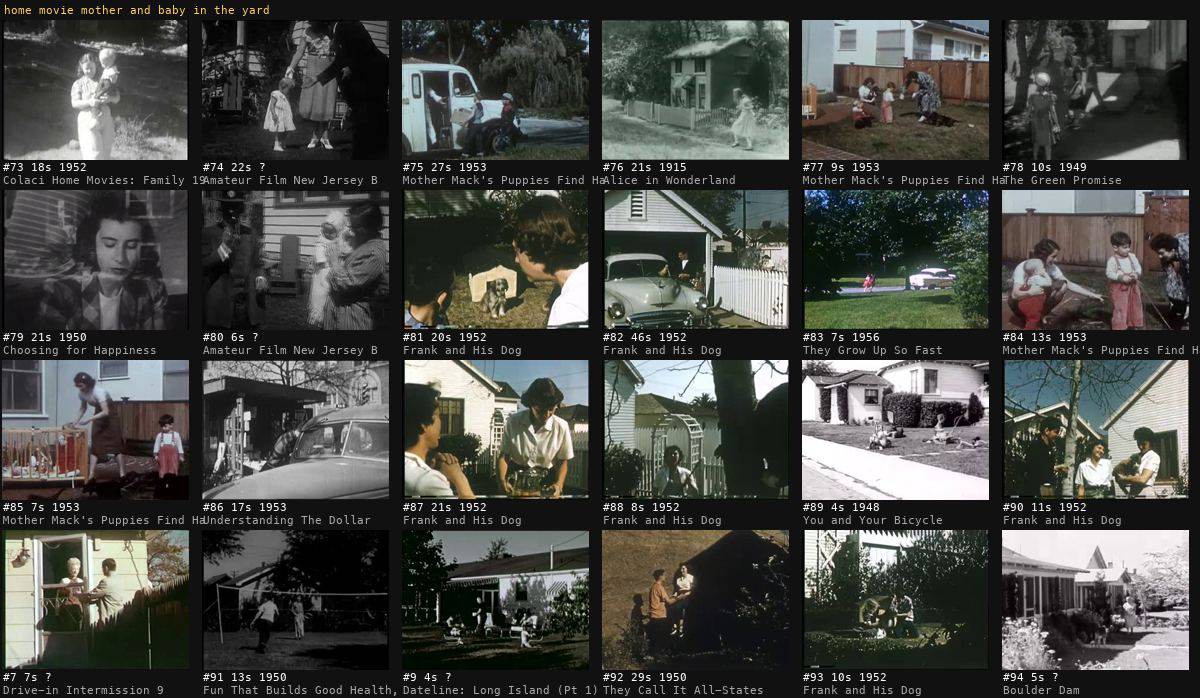
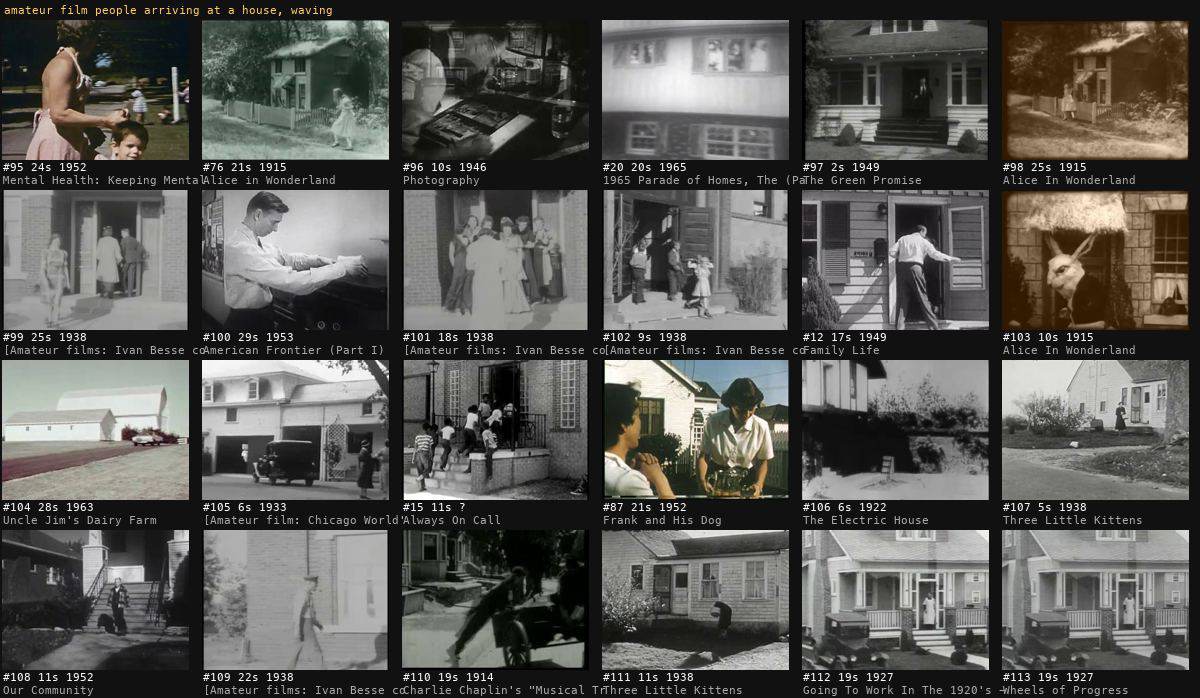
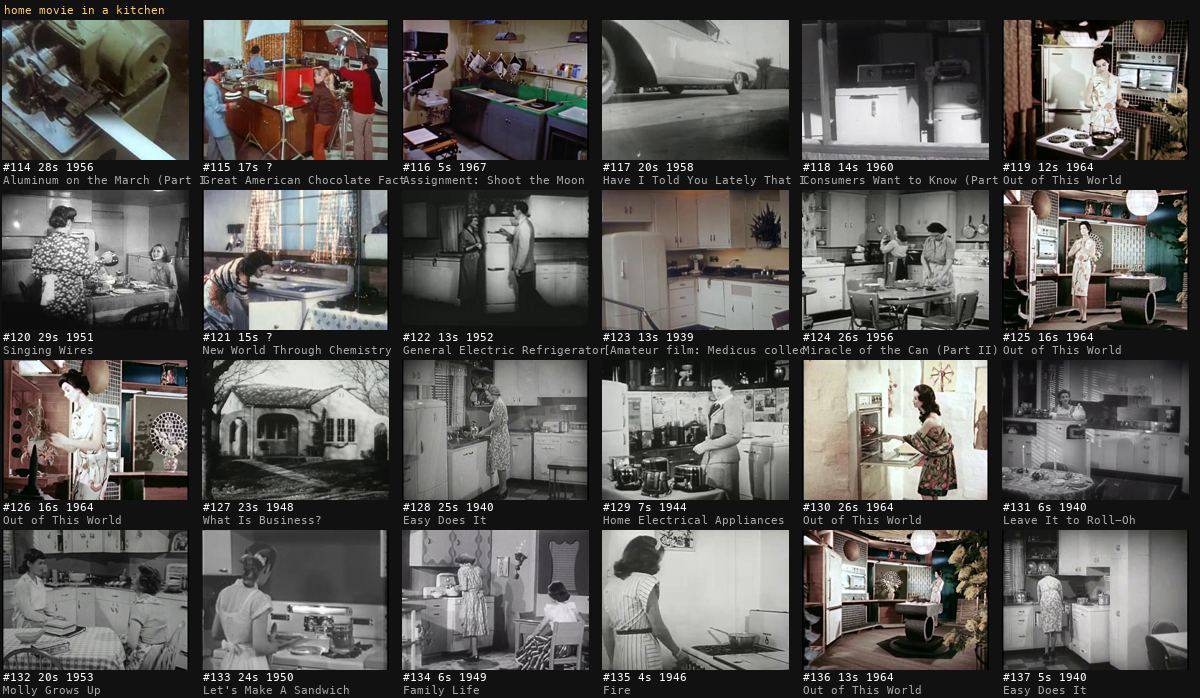
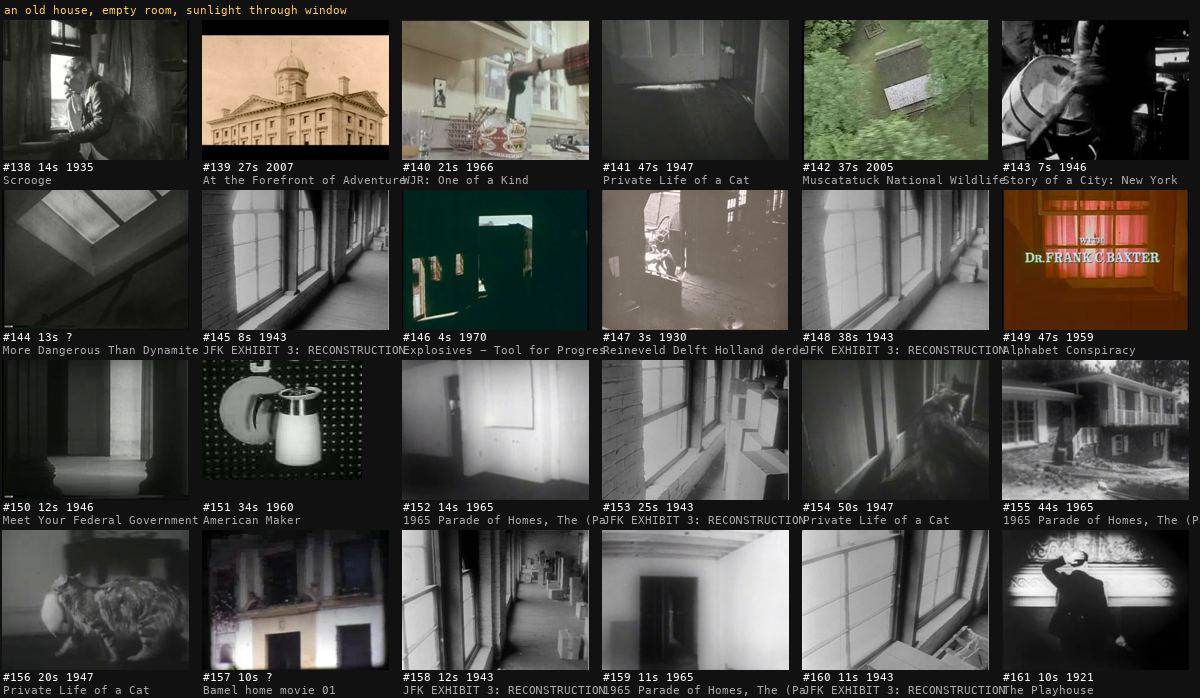
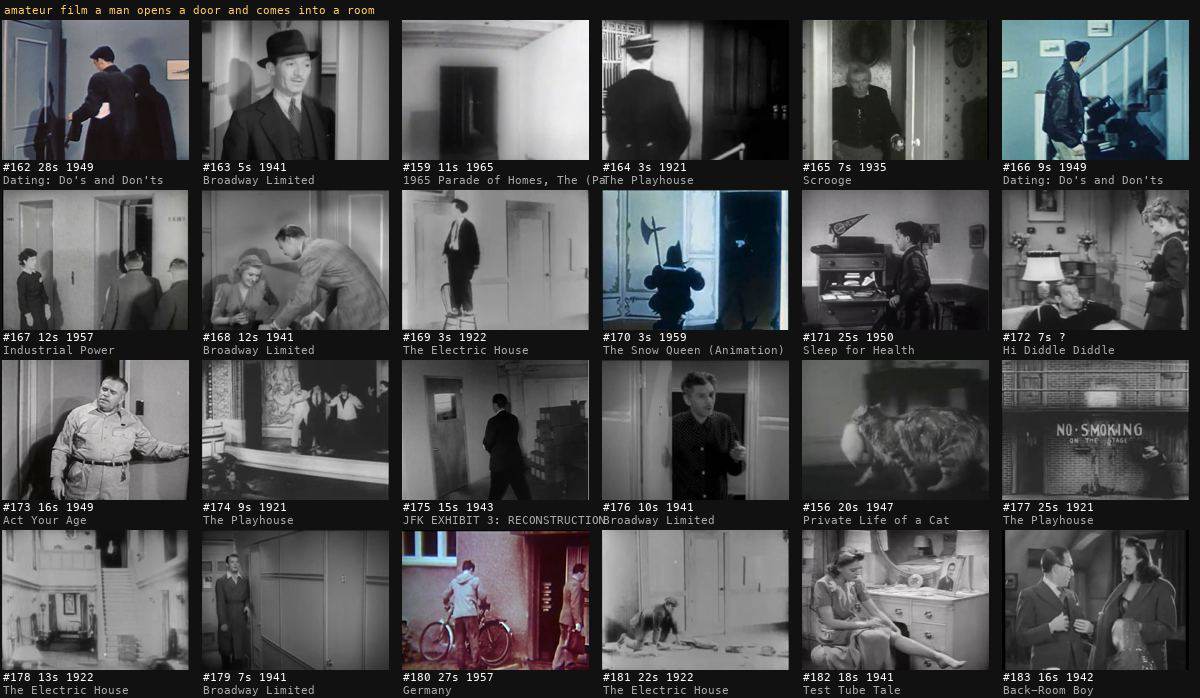
home movie family on a porch · 24 resultsamateur film children at a birthday party · 24 resultshome movie living room at Christmas · 24 resultshome movie mother and baby in the yard · 24 resultsamateur film people arriving at a house, waving · 24 resultshome movie in a kitchen · 24 resultsan old house, empty room, sunlight through window · 24 resultsamateur film a man opens a door and comes into a room · 24 resultshome movie a girl on a swing · 24 resultsamateur film an old woman on a chair · 24 results
4 What was looked at closely
A time-coded filmstrip and waveform for each candidate. Outlined strips are in the cut.
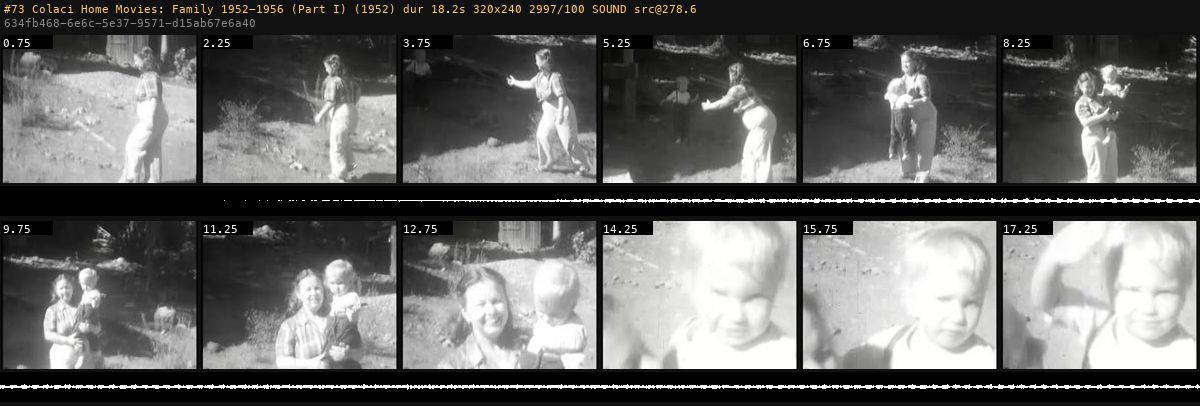
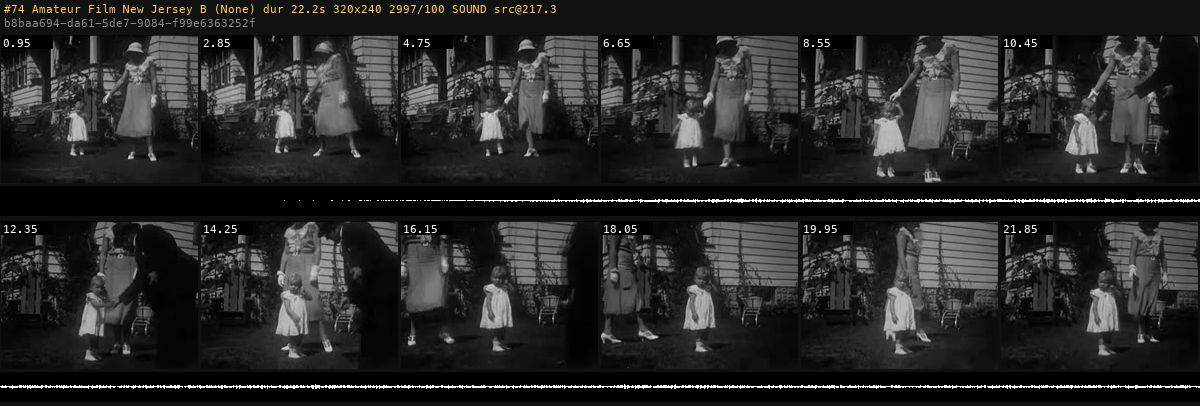
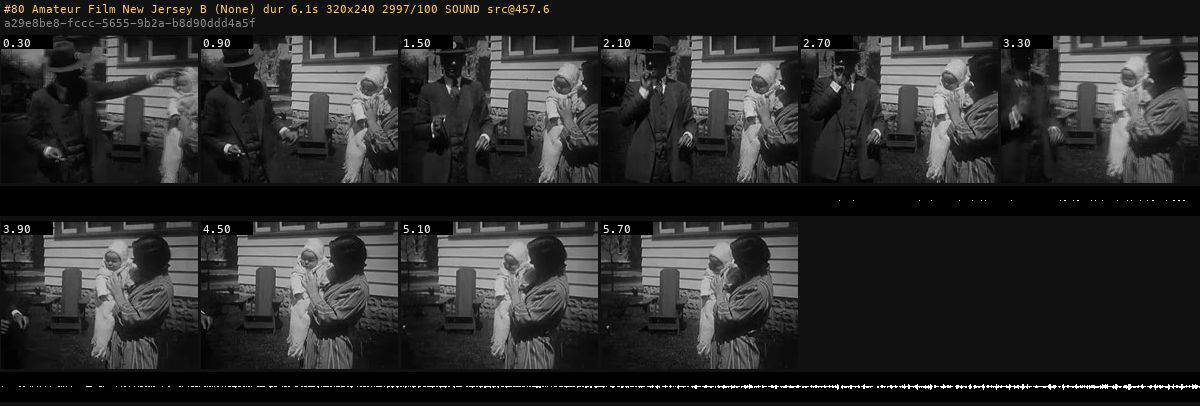
#73 Colaci Home Movies: Family 1952-1956 (Part I) (1952) · in the cut (shot 8, 9, 10, 11, 15, 16)#74 Amateur Film New Jersey B (undated) · in the cut (shot 1, 4, 12)#80 Amateur Film New Jersey B (undated) · in the cut (shot 2, 3, 13)#99 [Amateur films: Ivan Besse collection: Britton, South Dakota 1938-39] (Part V) (1938) · looked at, not used#102 [Amateur films: Ivan Besse collection: Britton, South Dakota 1938-39] (Part VII) (1938) · looked at, not used#123 [Amateur film: Medicus collection: New York World's Fair, 1939-40] (Reel 3) (Part I) (1939) · in the cut (shot 5, 6, 7, 14)#157 Bamel home movie 01 (undated) · looked at, not used
5 The cut
The finished film, shot by shot (first, middle and last frame of each):
The final cut as a contact sheet
Every shot, where it came from, and why it is here. Source seconds are in the original film. Links go to the archive's own copy of the clip.
sound: Colaci Home Movies: Family 1952-1956 (Part I) (1952) 292.7–296.5
292.7–296.5
the invention declared.
6 Review
A fresh agent was given only a timecoded contact sheet of the film, a transcript with loudness, and the brief. Not the edit list, the ledger, or these reasons. It cannot hear.
Round 1 pass, narrowly
independent critic (fresh Claude Sonnet 5.5 agent). Its report, verbatim:
The report
VERDICT: pass, narrowly. I can't hear the film, so voice quality and the 57.5 "Thank you" (likely hiss) are unjudged.

Noticed before the brief: at 0:35-0:40 the "untouched kitchen" fills with two coated visitors seen from behind, with rope stanchions and a rail in frame. The narration at 25.9-27.5 says "Nobody had touched the kitchen." The picture undercuts the voice, so the room reads as an exhibit before any caption says so. At 48.5 the voice contradicts itself ("didn't have gloves... wasn't in a dress"), which is a real, concrete break.

Largest gap: the reveal is carried by tiny, low-contrast captions at 0:58-1:13, after speech has stopped (loudness about -37 dB). It reads as a recap of earlier clips, not a discovery. The 52-57s close-ups of the boy run with no narration, so the emotional payoff is silent and unanchored.

Repairs:
1. Enlarge the captions at 58.3-73.7 so they are legible at thumbnail size. Check: caption text height at least 3% of frame height.
2. Add one narrated line over 1:10.6-1:12.1, for example the narrator naming the borrowed footage, so the final 15s is not caption-only. Check: speech present in that window, loudness above -30 dB.
3. Cut the 53.7-56.8 close-ups to 2s, or put a line over them. Check: no speech gap longer than 4s between 43s and 58s.

Protect: the kitchen sequence at 23-40s. The narration lists details (plant, red chair, icebox) that match the frames, and the exhibit rope then breaks the claim without any comment.
 Argon