72 s · ends with a 5 s card naming every source. I cannot hear; neither could the critics. Sound is unjudged until a person listens.
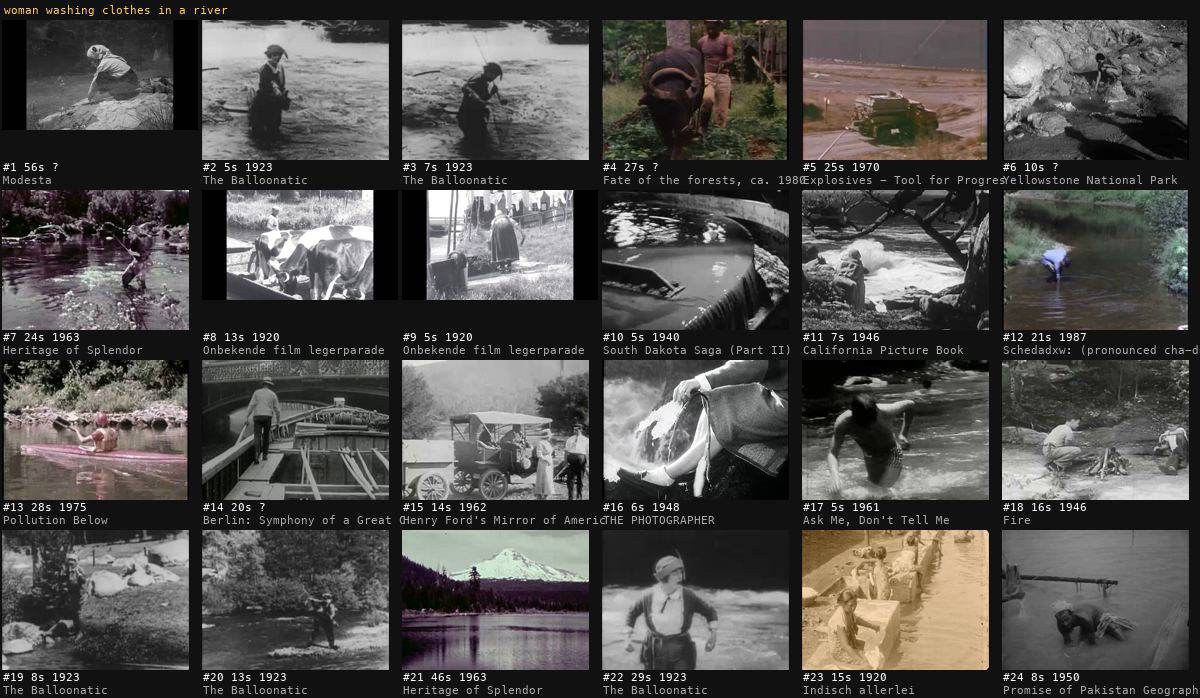
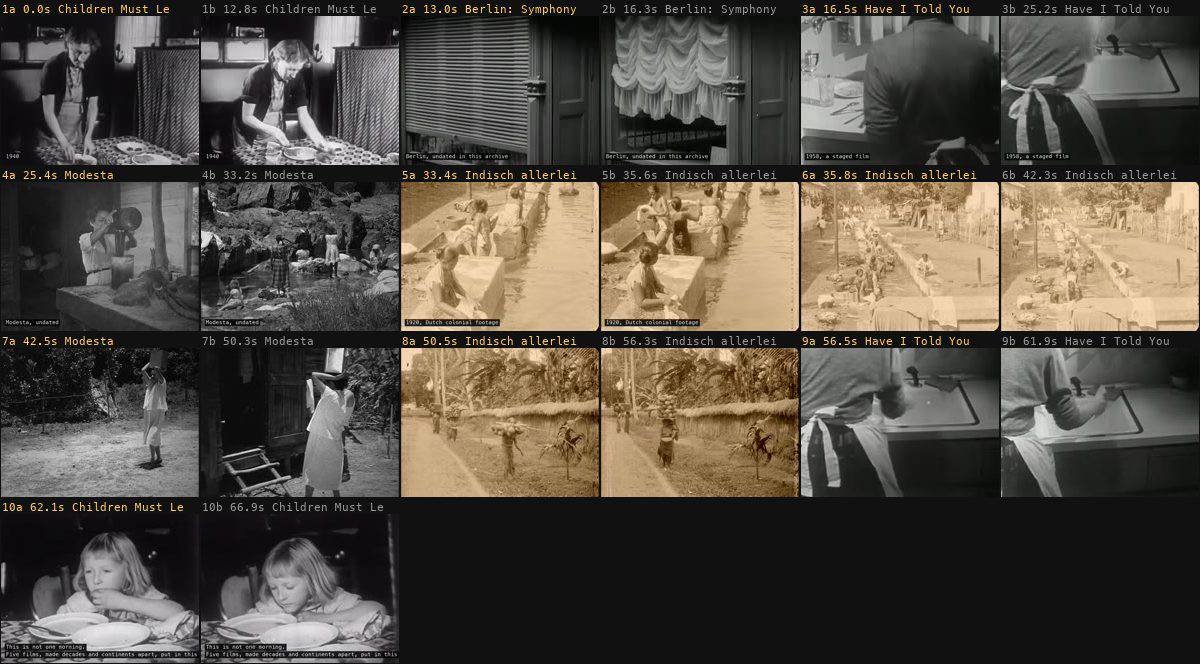
A morning assembled from five films: a woman lays a table, a blind rises in Berlin, a woman at a sink, women washing in a river, a Dutch colonial washing channel and carriers. Each has its year or place on screen, and the film closes on a card saying it is not one morning.
13searches
7filmstrips looked at
10shots
1review rounds
1 The brief
A day is composed from many people’s ordinary work, with one gesture taking up where another leaves off.
First proof. Make a two-minute composite morning from five situated participants or source records. Give each one intact practical action before connecting them through washing, carrying, preparing, or clearing away. Let a handoff between excerpts suggest continuation, then widen the frame to reveal its changed circumstances. Preserve one task that remains unfinished. End by returning to the earliest participant after their action, with a different pace and sound. Identify the assembled day as an editorial construction.
Development boundary. The documentary primary governs source treatment. A shared action sequence does not make the recordings one documented day or their participants interchangeable.
The operator’s acceptance criteria
A viewer can distinguish the five participants after the film.
At least one parallel action leads to a meaningful difference.
The exception is integral to the structure rather than treated as an inconvenient mismatch.
Speech, subtitles and source context agree.
The final passage changes the initial understanding of at least one practice.
2 The prompt
The method prompt for this run, followed by this film's inputs. Paste it into an agent with a shell, ffmpeg, a speech recognizer and image reading. It is a reconstruction of what the run did, written afterwards; the run itself began from a short request.
1,141 words
You are making one proof film for ALLWAYS (a cinema practice within PAELEO) from the Moving Image Archive (movingimagearchive.com; public-domain films, which the site says are free to reuse). You work as a hand editor.

"By hand" means: you search, you look at what came back, you listen, and you write every in-point, out-point, order, gain and reason yourself, in an edit list. Software renders the list; it never chooses a shot, a trim or a sound. Do not generate footage. Do not pick shots by similarity score. Do not run a pipeline that edits for you.

## Input

- `[FILM]` the title, concept, first proof and development boundary (below).
- `[OPERATOR]` the primary SCION operator and its acceptance criteria (below; the full prompt is at `operator.html#s<N>`).
- `[SOURCE SET]` the archive's search API: `POST https://www.movingimagearchive.com/api/search` with `{"query": "..."}` returns clips with `videoUrl`, `thumbnailUrl`, `startSeconds`, `endSeconds`, `sourceTitle`, `sourceYear`, `sourceSlug`. One request at a time, about 1.4 s apart; it rate-limits.
- `[DELIVERY]` one film, 4:3, with sound, no longer than the proof asks, plus the case-study folder described in `RUNS.md`.

## Process (do all of it, in order; keep what you make, including what fails)

1. **Read the proof.** Write the three to six specific things a viewer must be able to notice. These are what you will judge your own cut against.
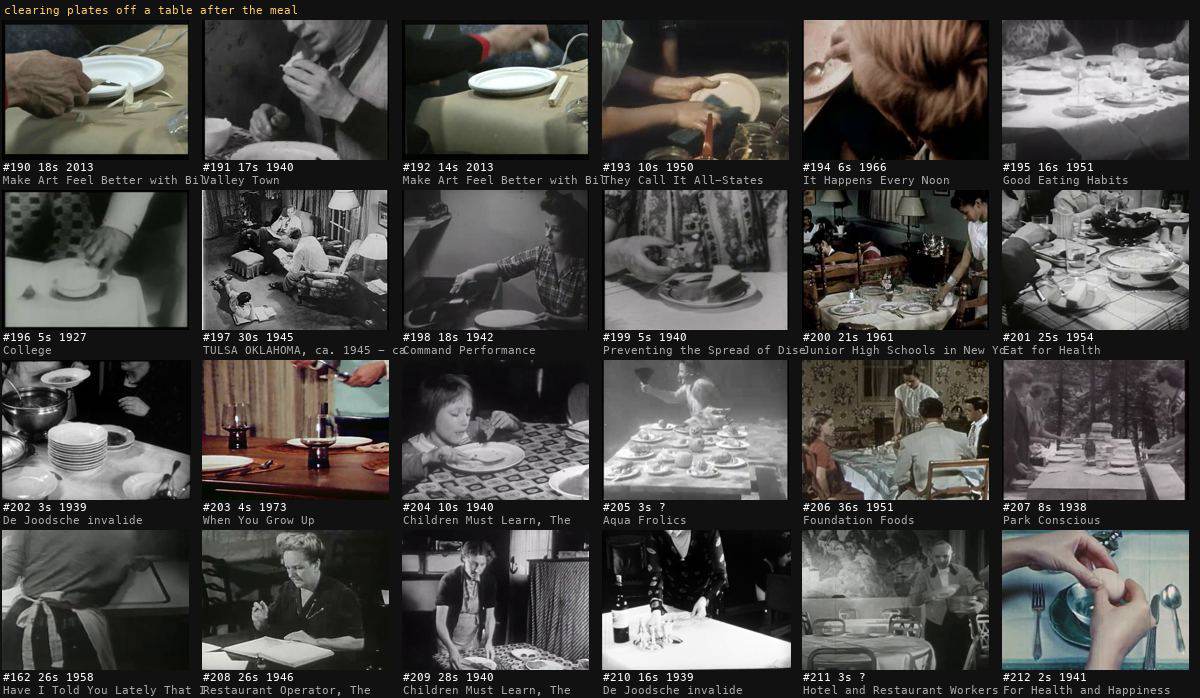
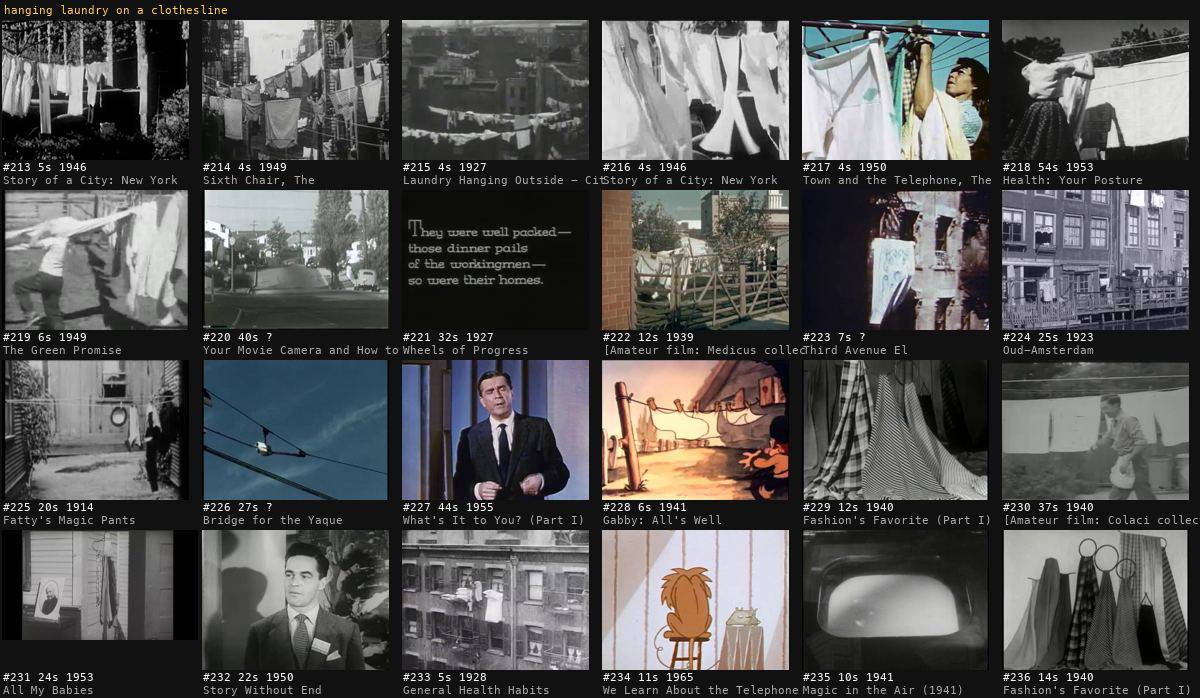
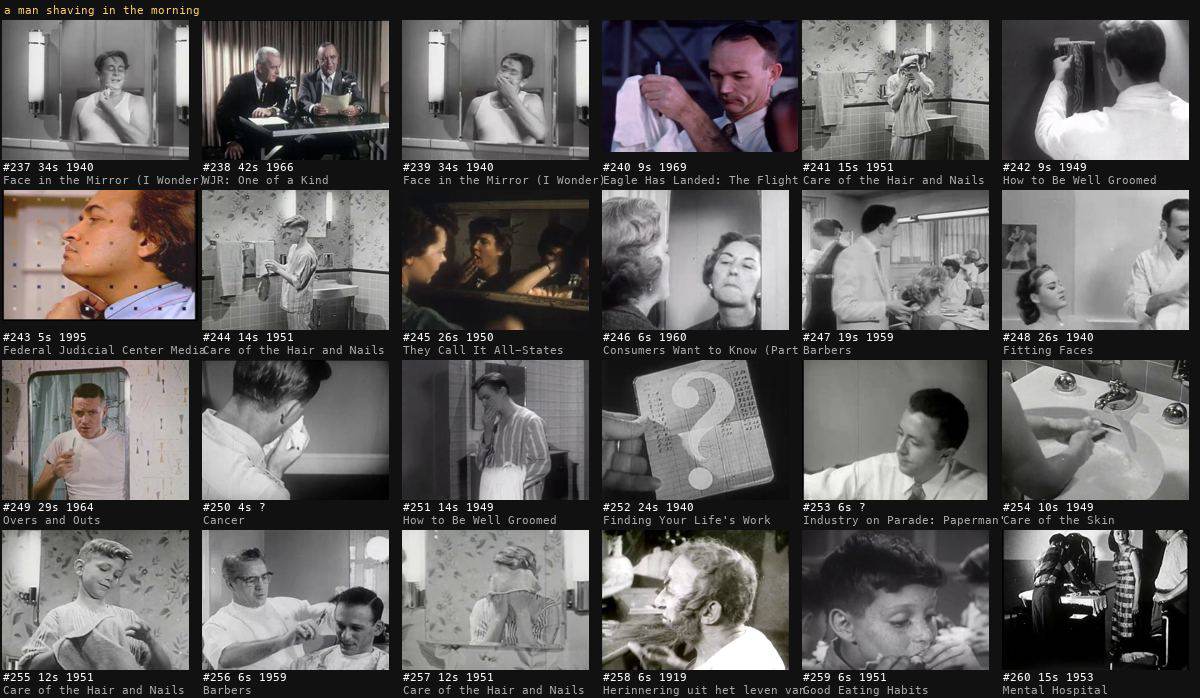
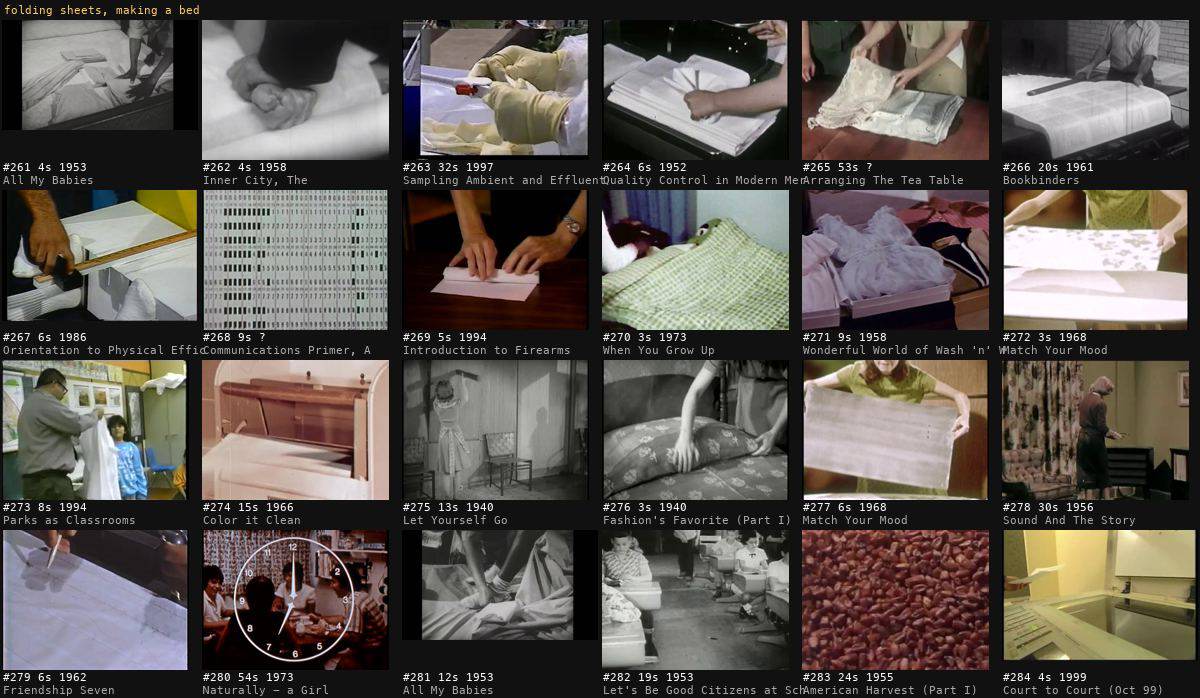
2. **Forage.** Write 8 to 14 searches in plain visible-action language ("a woman adjusts her hat, looking at herself"), not themes. Run each, save the results, and make one numbered contact sheet per query (thumbnail, #number, duration, year, title). Look at every sheet.
3. **Look closer.** For each candidate, fetch the clip and make a time-coded filmstrip with its waveform. Find where the action starts, completes, and what follows it. Note the native size and whether it has sound.
4. **Listen.** Transcribe candidates with word timings. Speech recognition invents words in hiss ("Thank you."). Check against the waveform and loudness before believing a word. An invented word is never evidence. If you cannot hear audio, say so in the case study and treat sound decisions as unverified.
5. **Write the edit list.** For each shot: clip number, in, out, gain, any sound taken from another clip (with its source), speed, hold, caption, and one sentence of reason that a reader could disagree with. Sound or captions from another source go in the ledger as such.
6. **Render, then check the render.** Make a contact sheet of every shot's head, middle and tail; transcribe the render; measure loudness per shot. Fix what you find. Known traps: a clip's closing cut can show up in your trim; holding a last frame can freeze the next shot of the source.
7. **Disclose derived layers.** If you remove, extend, generate, retime, mirror, or re-voice anything: keep the original, mark the derived layer on screen or in the ledger, and say what is unknown. Authored narration is labelled invented and synthetic.
8. **Blind critic.** Give a fresh agent only: a timecoded contact sheet of the final film, a transcript with loudness per 2 s, and the film's brief and acceptance criteria. Not your edit list, ledger, reasons or summaries. It names one specific event before it reads the brief. It returns a verdict (pass / reference stronger / inconclusive), the largest gap, up to three repairs each with a timecode and a checkable condition, and one strength to protect. It cannot hear: take no sound verdicts from it, and check its claims against the cut before obeying them.
9. **Repair what is true; leave what is wrong and say so.** If you changed the film, ask a new critic. Stop when you can say honestly what still falls short of the brief.
10. **Package** the case study per `RUNS.md`: searches and sheets, strips, the edit list with reasons, the ledger, the critic packets and verbatim reports, repairs, and what is open.

## Rules

- Status is not self-awarded. A film is "proof in progress" unless a blind critic passed it; "released" is for a person to say.
- Unknown dates and names stay unknown. Never imply two clips recorded the same event.
- Do not make assembled speech look like a speaker's own statement.
- Say what you could not perceive. A maker that cannot hear, or cannot see motion, must say so, because it changes what the cut proves.

## Tools (in `tools/`; Python 3, ffmpeg, Pillow, numpy)

- `forage.py <film> "query" ...` runs searches one at a time, writes `forage.json` and a contact sheet per query.
- `look.py <film> <n>[:step[:in:out]] ...` makes a time-coded filmstrip with waveform for clip #n.
- `hear.py <film> <n> ...` word timings (needs `mlx_whisper`, Apple silicon; substitute any word-timing ASR).
- `beats.py <film> <n> <in> <out>` motion-energy peaks, a helper for the eye.
- `cut.py <film>` renders `edl.json`; it chooses nothing. `pairs.py <film>` renders side-by-side pairs from `pairs.json`.
- `reel.py <film>` contact sheet of the rendered film, shot by shot.
- `packet.py <film>` builds what the critic gets.
- `erase.py` + `erase_plate.py` person removal for NOBODY HOME (SAM 2.1 tracked mask; replacement pixels from the same shot; unknowns listed). Set `SAM2_ROOT` to a folder with `models/sam2.1_hiera_small.pt`.
- `speak.py` authored narration with Kokoro-82M. `adopt.py` brings clips found in a local word index into a film's forage (set `CINEOSIS_LAB`).

---

## This film

**Title:** COLLECTIVE INVENTORIES (A composite day)

**Concept:** A day is composed from many people’s ordinary work, with one gesture taking up where another leaves off.

**First proof:** Make a two-minute composite morning from five situated participants or source records. Give each one intact practical action before connecting them through washing, carrying, preparing, or clearing away. Let a handoff between excerpts suggest continuation, then widen the frame to reveal its changed circumstances. Preserve one task that remains unfinished. End by returning to the earliest participant after their action, with a different pace and sound. Identify the assembled day as an editorial construction.

**Development boundary:** The documentary primary governs source treatment. A shared action sequence does not make the recordings one documented day or their participants interchangeable.

**Primary operator:** SCION 65 · Five — Parallel Lives, Unequal Details. Full operator prompt: https://hartswf0.github.io/bolas/paeleo/allways/operator.html#s65
**Supporting:** SCION 84 · Pickpocket — Object Transfer as Dramatic Grammar, SCION 92 · Hands of Bresson — Gesture Evidence Before a Generalization

**Operator's creative theorem:** Let several people inhabit the same editorial structure while preserving differences in language, routine and belief. Shared gestures should create a relation without making individual testimony interchangeable.

**Acceptance criteria (from the operator):**
- A viewer can distinguish the five participants after the film.
- At least one parallel action leads to a meaningful difference.
- The exception is integral to the structure rather than treated as an inconvenient mismatch.
- Speech, subtitles and source context agree.
- The final passage changes the initial understanding of at least one practice.
3 What was searched
One search at a time, in plain visible-action language. Each sheet is what came back: numbered thumbnails with duration, year and title. These are the images the maker looked at (or, where it could not, see the note below).
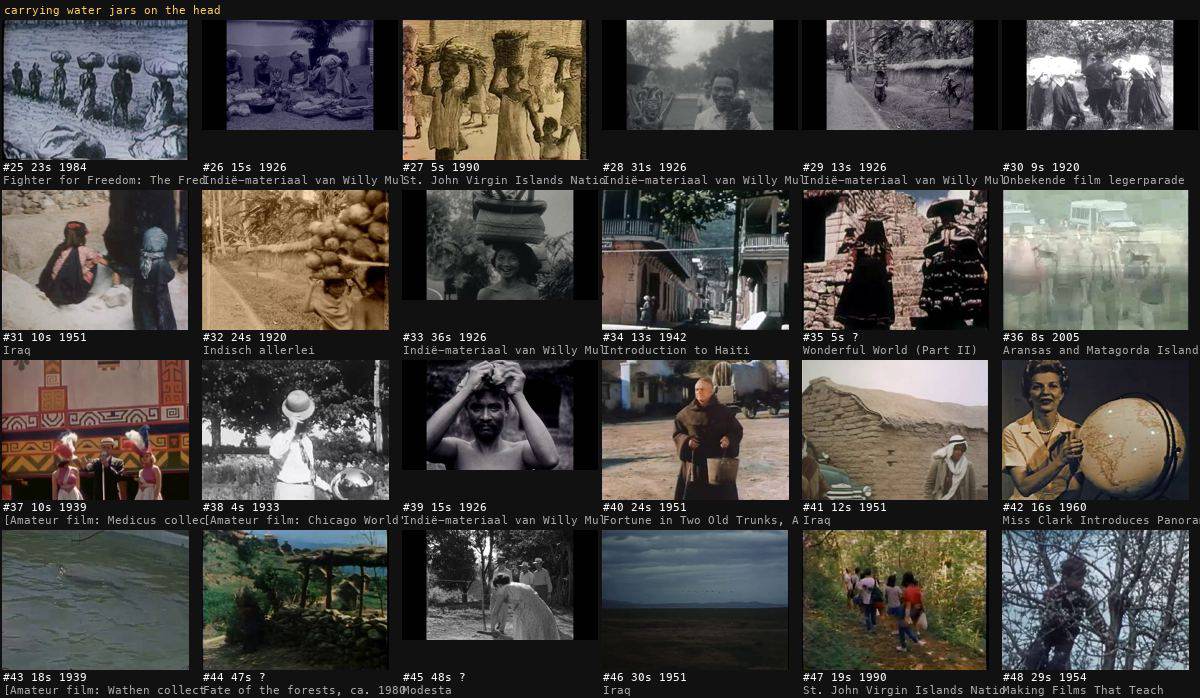
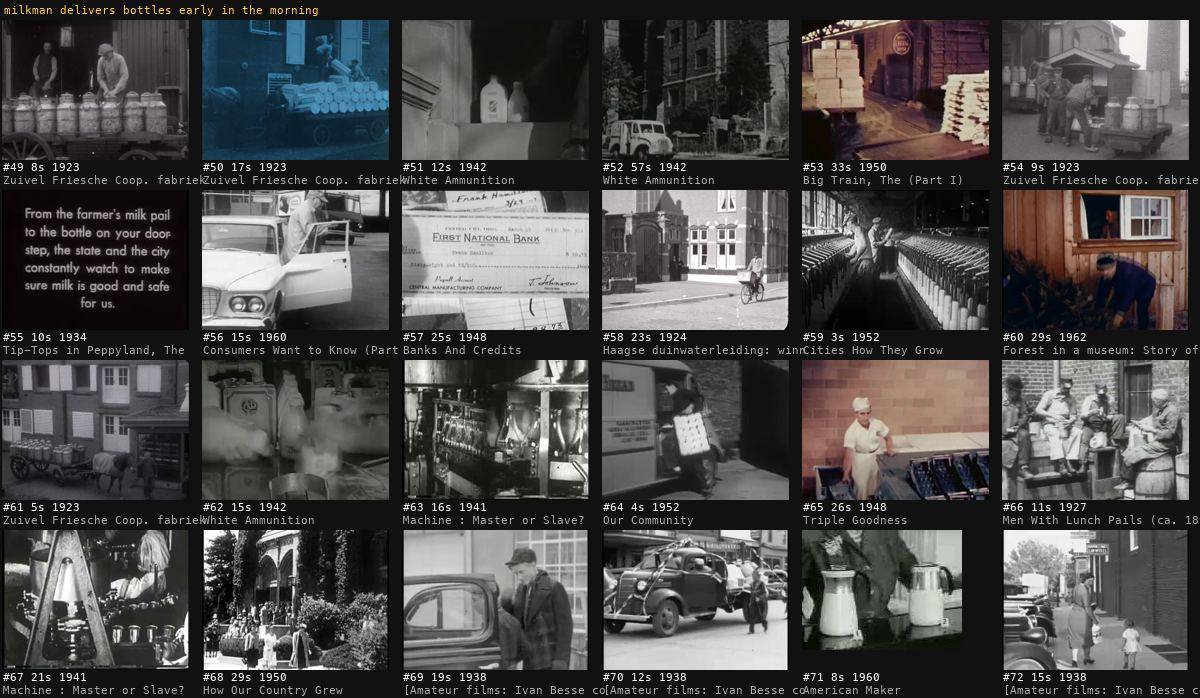
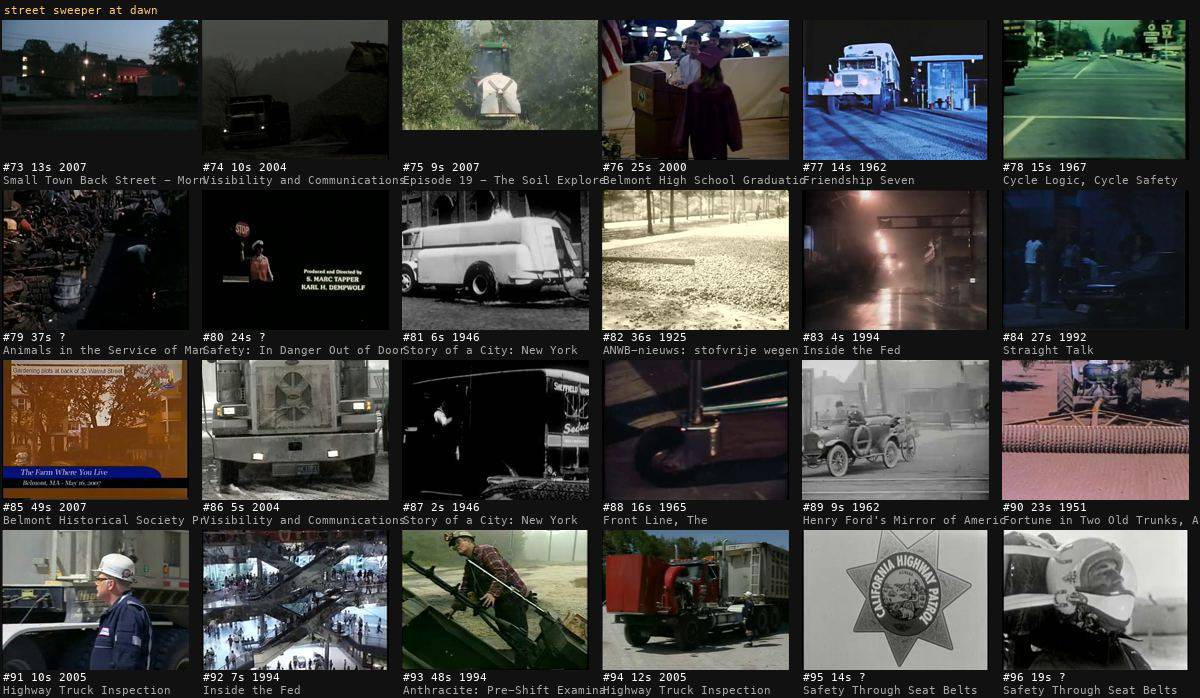
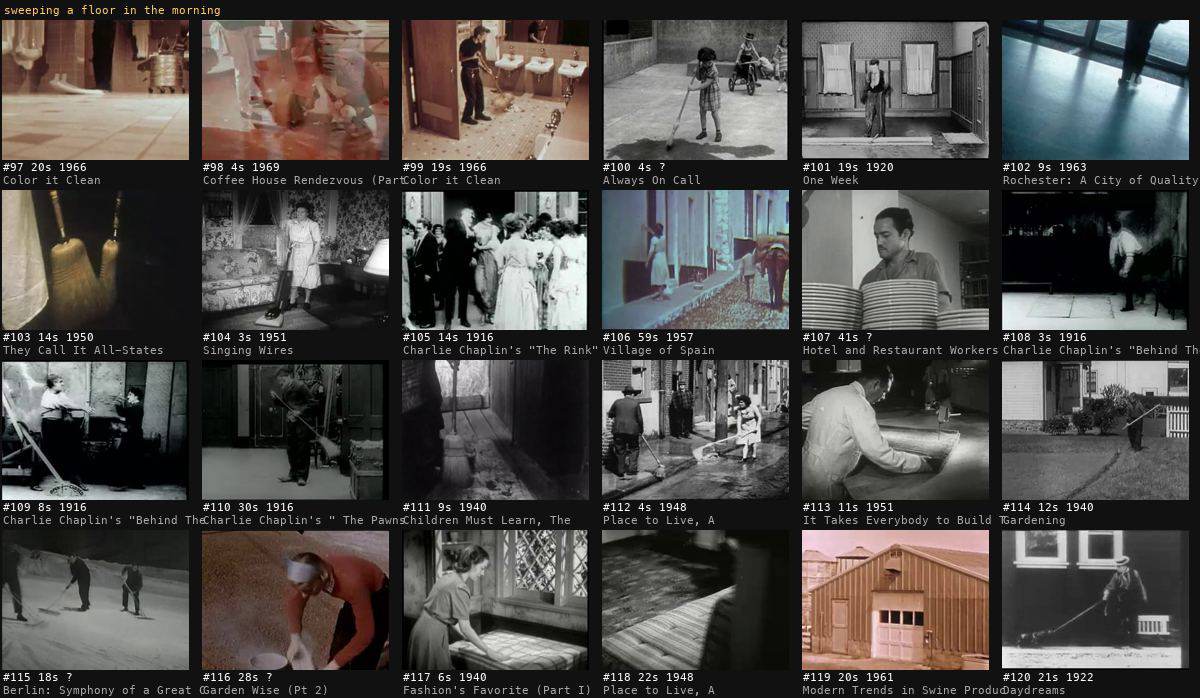
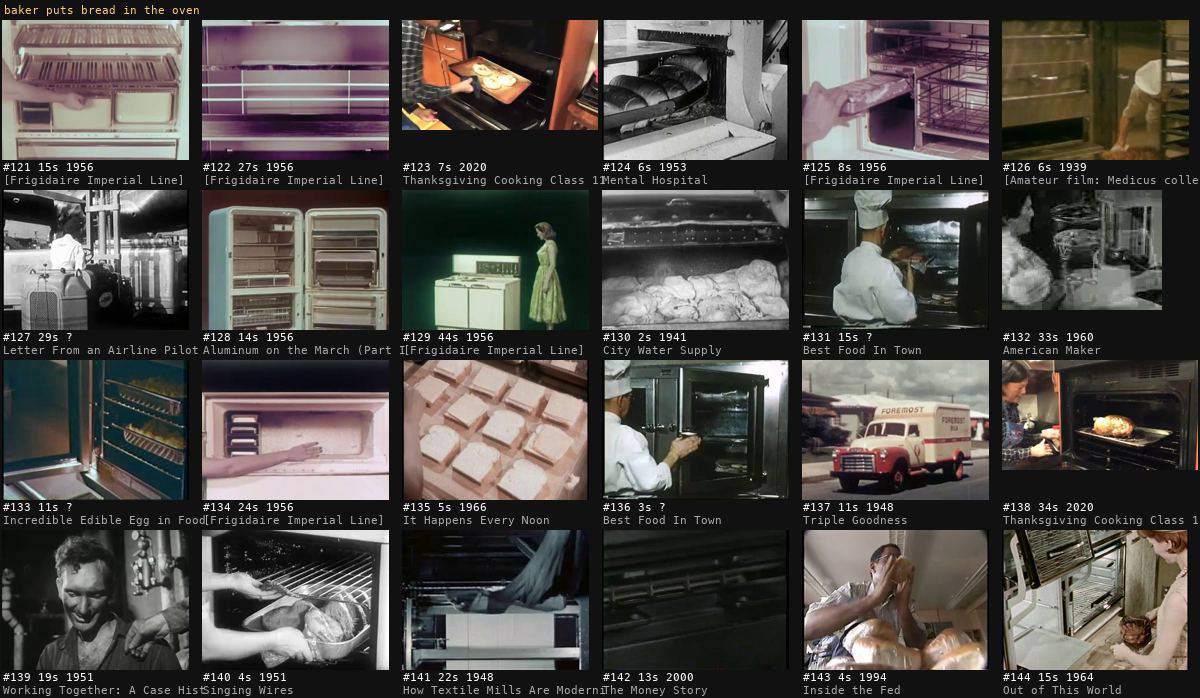
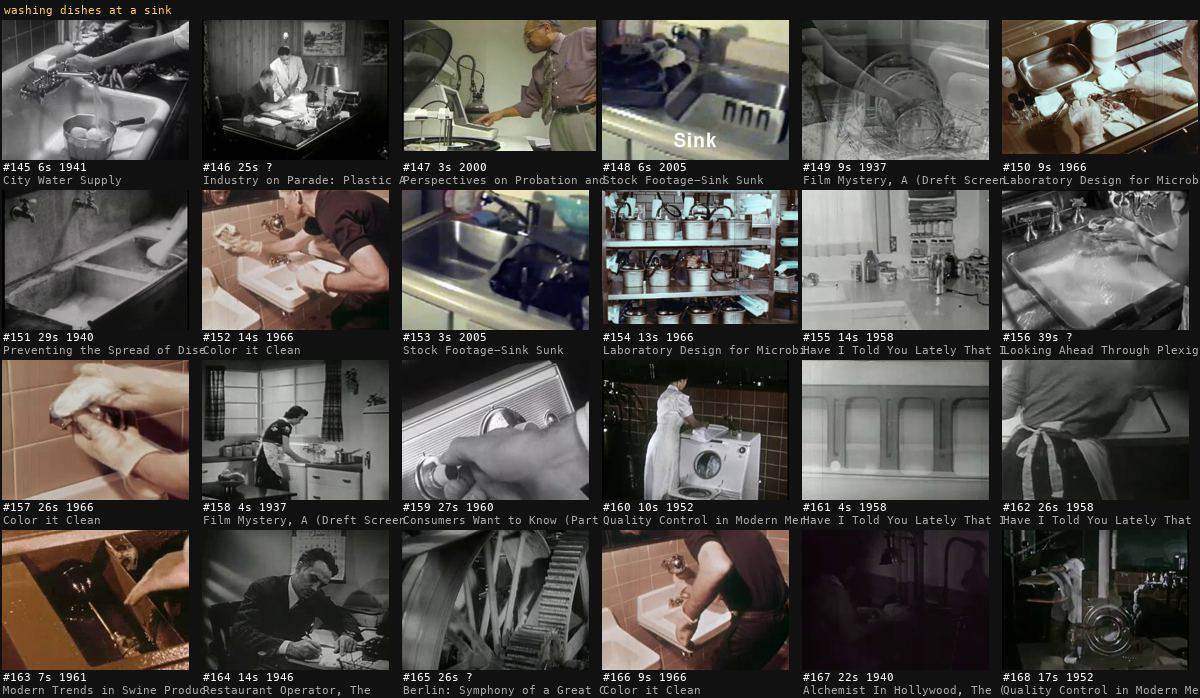
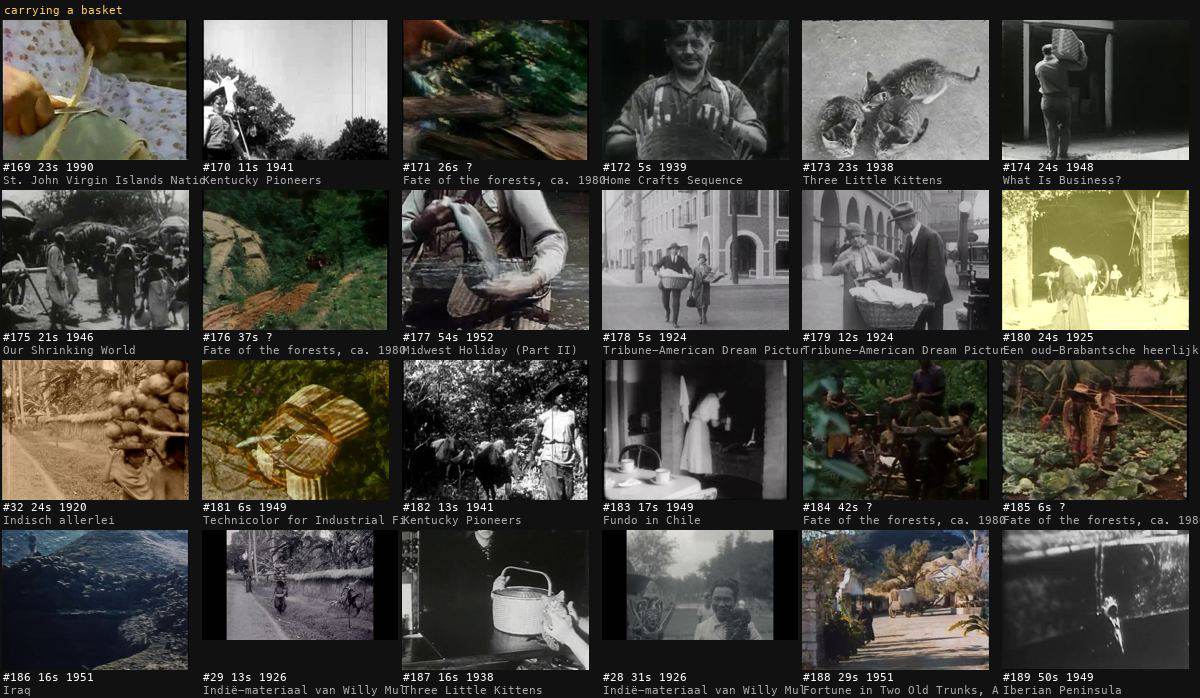
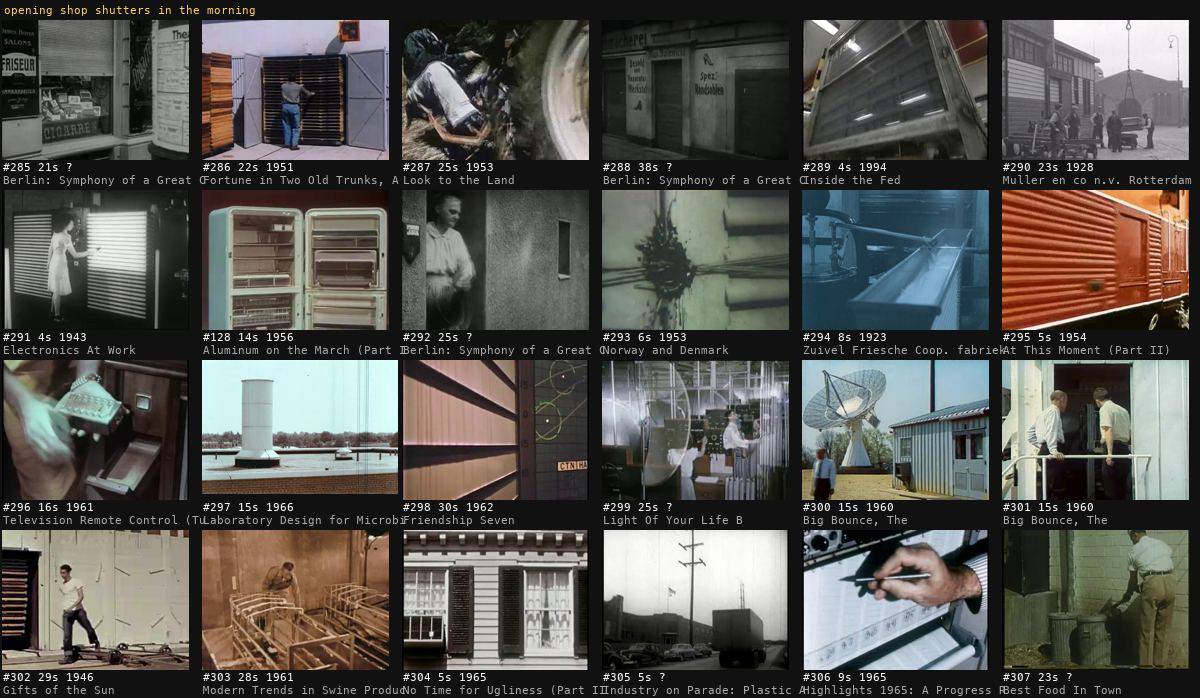
woman washing clothes in a river · 24 resultscarrying water jars on the head · 24 resultsmilkman delivers bottles early in the morning · 24 resultsstreet sweeper at dawn · 24 resultssweeping a floor in the morning · 24 resultsbaker puts bread in the oven · 24 resultswashing dishes at a sink · 24 resultscarrying a basket · 24 resultsclearing plates off a table after the meal · 24 resultshanging laundry on a clothesline · 24 resultsa man shaving in the morning · 24 resultsfolding sheets, making a bed · 24 resultsopening shop shutters in the morning · 24 results
4 What was looked at closely
A time-coded filmstrip and waveform for each candidate. Outlined strips are in the cut.
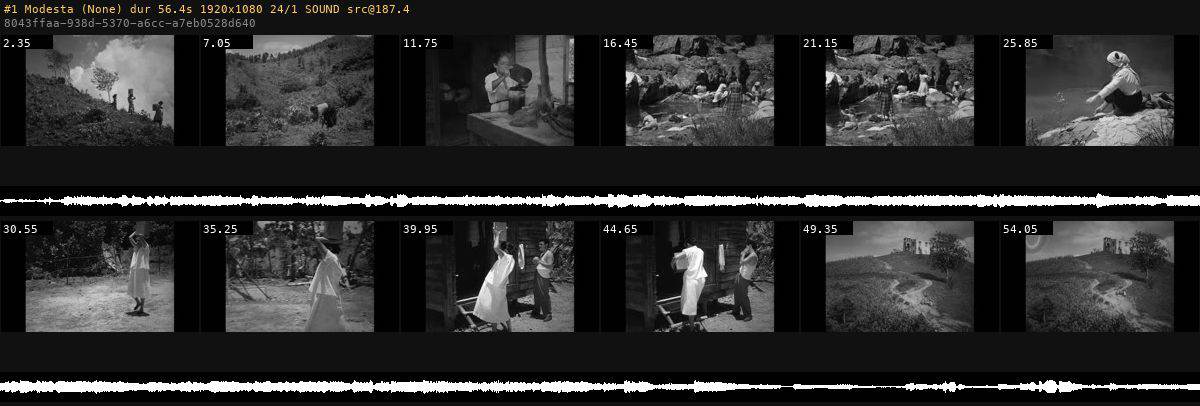
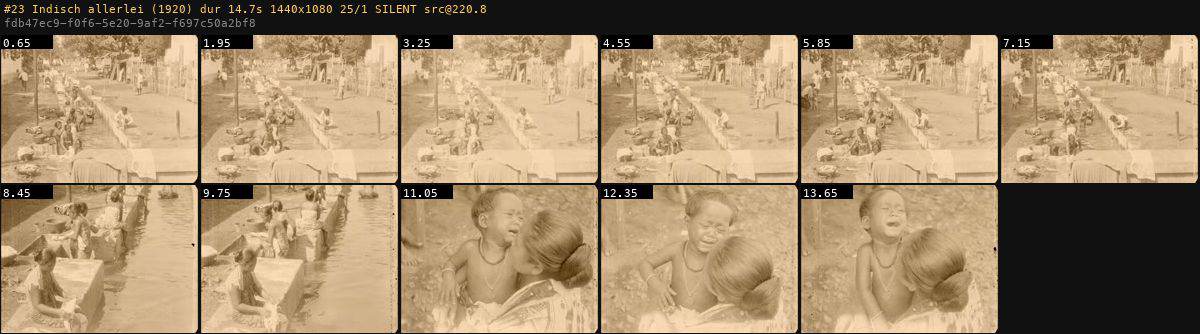
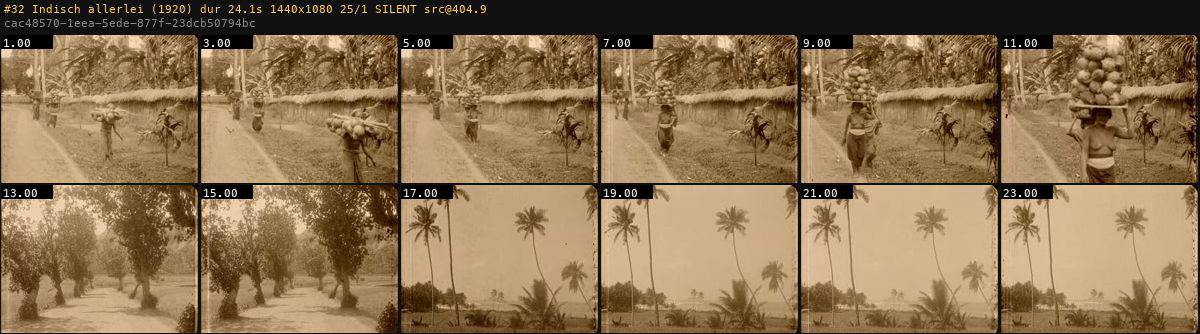
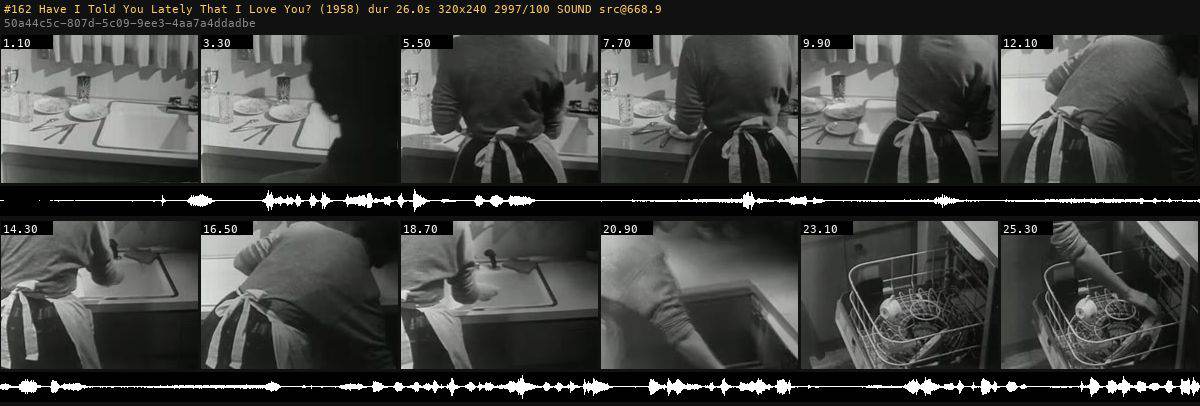
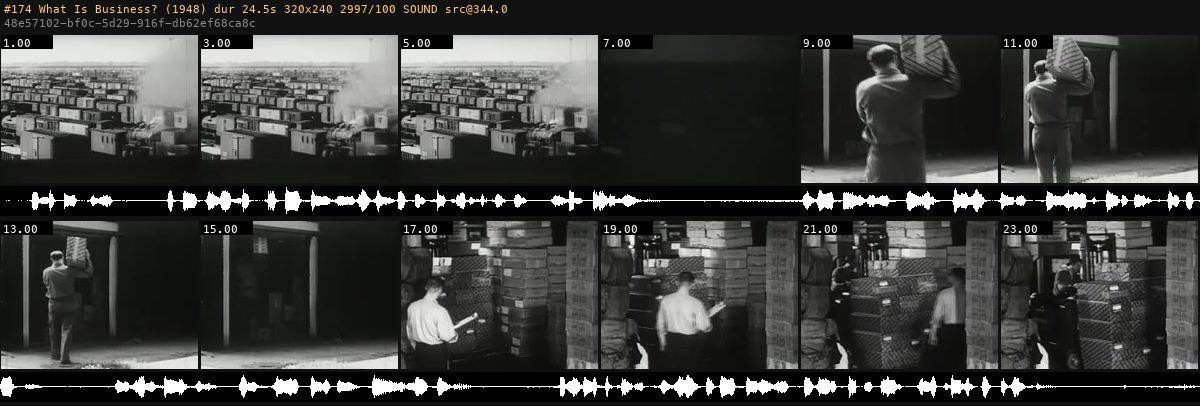
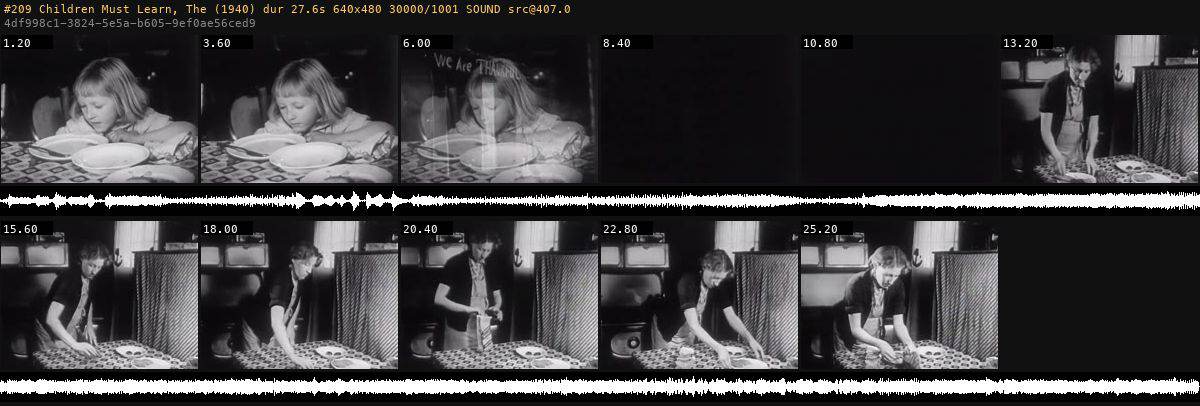
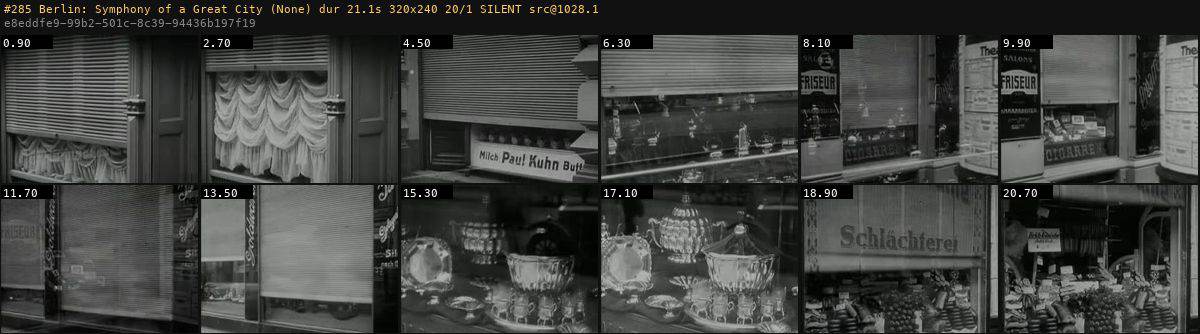
#1 Modesta (undated) · in the cut (shot 4, 7)#23 Indisch allerlei (1920) · in the cut (shot 5, 6)#32 Indisch allerlei (1920) · in the cut (shot 8)#162 Have I Told You Lately That I Love You? (1958) · in the cut (shot 3, 9)#174 What Is Business? (1948) · looked at, not used#209 Children Must Learn, The (1940) · in the cut (shot 1, 10)#285 Berlin: Symphony of a Great City (undated) · in the cut (shot 2)
5 The cut
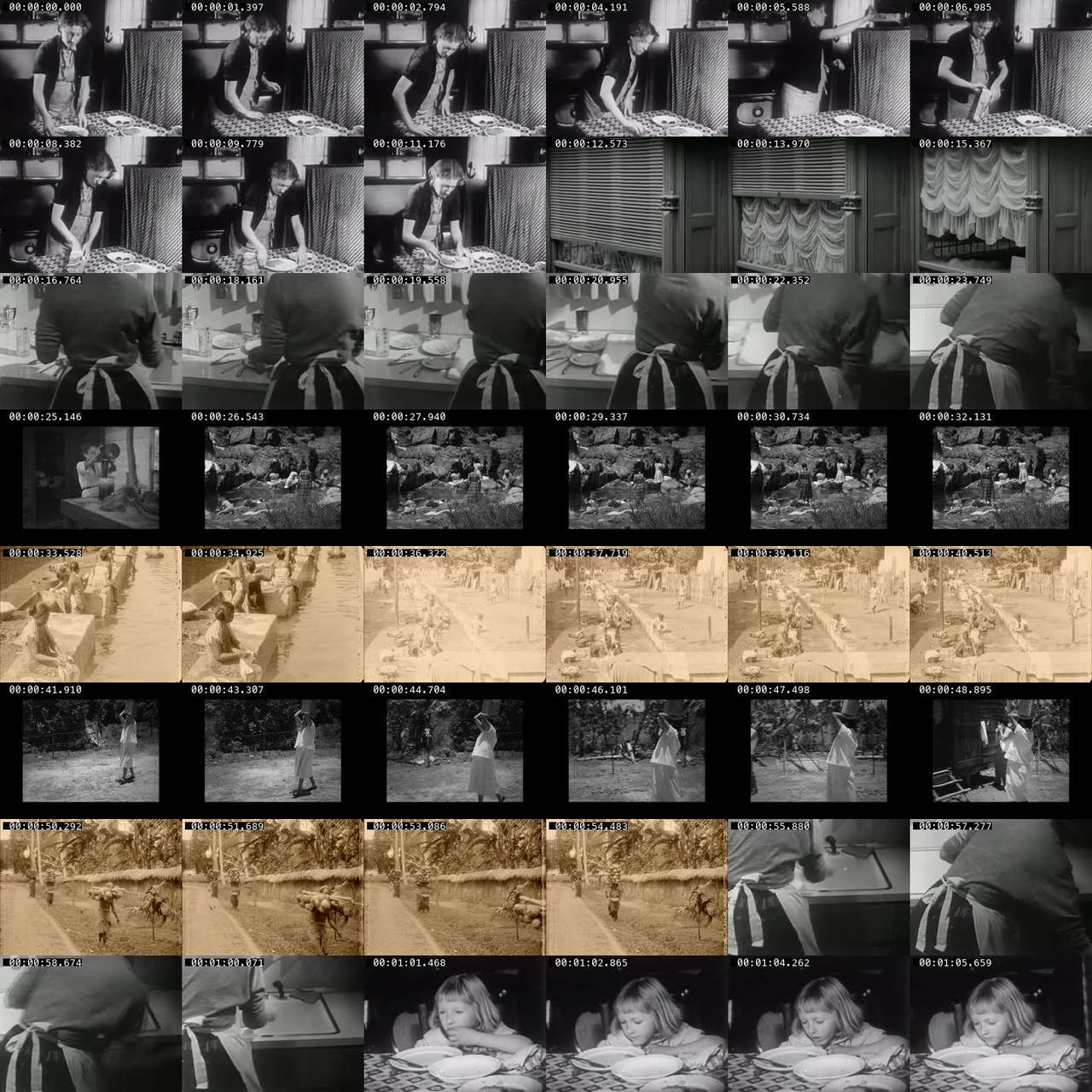
The finished film, shot by shot (first, middle and last frame of each):
The final cut as a contact sheet
Every shot, where it came from, and why it is here. Source seconds are in the original film. Links go to the archive's own copy of the clip.
sound: Children Must Learn, The (1940) 429.6–433.0
1028.4–1031.8
second participant, whoever raises this blind in Berlin; never seen. Silent source, room sound carried over from the table so the seam is audible as a borrowing.
handoff on water: sink to river, Modesta, undated in the archive. Women washing together, not one woman alone: the bigger frame already changes the job.
return to the first film after its job: what she laid is now under a child's elbows. A different pace, and this film's own boast about pioneers, which the morning has not earned.
6 Review
A fresh agent was given only a timecoded contact sheet of the film, a transcript with loudness, and the brief. Not the edit list, the ledger, or these reasons. It cannot hear.
Round 1 inconclusive, leaning reference stronger
independent critic (fresh Claude Sonnet 5.5 agent). Its report, verbatim:
The report
VERDICT: inconclusive, leaning reference stronger. I can't hear the film. Loudness and speech are the only audio evidence, and the speech is partly suspect.

Noticed before the brief: 00:12.6-15.4 shows a cupboard shutter rising to reveal a ruched curtain. It is a clean, specific motion, but it is only decoration between two kitchen shots. At 00:25.1 a woman lifts a vessel in a small black-boxed frame, then holds on laundry at a stream (26.5-32.1). That is the strongest handoff. It sits next to "Oh, my God" at 27.6-31.2, which is possibly a false transcription.

Largest gap: the brief asks for five distinguishable participants, and the sheet shows only about three. Two are the same American kitchen woman, and the rest are washing, carrying and coconut-hauling extras with no identification. Sepia and b/w stock changes carry the difference. Nothing visible signals "editorial construction". The English dialogue at 16-20 and 58-62 belongs to the kitchen footage, so it plays over the other cultures' action.

Repairs:
1. Put an identity cue (a text or voice marker) on each participant in 25.1-32.1, 33.5-40.5, 41.9-48.9 and 50.3-54.5. Check: each block carries a distinct label.
2. At 58.7-62, remove the "new clothes" line, or move it clear of the sepia material. Check: no speech overlaps footage from another source.
3. Add a visible construction title or caption between 62 and 67.1. Check: the closing text names the day as assembled.

Strength to protect: the apron-back match cuts (16.8-24 into 55.9-60) and the return to the child at the table (61.5+), where the loudness lifts to about -23 dB.
Year and place captions were added to the first five shots and a closing card says the day is assembled. Still only about three distinguishable participants. As far as the ledger shows, the spoken lines sit on their own pictures (the kitchen and table clips), not on the other cultures' footage.
7 What happened
Repairs after review
Added year and place captions and the closing card.
What worked
Silent sources get another source's room sound under them; every borrowed bed is in the ledger.
A carrying shot is cut before the camera moves in on a bare-chested woman, which the source film chose and this film declines.
What failed
Five distinguishable participants were asked for; the cut has about three.
67 s against 120 s.
What is still open
A task left unfinished, explicitly (the sink shot leaves mid-sentence but is not marked).
A caption naming each handoff.
8 Files
edl.jsonedit list: every in, out, gain and reason, as written
ledger.jsonledger: each shot traced to its source seconds
 Argon