41 s · ends with a 5 s card naming every source. I cannot hear; neither could the critics. Sound is unjudged until a person listens.
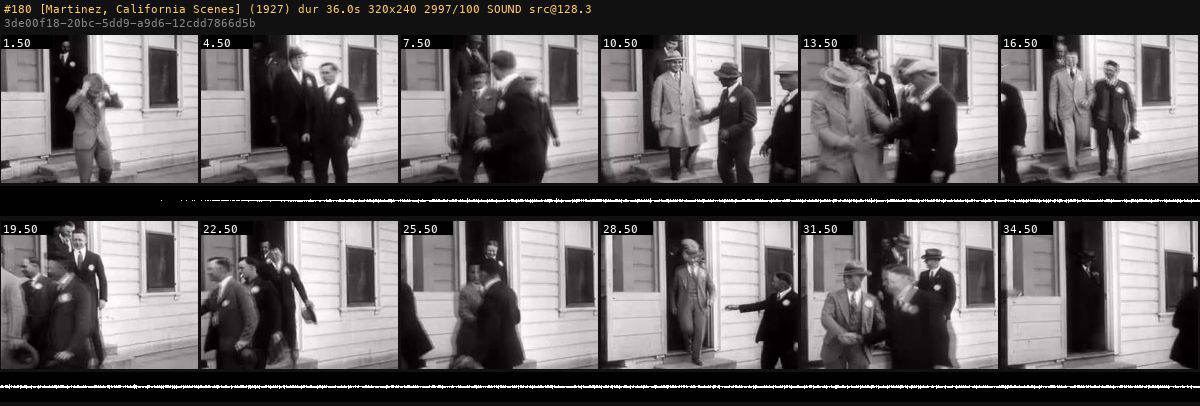
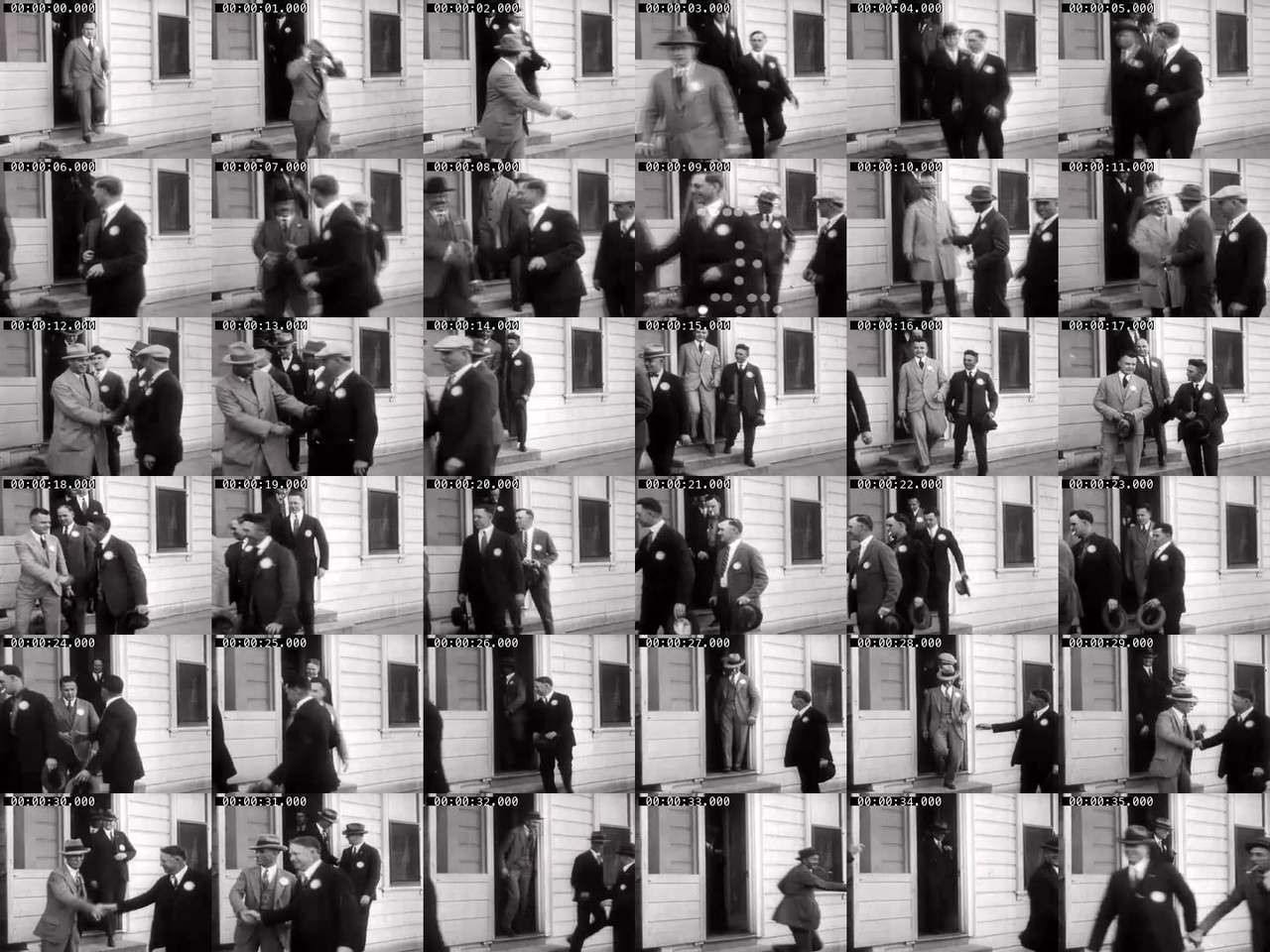
One camera, one doorway, Martinez, California, 1927. Men come out of a building and are stopped by others shaking hands in front of the door. One unbroken 36 seconds with only the source's own hiss, raised.
10searches
16filmstrips looked at
1shots
2review rounds
1 The brief
Locked-off images turn rooms and public spaces into stages where routine, background activity, and a small deviation become the event.
First proof. Stage or select one ninety-second fixed view of a room with two practical activities at different depths. Establish their ordinary relation before a small obstruction changes one person’s route. Hold the frame while the second activity continues, letting the viewer discover the conflict through timing and sound. End on the changed arrangement without a rescuing close-up. If staged, present it as fiction; if archival, preserve the actual action and camera behavior.
Development boundary. Static, centered, and planimetric are separate constraints. The fixed-view proof takes precedence over supporting operators that permit camera moves.
The operator’s acceptance criteria
The rule is legible from behavior with minimal exposition.
Pressure grows through interacting tasks rather than unrelated absurd details.
A viewer can discover more than one event within the sustained frame.
Deadpan timing retains practical stakes and does not become empty solemnity.
The final state differs materially from the opening arrangement.
2 The prompt
The method prompt for this run, followed by this film's inputs. Paste it into an agent with a shell, ffmpeg, a speech recognizer and image reading. It is a reconstruction of what the run did, written afterwards; the run itself began from a short request.
1,149 words
You are making one proof film for ALLWAYS (a cinema practice within PAELEO) from the Moving Image Archive (movingimagearchive.com; public-domain films, which the site says are free to reuse). You work as a hand editor.

"By hand" means: you search, you look at what came back, you listen, and you write every in-point, out-point, order, gain and reason yourself, in an edit list. Software renders the list; it never chooses a shot, a trim or a sound. Do not generate footage. Do not pick shots by similarity score. Do not run a pipeline that edits for you.

## Input

- `[FILM]` the title, concept, first proof and development boundary (below).
- `[OPERATOR]` the primary SCION operator and its acceptance criteria (below; the full prompt is at `operator.html#s<N>`).
- `[SOURCE SET]` the archive's search API: `POST https://www.movingimagearchive.com/api/search` with `{"query": "..."}` returns clips with `videoUrl`, `thumbnailUrl`, `startSeconds`, `endSeconds`, `sourceTitle`, `sourceYear`, `sourceSlug`. One request at a time, about 1.4 s apart; it rate-limits.
- `[DELIVERY]` one film, 4:3, with sound, no longer than the proof asks, plus the case-study folder described in `RUNS.md`.

## Process (do all of it, in order; keep what you make, including what fails)

1. **Read the proof.** Write the three to six specific things a viewer must be able to notice. These are what you will judge your own cut against.
2. **Forage.** Write 8 to 14 searches in plain visible-action language ("a woman adjusts her hat, looking at herself"), not themes. Run each, save the results, and make one numbered contact sheet per query (thumbnail, #number, duration, year, title). Look at every sheet.
3. **Look closer.** For each candidate, fetch the clip and make a time-coded filmstrip with its waveform. Find where the action starts, completes, and what follows it. Note the native size and whether it has sound.
4. **Listen.** Transcribe candidates with word timings. Speech recognition invents words in hiss ("Thank you."). Check against the waveform and loudness before believing a word. An invented word is never evidence. If you cannot hear audio, say so in the case study and treat sound decisions as unverified.
5. **Write the edit list.** For each shot: clip number, in, out, gain, any sound taken from another clip (with its source), speed, hold, caption, and one sentence of reason that a reader could disagree with. Sound or captions from another source go in the ledger as such.
6. **Render, then check the render.** Make a contact sheet of every shot's head, middle and tail; transcribe the render; measure loudness per shot. Fix what you find. Known traps: a clip's closing cut can show up in your trim; holding a last frame can freeze the next shot of the source.
7. **Disclose derived layers.** If you remove, extend, generate, retime, mirror, or re-voice anything: keep the original, mark the derived layer on screen or in the ledger, and say what is unknown. Authored narration is labelled invented and synthetic.
8. **Blind critic.** Give a fresh agent only: a timecoded contact sheet of the final film, a transcript with loudness per 2 s, and the film's brief and acceptance criteria. Not your edit list, ledger, reasons or summaries. It names one specific event before it reads the brief. It returns a verdict (pass / reference stronger / inconclusive), the largest gap, up to three repairs each with a timecode and a checkable condition, and one strength to protect. It cannot hear: take no sound verdicts from it, and check its claims against the cut before obeying them.
9. **Repair what is true; leave what is wrong and say so.** If you changed the film, ask a new critic. Stop when you can say honestly what still falls short of the brief.
10. **Package** the case study per `RUNS.md`: searches and sheets, strips, the edit list with reasons, the ledger, the critic packets and verbatim reports, repairs, and what is open.

## Rules

- Status is not self-awarded. A film is "proof in progress" unless a blind critic passed it; "released" is for a person to say.
- Unknown dates and names stay unknown. Never imply two clips recorded the same event.
- Do not make assembled speech look like a speaker's own statement.
- Say what you could not perceive. A maker that cannot hear, or cannot see motion, must say so, because it changes what the cut proves.

## Tools (in `tools/`; Python 3, ffmpeg, Pillow, numpy)

- `forage.py <film> "query" ...` runs searches one at a time, writes `forage.json` and a contact sheet per query.
- `look.py <film> <n>[:step[:in:out]] ...` makes a time-coded filmstrip with waveform for clip #n.
- `hear.py <film> <n> ...` word timings (needs `mlx_whisper`, Apple silicon; substitute any word-timing ASR).
- `beats.py <film> <n> <in> <out>` motion-energy peaks, a helper for the eye.
- `cut.py <film>` renders `edl.json`; it chooses nothing. `pairs.py <film>` renders side-by-side pairs from `pairs.json`.
- `reel.py <film>` contact sheet of the rendered film, shot by shot.
- `packet.py <film>` builds what the critic gets.
- `erase.py` + `erase_plate.py` person removal for NOBODY HOME (SAM 2.1 tracked mask; replacement pixels from the same shot; unknowns listed). Set `SAM2_ROOT` to a folder with `models/sam2.1_hiera_small.pt`.
- `speak.py` authored narration with Kokoro-82M. `adopt.py` brings clips found in a local word index into a film's forage (set `CINEOSIS_LAB`).

---

## This film

**Title:** PLANIMETRIC (Held frames)

**Concept:** Locked-off images turn rooms and public spaces into stages where routine, background activity, and a small deviation become the event.

**First proof:** Stage or select one ninety-second fixed view of a room with two practical activities at different depths. Establish their ordinary relation before a small obstruction changes one person’s route. Hold the frame while the second activity continues, letting the viewer discover the conflict through timing and sound. End on the changed arrangement without a rescuing close-up. If staged, present it as fiction; if archival, preserve the actual action and camera behavior.

**Development boundary:** Static, centered, and planimetric are separate constraints. The fixed-view proof takes precedence over supporting operators that permit camera moves.

**Primary operator:** SCION 86 · Songs from the Second Floor — A Tableau That Accumulates Pressure. Full operator prompt: https://hartswf0.github.io/bolas/paeleo/allways/operator.html#s86
**Supporting:** SCION 85 · Jeanne Dielman — Routine as a Sensitive Measuring Instrument, SCION 89 · Wes Anderson / Robert Yeoman — Geometry That Times an Encounter

**Operator's creative theorem:** Let an ordinary institutional rule become absurd through simultaneous visible consequences inside one sustained tableau. The viewer should discover where pressure accumulates without a cut, zoom, or narrator ordering the sequence of attention.

**Acceptance criteria (from the operator):**
- The rule is legible from behavior with minimal exposition.
- Pressure grows through interacting tasks rather than unrelated absurd details.
- A viewer can discover more than one event within the sustained frame.
- Deadpan timing retains practical stakes and does not become empty solemnity.
- The final state differs materially from the opening arrangement.
3 What was searched
One search at a time, in plain visible-action language. Each sheet is what came back: numbered thumbnails with duration, year and title. These are the images the maker looked at (or, where it could not, see the note below).
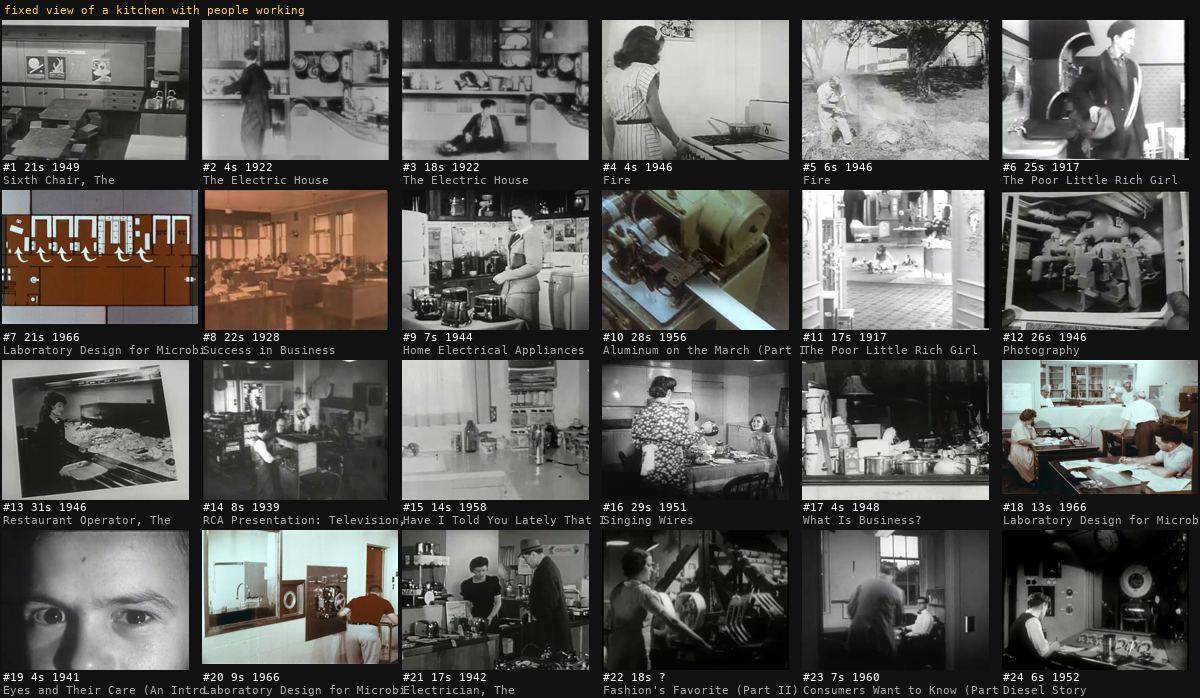
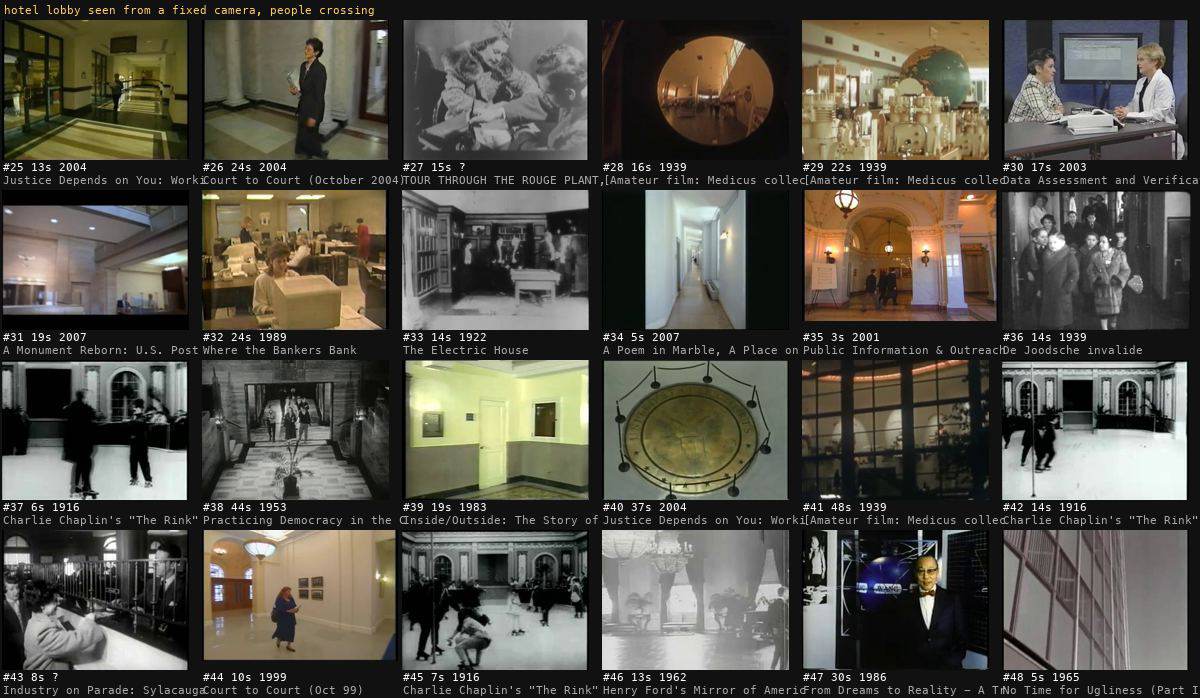
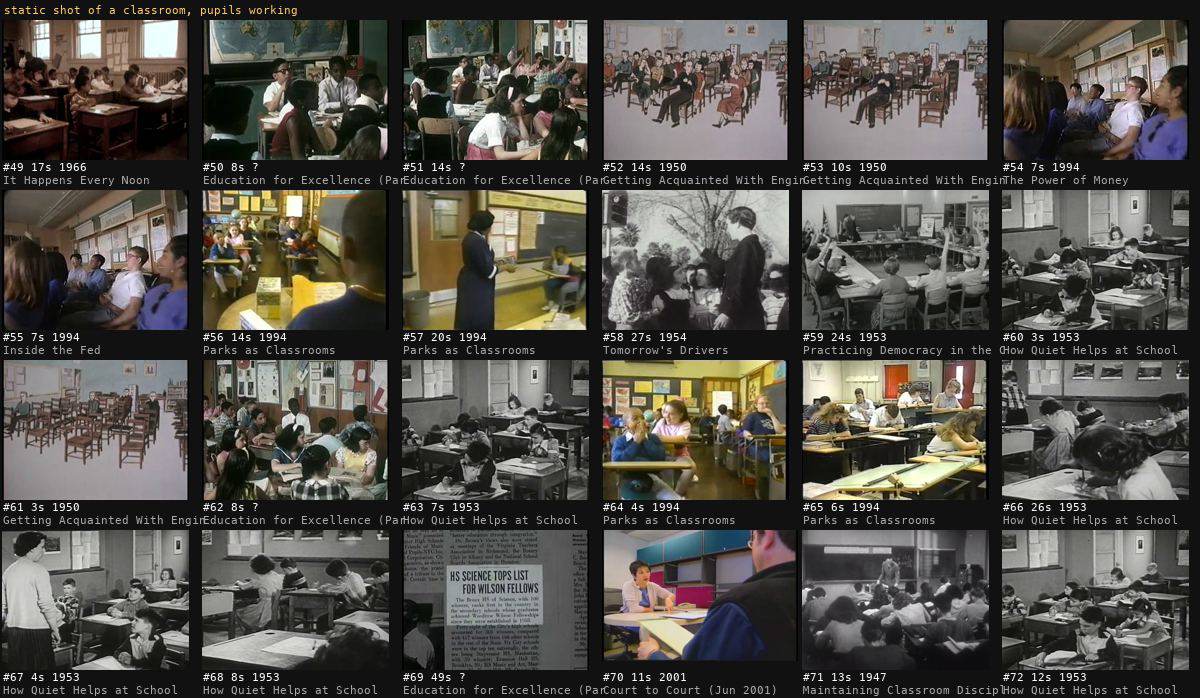
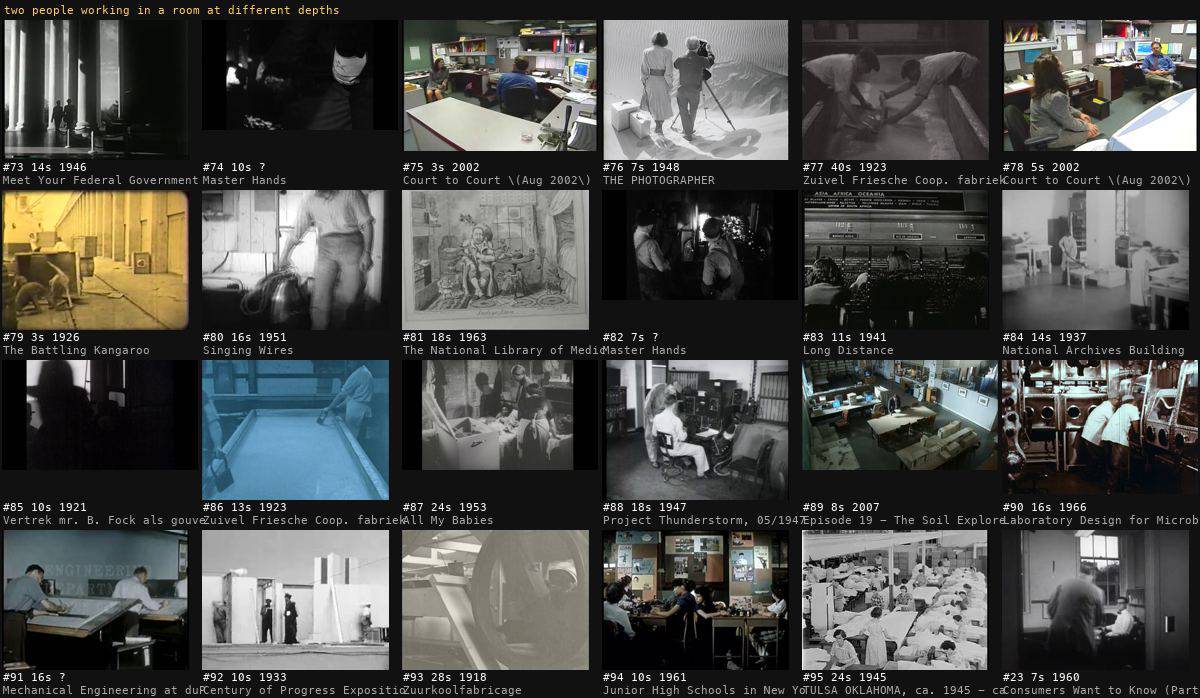
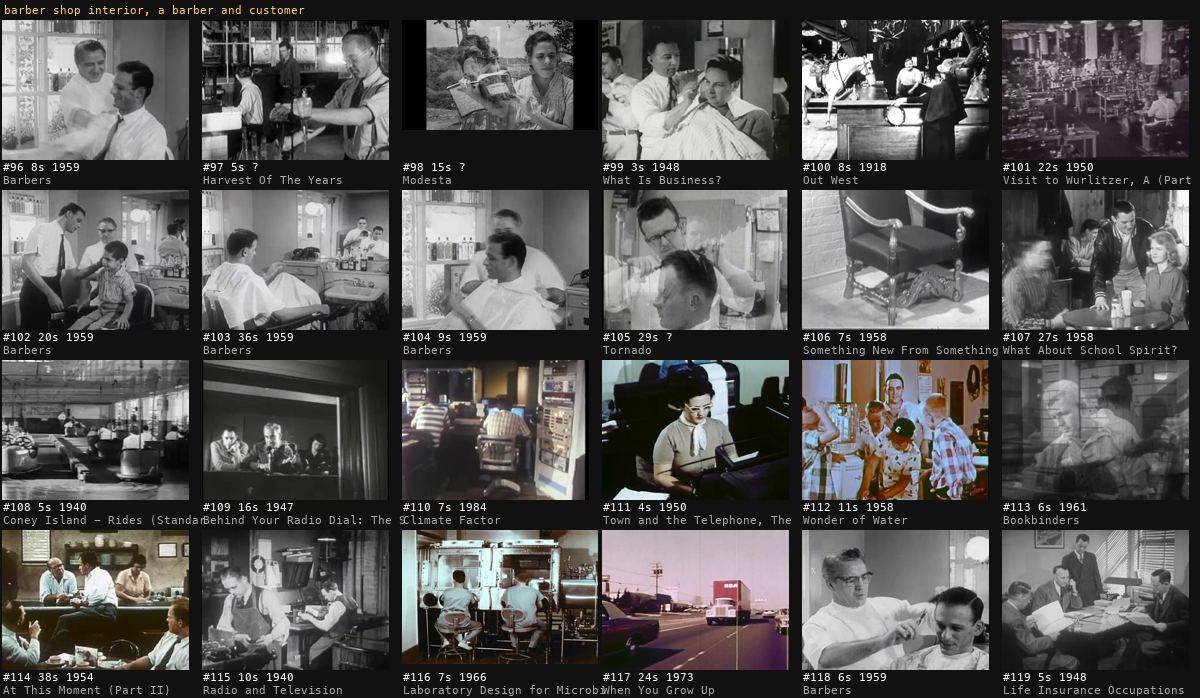
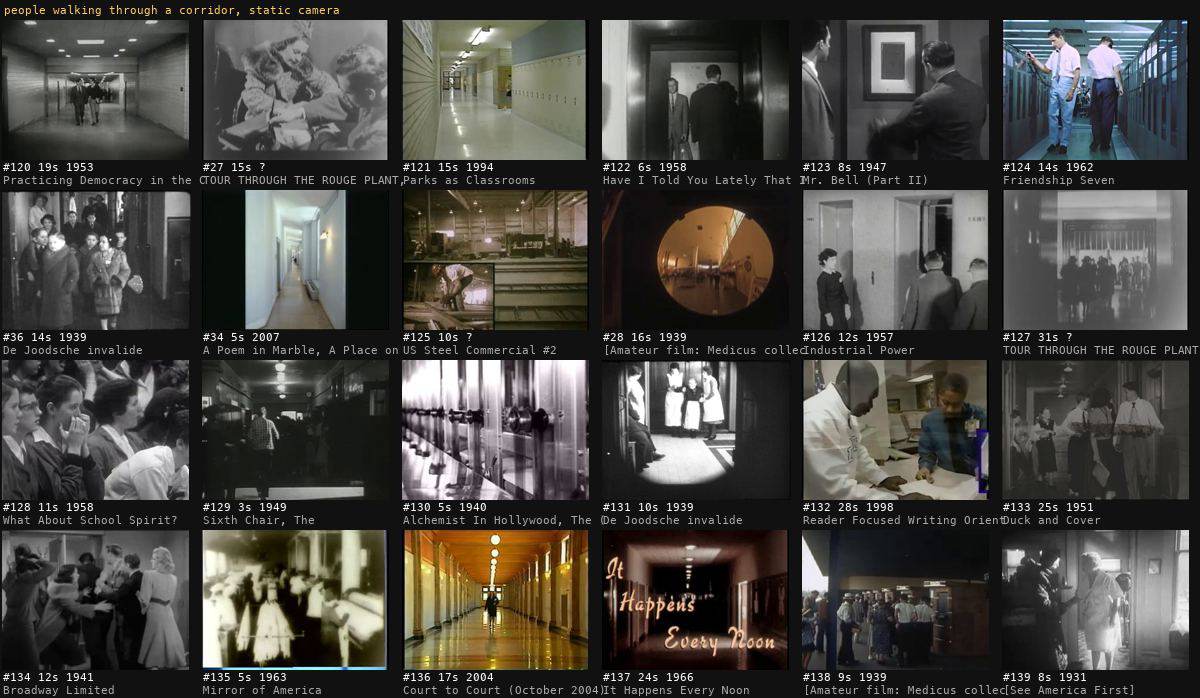
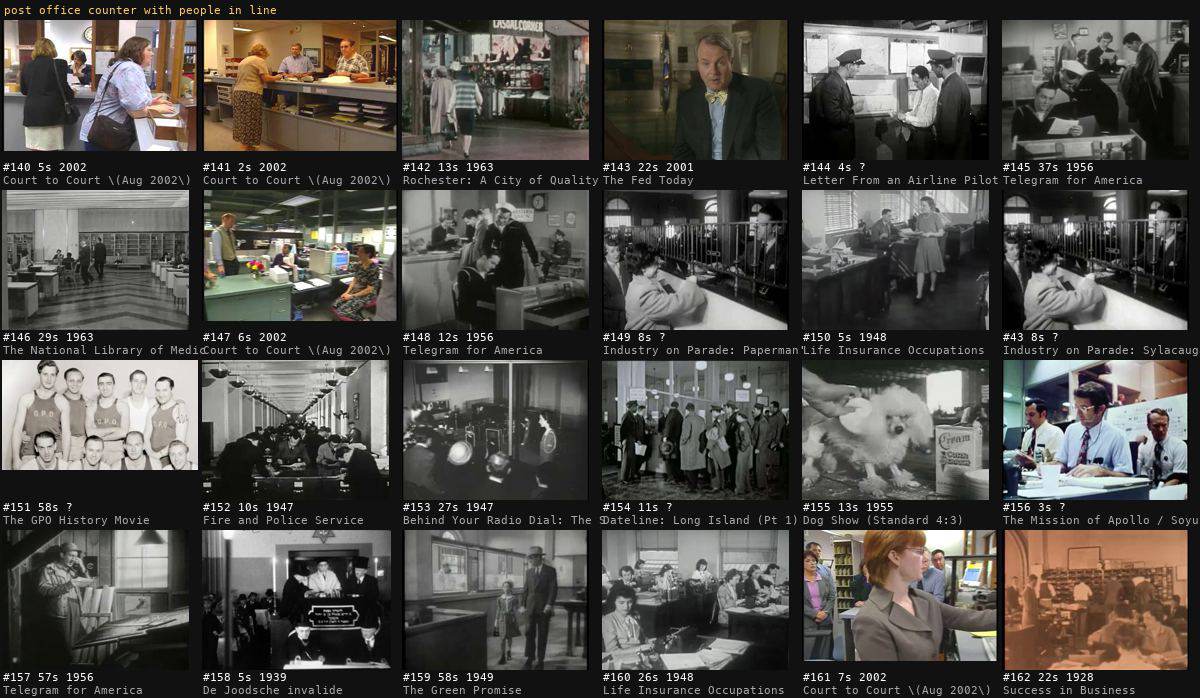
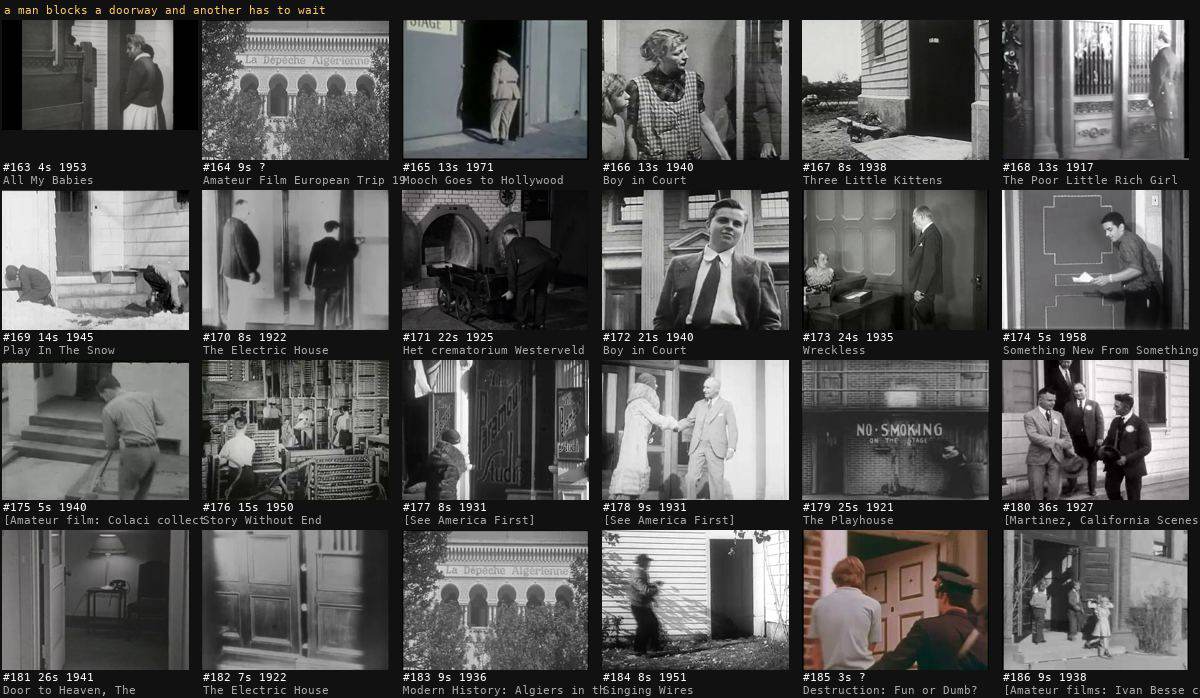
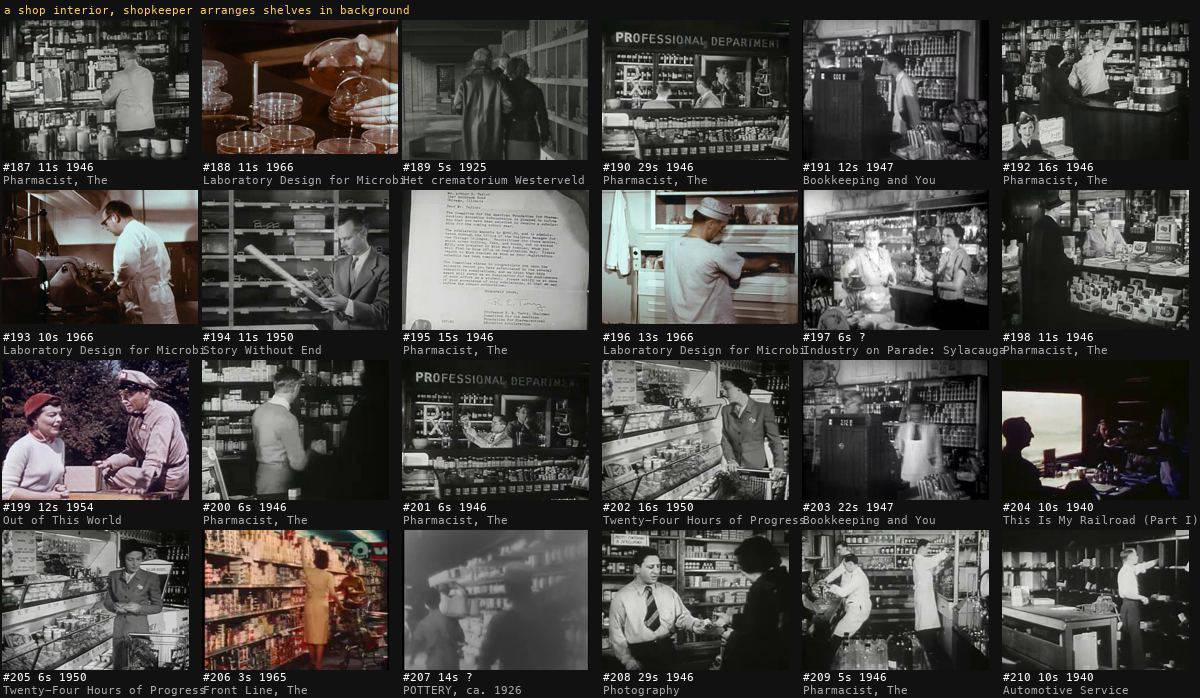
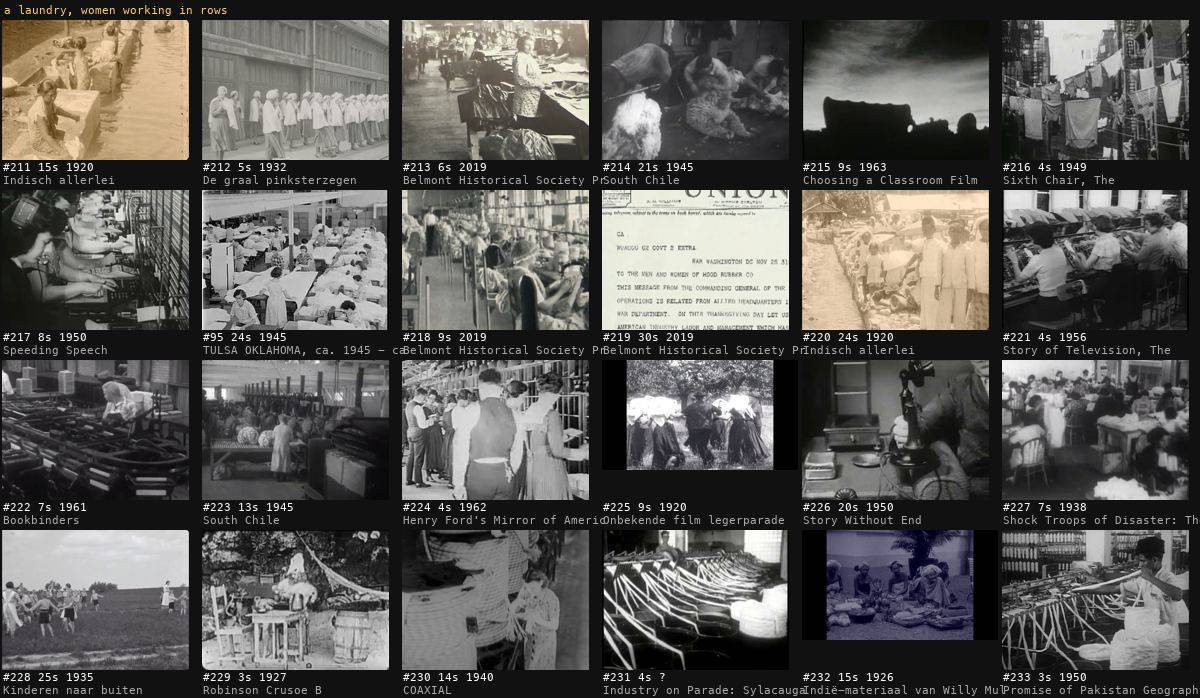
fixed view of a kitchen with people working · 24 resultshotel lobby seen from a fixed camera, people crossing · 24 resultsstatic shot of a classroom, pupils working · 24 resultstwo people working in a room at different depths · 24 resultsbarber shop interior, a barber and customer · 24 resultspeople walking through a corridor, static camera · 24 resultspost office counter with people in line · 24 resultsa man blocks a doorway and another has to wait · 24 resultsa shop interior, shopkeeper arranges shelves in background · 24 resultsa laundry, women working in rows · 24 results
4 What was looked at closely
A time-coded filmstrip and waveform for each candidate. Outlined strips are in the cut.
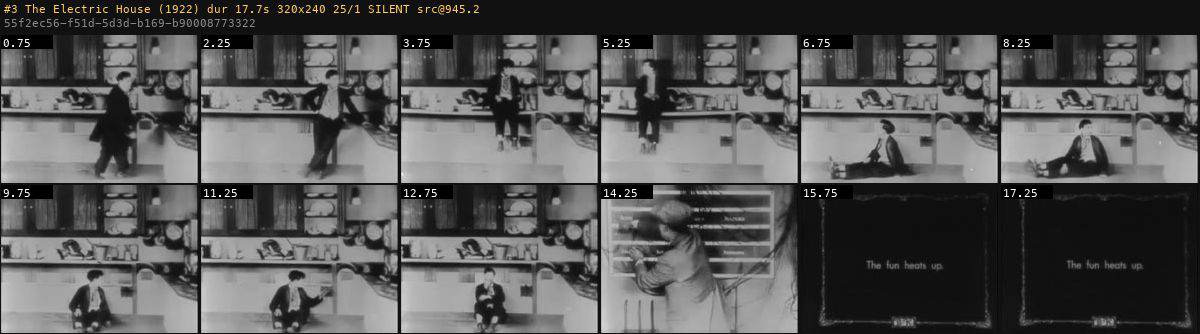
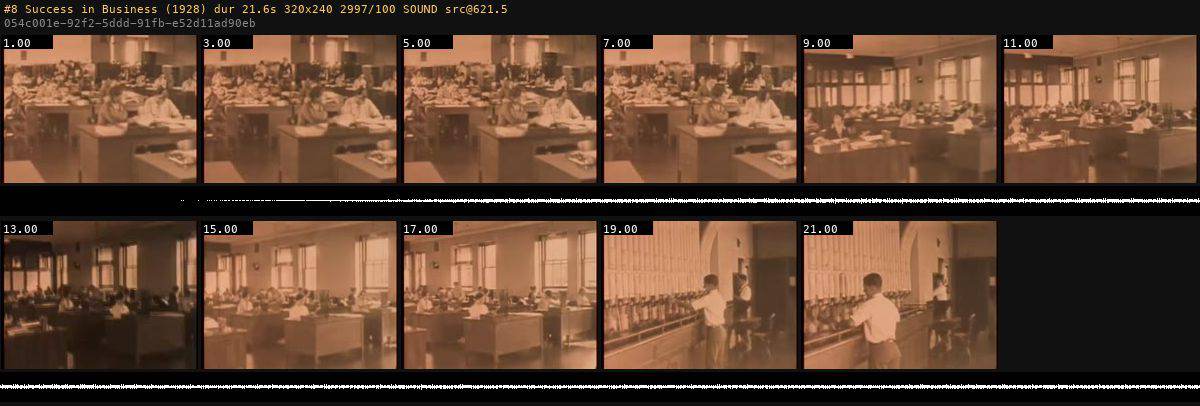
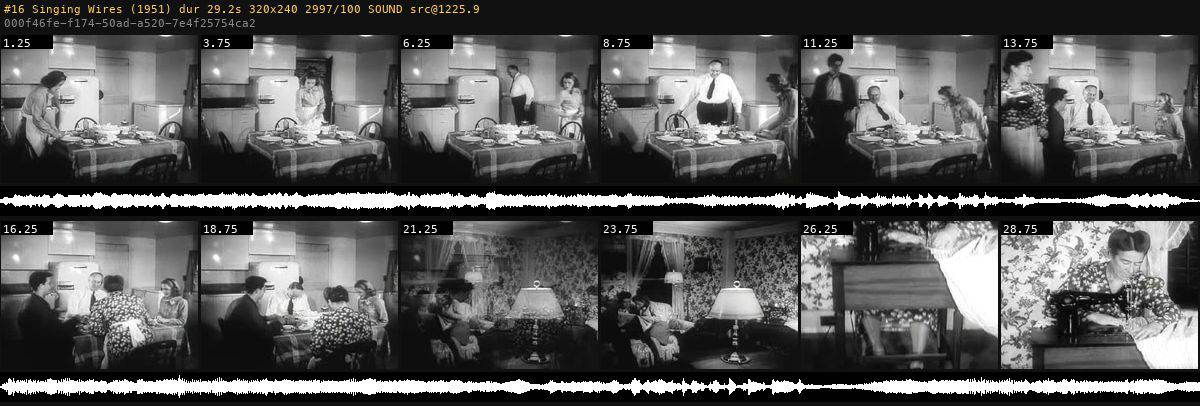
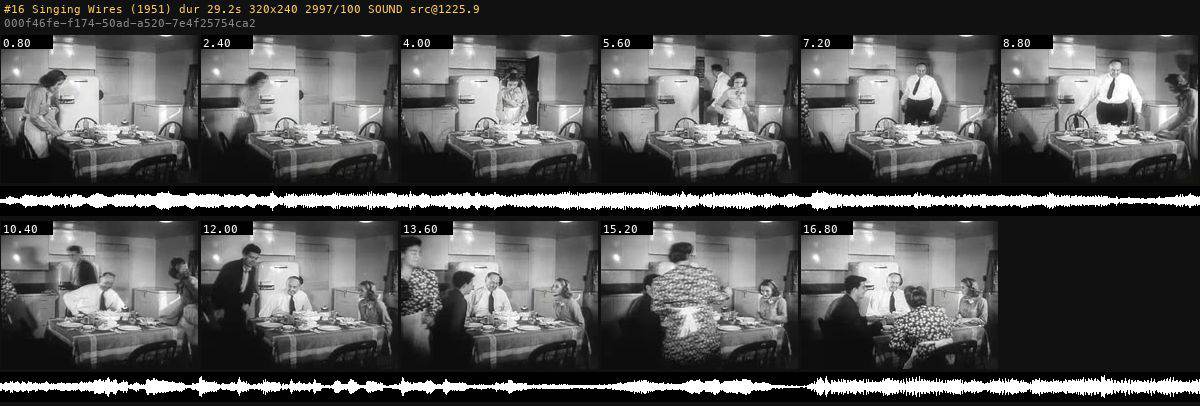
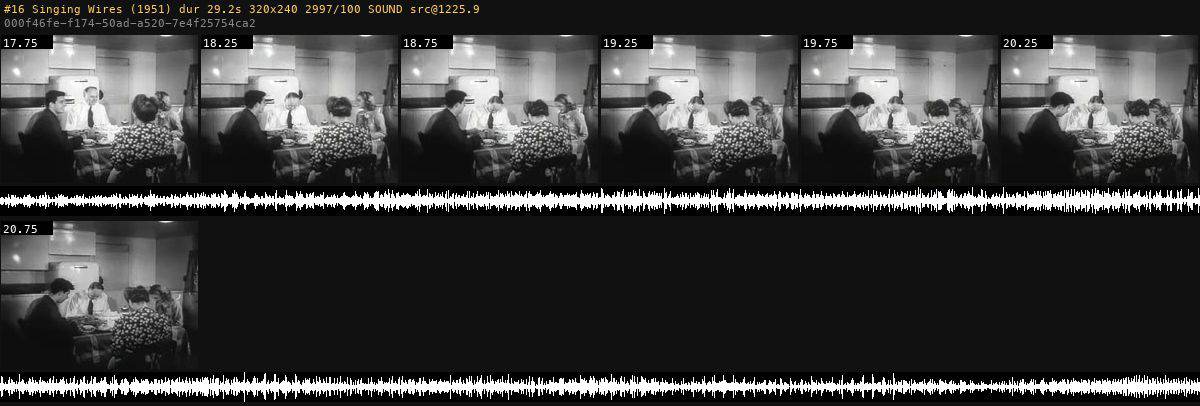
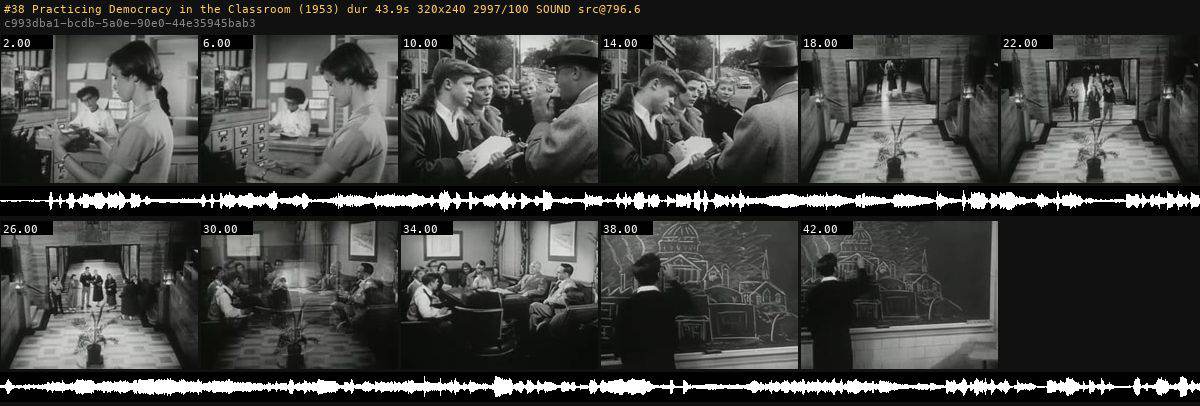
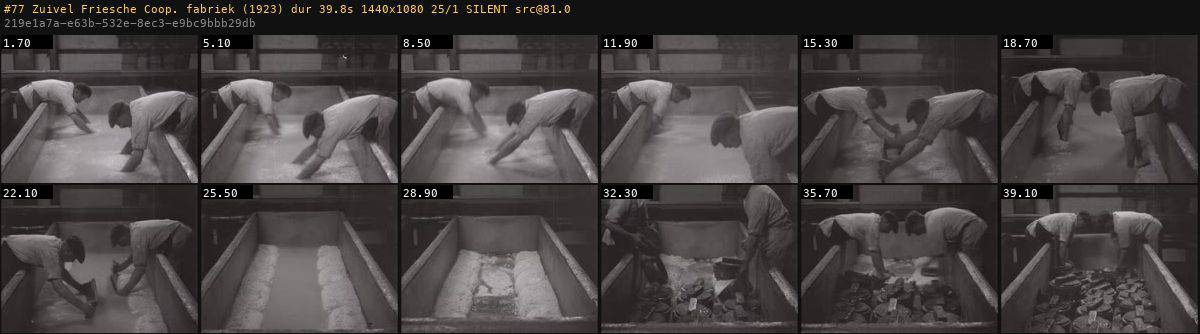
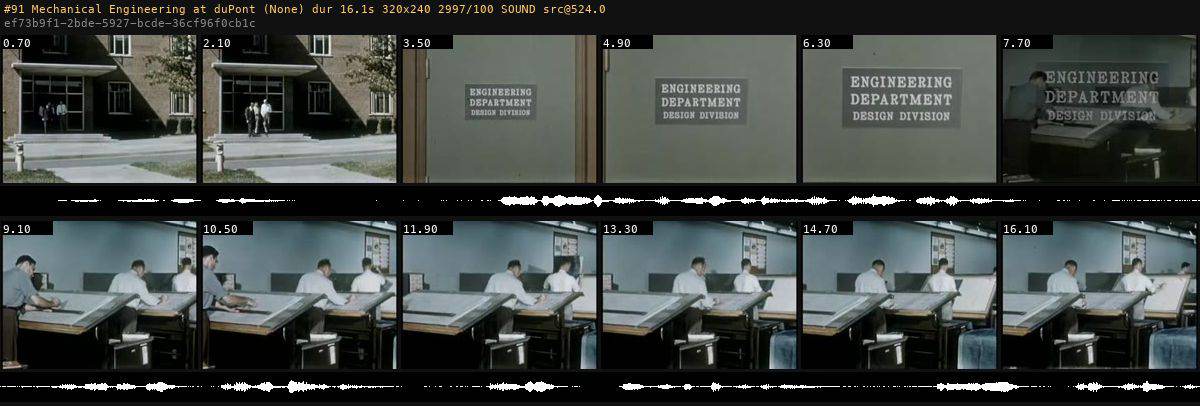
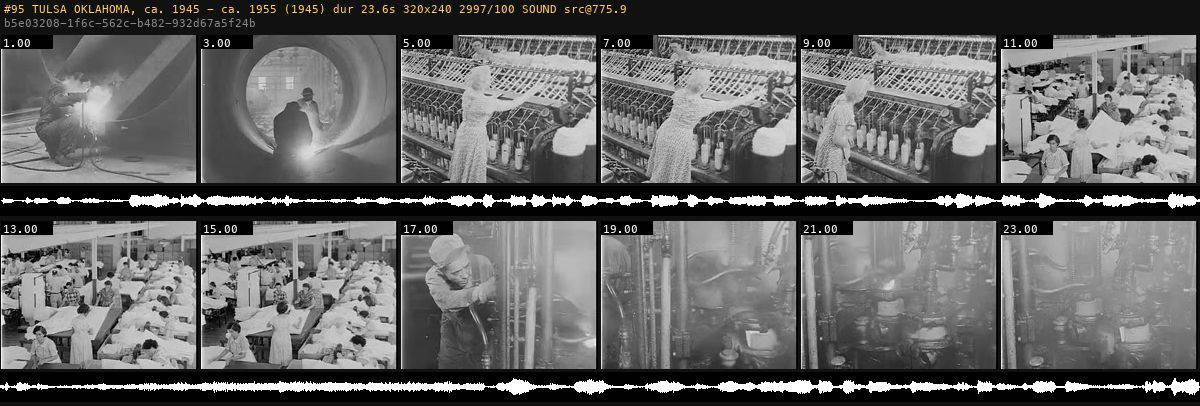
#3 The Electric House (1922) · looked at, not used#8 Success in Business (1928) · looked at, not used#13 Restaurant Operator, The (1946) · looked at, not used#16 Singing Wires (1951) · looked at, not used#16 Singing Wires (1951) · looked at, not used#16 Singing Wires (1951) · looked at, not used#38 Practicing Democracy in the Classroom (1953) · looked at, not used#77 Zuivel Friesche Coop. fabriek (1923) · looked at, not used#91 Mechanical Engineering at duPont (undated) · looked at, not used#95 TULSA OKLAHOMA, ca. 1945 - ca. 1955 (1945) · looked at, not used#103 Barbers (1959) · looked at, not used#151 The GPO History Movie (undated) · looked at, not used#157 Telegram for America (1956) · looked at, not used#159 The Green Promise (1949) · looked at, not used#180 [Martinez, California Scenes] (1927) · in the cut (shot 1)#203 Bookkeeping and You (1947) · looked at, not used
5 The cut
The finished film, shot by shot (first, middle and last frame of each):
The final cut as a contact sheet
Every shot, where it came from, and why it is here. Source seconds are in the original film. Links go to the archive's own copy of the clip.
one amateur camera, one doorway, Martinez, California, 1927. Men come out of the door at the back and are stopped by others shaking hands in front of it; nobody planned the traffic. Thirty-six seconds is all the record holds; no rescue, no cut, hiss raised.
6 Review
A fresh agent was given only a timecoded contact sheet of the film, a transcript with loudness, and the brief. Not the edit list, the ledger, or these reasons. It cannot hear.
Round 1 inconclusive, leaning reference stronger
independent critic (fresh Claude Sonnet 5.5 agent). Its report, verbatim:
The report
VERDICT: inconclusive, leaning reference stronger. The sheet supports only about 20s of a 90s proof, and I can't hear the film.

Noticed before the brief: at 0:03-0:06 a woman sets the table while a man and a girl enter from a back doorway. By 0:11 the father is seated and the son stands at the table. The camera seems fixed with a slight drift. At 8.9-12.6 a narrator says "For once, Ma and Pa sat down to supper without being dog tired." That line explains the scene instead of letting timing carry it.

Largest gap: there is no obstruction and no second activity at a different depth. The scene is one ordinary routine, a family assembling for supper. The mother walks through the frame at 0:14-0:17 and sits, which looks like ordinary blocking, not a deviation. At 0:18-0:19 the frame shows a completed arrangement, but nothing suggests a conflict. Narration also directs attention, which the primary operator forbids.

Repairs:
1. Cut the voiceover line at 8.9-12.6. Condition: no narration over the held frame, and the viewer learns the "tired" premise from behavior.
2. Add a visible obstruction between 0:06 and 0:12, such as the son blocking the mother's route. Condition: one person's path visibly changes while another activity continues at a different depth.
3. Make the 0:18-0:19 state differ materially from 0:00, for example a vacated chair or an unserved plate. Condition: a frame comparison shows a change in arrangement beyond people sitting down.

Strength to protect: the locked, deep kitchen composition, with the table in the foreground and the doorway behind it. It lets entrances at different depths read within one frame.
This round's packet images were overwritten when the next round's packet was built, so they are not kept.
The builder, after reading it
True. The 1951 kitchen take was replaced rather than repaired: an obstruction cannot be staged in found footage, so the take itself had to change.
Round 2 reference stronger
independent critic (fresh Claude Sonnet 5.5 agent). Its report, verbatim:
The report
VERDICT: reference stronger (the film does not meet its brief; I could not judge sound, and the sheet shows no pass).

Before the brief: I saw a locked-off view of a white clapboard building. Men with lapel rosettes come out through the door and shake hands, one pair after another. At 00:09 a large white-dot overlay sits on one man's coat. It reads as a glitch or a stamp, not as part of the action. At 00:34 a man runs across the frame with his arm out. This is a convention-style exit, charming but repetitive.

Largest gap: the brief wants two activities at different depths, an obstruction that reroutes one person, and an ending that differs from the opening. The sheet shows one activity, in one plane, in a cycle that repeats from 00:00 to 00:35. Frame 00:35 is the same arrangement as 00:00. There is no second depth plane, no obstruction and no accumulating pressure. The loudness is flat at about -41 dB throughout, and the only speech is "We're here" at 0.0 and "This is the point" at 28.6. Both are probably false, and "This is the point" would be an unwanted narrator line if real. I can't hear the film, so I can't judge the sound-driven discovery the brief asks for.

Repairs:
1. Remove or justify the dot overlay at 00:09. Check: no non-photographic mark in any frame from 00:00 to 00:35.
2. Delete the speech at 0.0-0.7 and 28.6-30.0. Check: no recognized words in the transcript.
3. Stage a visible obstruction by 00:15 that changes one man's route. Check: by 00:35 the door area is arranged differently from 00:00.

Strength to protect: the locked camera and the rhythm of handshakes and hats at the doorway (00:12-00:19).
The 'white-dot overlay' at 9 s is a rosette on the men's lapels, in the source; the two recognised words are hiss. An obstruction cannot be added to a found take, so this take also falls short; a better one has to be foraged.
7 What happened
Repairs after review
Replaced the supper with the doorway take.
What worked
Locked-off found footage with real traffic in a doorway; nothing is cut.
What failed
The first take (a 1951 family supper with a narrator) was rejected by the critic: no obstruction, narration directing attention. I replaced it instead of repairing it.
The second take shows one activity in one plane and repeats; no obstruction reroutes anyone.
36 s against 90 s.
What is still open
A better take: two activities at different depths and a small deviation, not a cycle.
8 Files
edl.jsonedit list: every in, out, gain and reason, as written
ledger.jsonledger: each shot traced to its source seconds

 Argon