115 s · ends with a 5 s card naming every source. I cannot hear; neither could the critics. Sound is unjudged until a person listens.
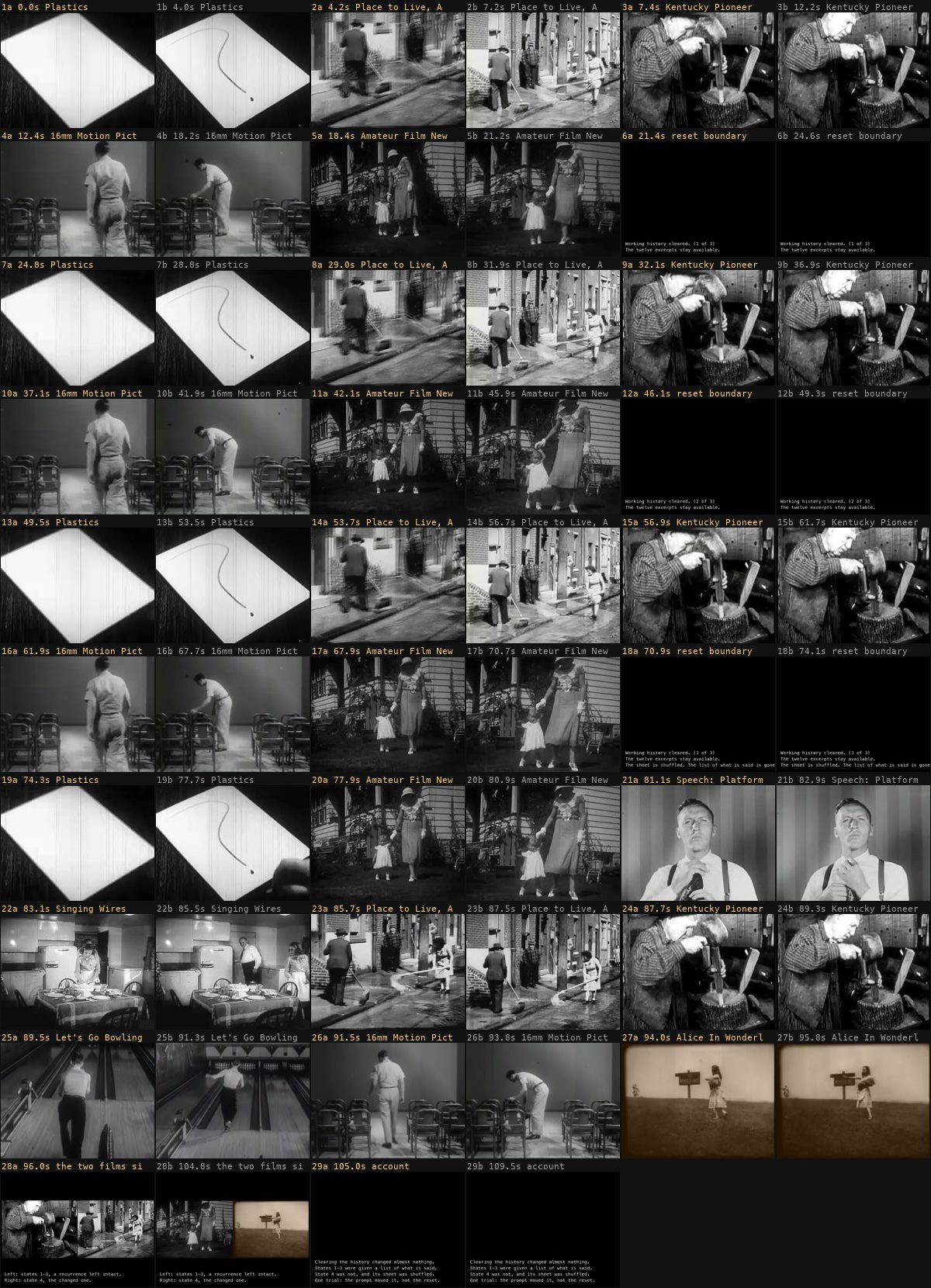
Fresh editors with no record of each other cut the same twelve excerpts. Three given a list of what each excerpt says made nearly the same five-excerpt film, which the film plays with a black card after each. A fifth editor, given a shuffled sheet and no list, made a different one, set beside the first.
29shots
2review rounds
1 The brief
An editor repeatedly forgets the sequence it has just made, while its archive remains available. The audience begins to remember more of the film than its maker.
First proof. Use a fixed collection of twelve short excerpts to build a ninety-second experiment. Give the editor access to the same collection throughout, but reset its declared working history at three visible boundaries. Keep a separate audit log inaccessible to that editing state. Allow repeated selections to remain, then place an intact recurrence beside a changed one in the final passage. Sound should make returning material recognizable without pretending that the underlying model has forgotten its training.
Development boundary. Requires a new memory-reset policy and external audit log. Persistent archive access, model training, working history, and the spectator’s memory are different things.
The operator’s acceptance criteria
The available media exceeds the budget, while reported exploration states match the actual route.
Pause visibly suspends both time and progression, with exit always usable.
The coda composes the actual route rather than inventing incompleteness or ending as an access error.
The untimed index offers a different way of attending without rewriting session results.
Adjustable audio remains intelligible; counts imply neither understanding nor a psychological diagnosis.
2 The prompt
The method prompt for this run, followed by this film's inputs. Paste it into an agent with a shell, ffmpeg, a speech recognizer and image reading. It is a reconstruction of what the run did, written afterwards; the run itself began from a short request.
1,164 words
You are making one proof film for ALLWAYS (a cinema practice within PAELEO) from the Moving Image Archive (movingimagearchive.com; public-domain films, which the site says are free to reuse). You work as a hand editor.

"By hand" means: you search, you look at what came back, you listen, and you write every in-point, out-point, order, gain and reason yourself, in an edit list. Software renders the list; it never chooses a shot, a trim or a sound. Do not generate footage. Do not pick shots by similarity score. Do not run a pipeline that edits for you.

## Input

- `[FILM]` the title, concept, first proof and development boundary (below).
- `[OPERATOR]` the primary SCION operator and its acceptance criteria (below; the full prompt is at `operator.html#s<N>`).
- `[SOURCE SET]` the archive's search API: `POST https://www.movingimagearchive.com/api/search` with `{"query": "..."}` returns clips with `videoUrl`, `thumbnailUrl`, `startSeconds`, `endSeconds`, `sourceTitle`, `sourceYear`, `sourceSlug`. One request at a time, about 1.4 s apart; it rate-limits.
- `[DELIVERY]` one film, 4:3, with sound, no longer than the proof asks, plus the case-study folder described in `RUNS.md`.

## Process (do all of it, in order; keep what you make, including what fails)

1. **Read the proof.** Write the three to six specific things a viewer must be able to notice. These are what you will judge your own cut against.
2. **Forage.** Write 8 to 14 searches in plain visible-action language ("a woman adjusts her hat, looking at herself"), not themes. Run each, save the results, and make one numbered contact sheet per query (thumbnail, #number, duration, year, title). Look at every sheet.
3. **Look closer.** For each candidate, fetch the clip and make a time-coded filmstrip with its waveform. Find where the action starts, completes, and what follows it. Note the native size and whether it has sound.
4. **Listen.** Transcribe candidates with word timings. Speech recognition invents words in hiss ("Thank you."). Check against the waveform and loudness before believing a word. An invented word is never evidence. If you cannot hear audio, say so in the case study and treat sound decisions as unverified.
5. **Write the edit list.** For each shot: clip number, in, out, gain, any sound taken from another clip (with its source), speed, hold, caption, and one sentence of reason that a reader could disagree with. Sound or captions from another source go in the ledger as such.
6. **Render, then check the render.** Make a contact sheet of every shot's head, middle and tail; transcribe the render; measure loudness per shot. Fix what you find. Known traps: a clip's closing cut can show up in your trim; holding a last frame can freeze the next shot of the source.
7. **Disclose derived layers.** If you remove, extend, generate, retime, mirror, or re-voice anything: keep the original, mark the derived layer on screen or in the ledger, and say what is unknown. Authored narration is labelled invented and synthetic.
8. **Blind critic.** Give a fresh agent only: a timecoded contact sheet of the final film, a transcript with loudness per 2 s, and the film's brief and acceptance criteria. Not your edit list, ledger, reasons or summaries. It names one specific event before it reads the brief. It returns a verdict (pass / reference stronger / inconclusive), the largest gap, up to three repairs each with a timecode and a checkable condition, and one strength to protect. It cannot hear: take no sound verdicts from it, and check its claims against the cut before obeying them.
9. **Repair what is true; leave what is wrong and say so.** If you changed the film, ask a new critic. Stop when you can say honestly what still falls short of the brief.
10. **Package** the case study per `RUNS.md`: searches and sheets, strips, the edit list with reasons, the ledger, the critic packets and verbatim reports, repairs, and what is open.

## Rules

- Status is not self-awarded. A film is "proof in progress" unless a blind critic passed it; "released" is for a person to say.
- Unknown dates and names stay unknown. Never imply two clips recorded the same event.
- Do not make assembled speech look like a speaker's own statement.
- Say what you could not perceive. A maker that cannot hear, or cannot see motion, must say so, because it changes what the cut proves.

## Tools (in `tools/`; Python 3, ffmpeg, Pillow, numpy)

- `forage.py <film> "query" ...` runs searches one at a time, writes `forage.json` and a contact sheet per query.
- `look.py <film> <n>[:step[:in:out]] ...` makes a time-coded filmstrip with waveform for clip #n.
- `hear.py <film> <n> ...` word timings (needs `mlx_whisper`, Apple silicon; substitute any word-timing ASR).
- `beats.py <film> <n> <in> <out>` motion-energy peaks, a helper for the eye.
- `cut.py <film>` renders `edl.json`; it chooses nothing. `pairs.py <film>` renders side-by-side pairs from `pairs.json`.
- `reel.py <film>` contact sheet of the rendered film, shot by shot.
- `packet.py <film>` builds what the critic gets.
- `erase.py` + `erase_plate.py` person removal for NOBODY HOME (SAM 2.1 tracked mask; replacement pixels from the same shot; unknowns listed). Set `SAM2_ROOT` to a folder with `models/sam2.1_hiera_small.pt`.
- `speak.py` authored narration with Kokoro-82M. `adopt.py` brings clips found in a local word index into a film's forage (set `CINEOSIS_LAB`).

---

## This film

**Title:** ZERO MEMORY (An editor forgets)

**Concept:** An editor repeatedly forgets the sequence it has just made, while its archive remains available. The audience begins to remember more of the film than its maker.

**First proof:** Use a fixed collection of twelve short excerpts to build a ninety-second experiment. Give the editor access to the same collection throughout, but reset its declared working history at three visible boundaries. Keep a separate audit log inaccessible to that editing state. Allow repeated selections to remain, then place an intact recurrence beside a changed one in the final passage. Sound should make returning material recognizable without pretending that the underlying model has forgotten its training.

**Development boundary:** Requires a new memory-reset policy and external audit log. Persistent archive access, model training, working history, and the spectator’s memory are different things.

**Primary operator:** SCION 106 · Network Effect — Bounded Attention, Unfinishable Archive. Full operator prompt: https://hartswf0.github.io/bolas/paeleo/allways/operator.html#s106
**Supporting:** SCION 67 · (nostalgia) — Anticipated Image, Vanishing Evidence

**Operator's creative theorem:** Make finite experience time confront more playable material than it can contain, then compose an ending from the visitor's actual route. Distinguish opening an item from completing its playback without claiming to measure attention or understanding.

**Acceptance criteria (from the operator):**
- The available media exceeds the budget, while reported exploration states match the actual route.
- Pause visibly suspends both time and progression, with exit always usable.
- The coda composes the actual route rather than inventing incompleteness or ending as an access error.
- The untimed index offers a different way of attending without rewriting session results.
- Adjustable audio remains intelligible; counts imply neither understanding nor a psychological diagnosis.
5 The cut
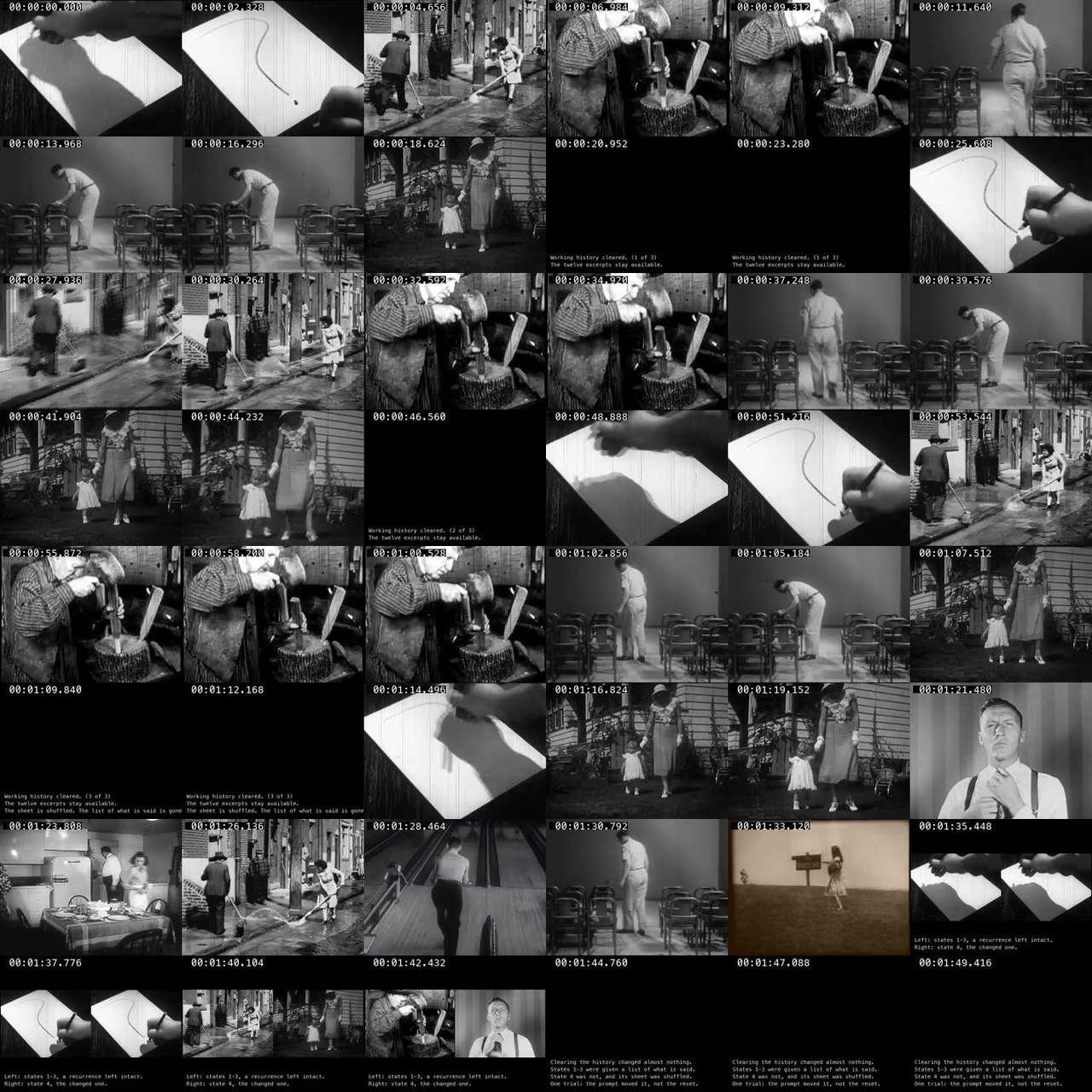
The finished film, shot by shot (first, middle and last frame of each):
The final cut as a contact sheet
Every shot, where it came from, and why it is here. Source seconds are in the original film. Links go to the archive's own copy of the clip.
sound: Amateur Film New Jersey B (undated) 220.3–222.3
293.1–295.1
state 4, shuffled, no word list, excerpt D: the editor's own choice, not mine; silent source, hiss from excerpt J
28
1:36.0 9.0s
the two films side by side undated
sound: both soundtracks, mixed
0.0–9.0
intact recurrence beside a changed one
29
1:45.0 4.7s
account undated
last frame held 2.5s
0.0–2.2
the account
The five editors
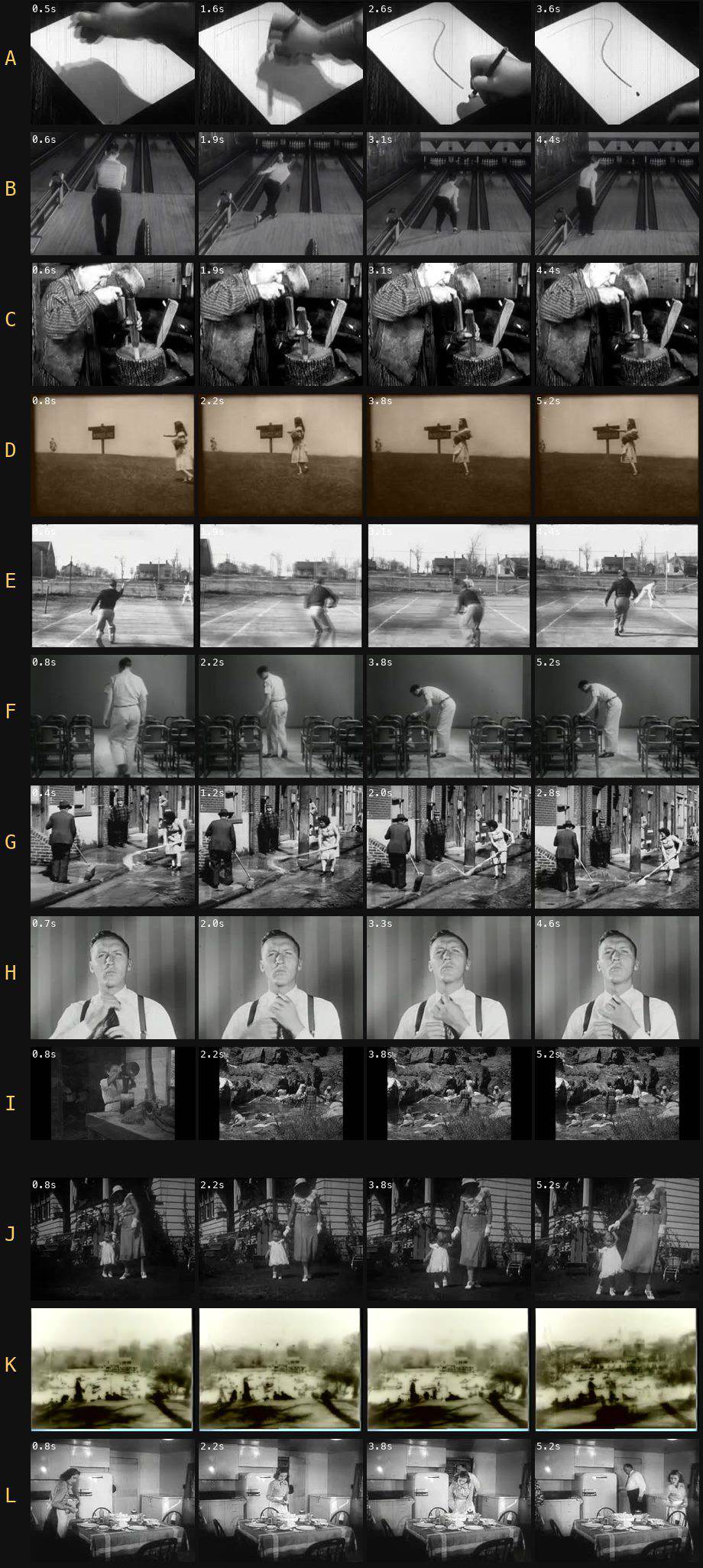
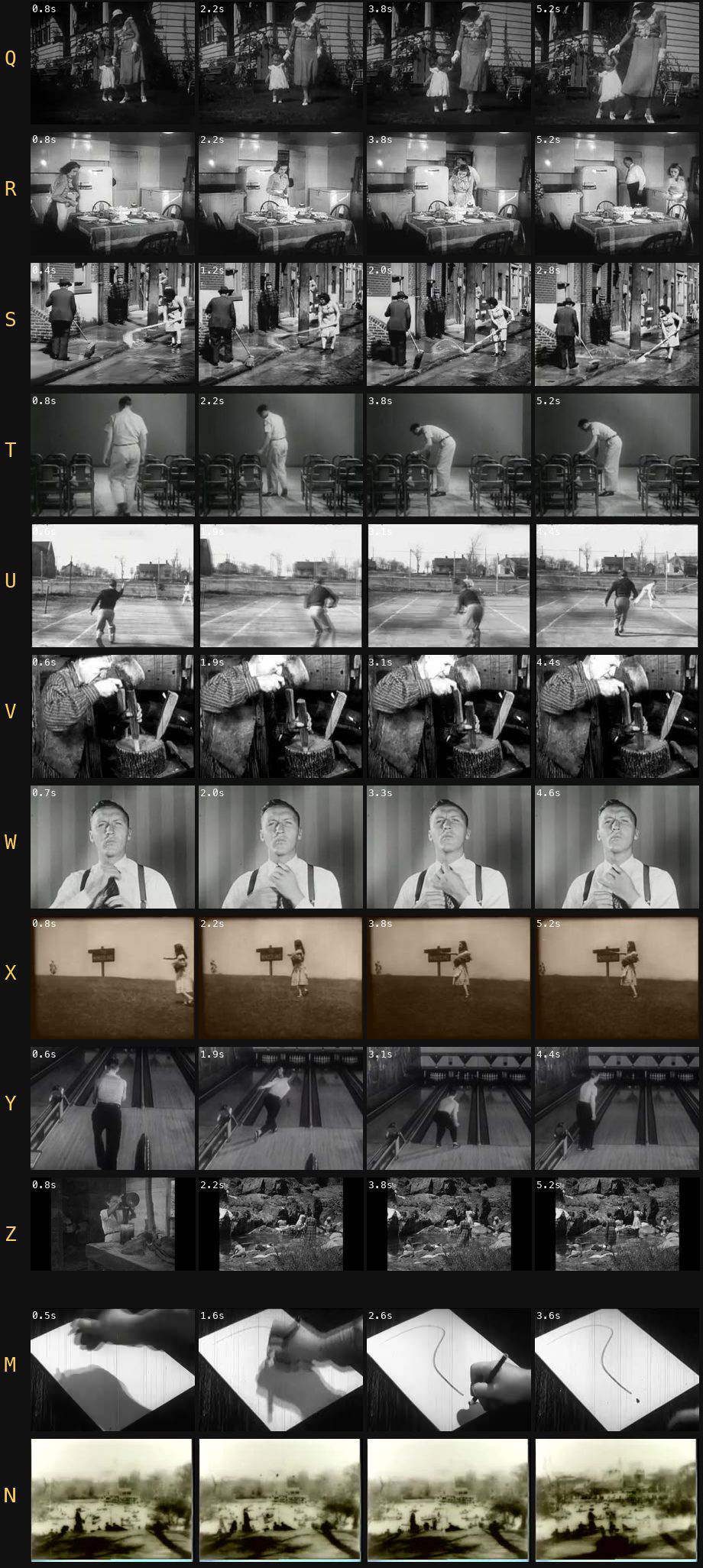
Each editor was a fresh agent with no record of any other. States 1-4 received a sheet of the twelve excerpts (below) plus a list of what is spoken in each. The control received the same excerpts on a shuffled, relabelled sheet with no list. Excerpt letters in the control row are mapped back to the collection's letters. State 4 gave the same answer as state 3, so the film plays states 1, 2, 3 and the control.
state
shots (excerpt, in-out in seconds)
the editor's reason
1
A 0-4.17, G 0-3.15, C 0-5, F 0-6, J 0.8-3.8
The voices chain into one mock-didactic question about what can be made from raw matter (plastics, then 'make out of this?' over street sweepings, then the carpenter's stool, then 'Seats' in an empty hall) until the talk stops and a mother and child walk silently toward the camera like the first audience arriving.
2
A 0-4.17, G 0-3.15, C 0-5, F 0-5, J 1.5-5.5
A hand draws a line from nothing and two voices ask what this stuff is and what anyone can make of it, the carpenter's stool and the man setting out 'Seats' answer with work, and the mother and child walking toward the camera in hiss are who it was all made for.
3
A 0-4.17, G 0-3.15, C 0-5, F 0-6, J 2.2-5.2
A hand's drawn line asks what plastics are and the sweepers ask what anyone can make out of this, then the answer comes as work (a stool, then a man setting rows of seats) before the talk stops and a child walks toward the camera in hiss, the one thing here nobody manufactured.
4
A 0-4.17, G 0-3.15, C 0-5, F 0-6, J 2.2-5.2
A chain of spoken questions and answers runs from the drawn line through the swept slum street to the carpenter's stool and the man setting out 'Seats', then the talk stops and a mother and child walk silently forward as if arriving as the audience for those chairs.
control
A 0-3.6, J 2-5.2, H 0.7-2.7, L 3-5.6, G 0.4-2.4, C 0.6-2.4, B 0.6-2.6, F 1.6-4.2, D 2.2-4.2
A hand draws a line and the film follows it through a day of small repeated gestures, from a child's first steps through dressing, kitchen, sweeping, hammering and bowling, with each downward stroke handing on to the next until a man stoops among empty chairs and a woman stands alone in an open field.
The collection:
A homonym, clip 13, source seconds 0.1-4.27
B split-second, clip 65, source seconds 14-19
C kinetic, clip 143, source seconds 1-6
D chase, clip 72, source seconds 0.7-6.7
E chase, clip 2, source seconds 5-10
F anybody, clip 46, source seconds 0.3-6.3
G anybody, clip 240, source seconds 1.15-4.3
H almost-human, clip 1, source seconds 29.9-35.2
I collective, clip 1, source seconds 14.5-20.5
J mnemonil, clip 74, source seconds 3-9
K terra, clip 38, source seconds 3-9
L planimetric, clip 16, source seconds 1-7
The sheet given to states 1-4.The shuffled sheet given to the control (letters Q-Z, M, N), no list of speech.
6 Review
A fresh agent was given only a timecoded contact sheet of the film, a transcript with loudness, and the brief. Not the edit list, the ledger, or these reasons. It cannot hear.
Round 1 inconclusive, leaning reference stronger
independent critic (fresh Claude Sonnet 5.5 agent). Its report, verbatim:
The report
VERDICT: inconclusive, leaning reference stronger. I cannot hear the film, so the sound requirement is unjudged.

Noticed before the brief: at 00:20.870, 00:45.914 and 01:08.871 the picture goes black and small caption text appears ("Working history cleared (1 of 3)", and so on). The same five excerpts then return in the same order: the pencil curve, street sweeping, mallet and wedge, the empty chairs, and the mother with the toddler. The captions at 01:31–01:36 say "five of twelve excerpts, in the same order, four times. Seven were never used."

Largest gap: the film shows loop, not forgetting. Four identical passes, with identical speech each time ("What are plastics?" at 0.0, 23.1, 46.9 and 70.3), mean there is no variation to compare. The brief's "intact recurrence beside a changed one" is barely visible. The only change I can see is the 01:15 street shot, which shows a different frame of the same shot. The twelve-excerpt archive is claimed in text only, since only five appear.

Repairs:
1. At 01:15.132–01:36.002, the final pass must hold one excerpt unchanged and one visibly altered, with a caption naming which is which. Check by frame-diffing it against the pass at 52.175.
2. At 20.870, 45.914 and 01:08.871, each reset card should hold at least 3s and read as legible, since it is currently tiny and low-contrast. Check that the text is at least about 4% of frame height.
3. Make each pass use at least one different excerpt of the twelve, in at least 2 of the 4 passes. Check by counting unique sources, which should be above 5.

Strength to protect: the black reset cards cut hard between the passes, and the identical opening line at each pass makes the return recognizable.
This round's packet images were overwritten when the next round's packet was built, so they are not kept.
The builder, after reading it
Fair: the first version was four passes of the same five excerpts. A fifth editor, given a shuffled sheet and no list of what is said, was added as the changed recurrence.
Round 2 reference stronger
independent critic (fresh Claude Sonnet 5.5 agent). Its report, verbatim:
The report
VERDICT: reference stronger (leaning inconclusive). I cannot hear the film; speech recognition in hiss may be false.

Noticed before the brief: at 0:20.9 to 0:23.3 the screen goes black with the text "Working history cleared. (1 of 3)". After it, the same cycle restarts. The drawn curve (0:00), the street sweepers, the carpenter and the chairs return in identical order at 0:25.6, 0:48.9 and 1:14.5. The transcript repeats "What are plastics?" at 0:24, 0:49, 1:14 and 1:35. The loop reads clearly, and the black cards act as the resets.

Largest gap: the changed state 4 is not legible. The final split screens (1:35 to 1:44) look nearly identical, left against right. The caption says "Clearing the history changed almost nothing", but the sheet shows no visible change to point to. Sound is also degraded and garbled by state 3 ("Retie", "come ball the brake ball"), with no sign this was meant. The film announces its finding instead of letting the viewer find it.

Repairs:
1. At 1:35.4 to 1:44.8, make the left and right panels differ in one checkable way, such as the order of two shots or the cut at 1:42.4. A viewer with the sound off should be able to name the difference.
2. At 1:09.8 to 1:14.5, hold the third reset card so the transcript at 1:12 to 1:14 matches it. Condition: ASR returns "plastics" cleanly after the reset.
3. At 1:44.8 to 1:51.7, the black final card sits over silence (-91 dB from 1:46). Cut it to 3 s or add a returning sound cue.

Protect: the identical black reset cards at 0:20.9, 0:46.6 and 1:09.8. They are the clearest recognition device in the film.
What the critic was given: the cut before the side-by-side was changed to the stretches where the two states differ. the contact sheet · the transcript.
The builder, after reading it
The side-by-side was changed after this round to show the stretches where state 1 and state 4 differ. The closing statement rests on one trial.
7 What happened
Repairs after review
Added the fifth editor with a shuffled sheet and no list.
Enlarged the reset cards and held them longer.
What worked
The four editors never saw each other's results or this film. Each answer is kept verbatim in audit/log.json.
The black reset cards and the identical first line make the recurrence recognisable.
What failed
I gave the first four editors a list of what is spoken in each excerpt. They built on it, so clearing their history changed almost nothing. The finding is about my prompt more than about forgetting.
The finding rests on one trial; the film says so.
What is still open
Repeat with several seeds, several models, and with and without the list.
Test what an editor does when the same history is cleared but the sheet is shuffled each time.
8 Files
edl.jsonedit list: every in, out, gain and reason, as written
ledger.jsonledger: each shot traced to its source seconds
 Argon