Symmetry
Three pairs of unrelated films side by side, lining up and then parting.
The operator’s theoremCreate a paired image that first satisfies an expectation of correspondence, then reveals a difference consequential enough to alter the relation. Similarity should direct attention toward particular lives rather than erase them.
critic review pending
54 s · 2,614 KB · found footage from movingimagearchive.com · source ledger
How it was made
- Forage10 shots from the notes appear below; 6 reached the cut.
- Choose6 source shots from 6 films, chosen from frames and sound levels.
- Cut7 shots over 54 s, edit list a98c001c3c34.
- Render640×480 at 24 fps, 2,614 KB, with a ledger of every source and transform.
- CriticNot yet reviewed
- RepairNot yet reviewed
The cut, shot by shot
Each frame below was taken from the middle of the shot in the finished film. The last column is the reason recorded in the edit list for putting it there. Times are in this film; “source film at” is where the shot sits in the original.
| Frame | In | Source | Why it is here |
|---|---|---|---|
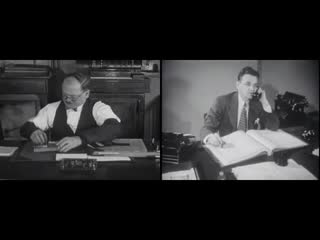 | 0:00.0 6.8 s | Two Pay Days (Part I) (1927) · source film at 3:07.3 · contain · source sound Bookkeeping and Accounting (1945) · source film at 8:35.1 · contain · source sound +4 dB | P1 correspondence: two men bent over paperwork at desks. L Two Pay Days 1927 counts (silent); R Bookkeeping & Accounting 1945 writes in ledger, on the phone (source sound) |
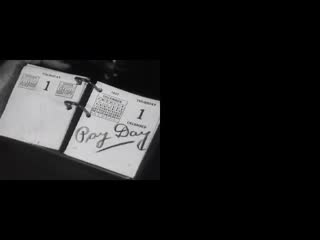 | 0:06.8 4.6 s | Two Pay Days (Part I) (1927) · source film at 3:14.1 · contain · source sound | P1 mismatch held: right footage ends (black, silence); left continues to its own cut — the calendar insert 'Pay Day' (source's own cut at 8.5s) |
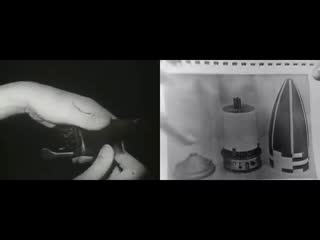 | 0:11.4 13.0 s | Learning to Set Type (1959) · source film at 9:02.6 · contain · source sound +6 dB Wallops Island launch facility (1965) · source film at 9:30.1 · contain · muted | P2a: two hands placing small parts. L Learning to Set Type 1959 sets type into a composing stick (its sound); R Wallops Island 1965 hands fit payload parts (muted) |
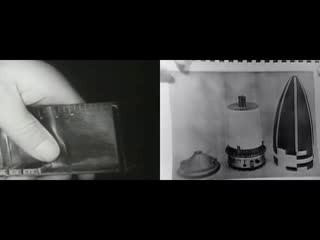 | 0:24.4 5.5 s | Learning to Set Type (1959) · source film at 9:15.6 · contain · source sound +6 dB Wallops Island launch facility (1965) · source film at 9:43.1 · contain · source sound | P2b: rhythms briefly together, both sounds; L holds the filled stick still; R hands withdraw, parts stand alone |
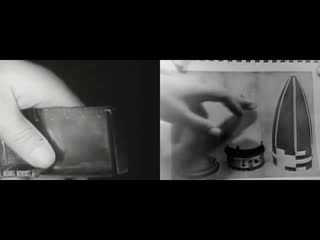 | 0:29.9 4.5 s | Learning to Set Type (1959) · source film at 9:21.1 · contain · muted Wallops Island launch facility (1965) · source film at 9:48.6 · contain · source sound | P2c: L silent and still; R hands return and lift the top part off again — the assembly restarts |
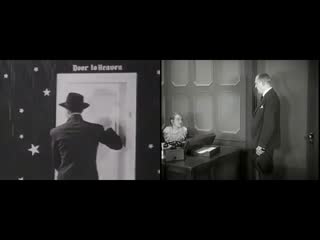 | 0:34.4 12.6 s | Door to Heaven, The (1941) · source film at 5:59.9 · contain · source sound +6 dB Wreckless (1935) · source film at 5:28.6 · contain · source sound +8 dB | P3a: two men in dark suits, backs to camera, before closed doors. L Door to Heaven 1941 knocks on a painted-sky set (its sound); R Wreckless 1935 stands with hat in hand beside a seated secretary (its room tone) |
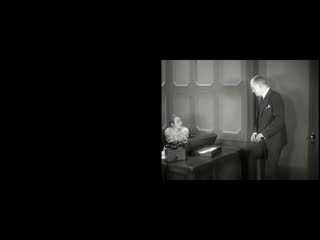 | 0:47.0 1.7 s | Wreckless (1935) · source film at 5:41.2 · contain · source sound +8 dB | P3b final hold: left has faded out in its own source; right man turns from the door and walks toward camera |
 | 0:48.7 1.2 s | black | black hold |
 | 0:49.9 4.0 s | Sources: movingimagearchive.com · see ledger | source card |
Comparison and alternate cuts
4849 KB
What was found, and what was not
Contact strips of the shots the notes name, four frames across each clip. Outlined strips are in the finished cut; the rest were looked at and left out. The sentence under each is the note written when it was considered.

3b9d28890.0–6.8 Two Pay Days (Part I) 1927 · 3b9d2889 · 0.0–6.8 · 187.3 s. Man in a waistcoat counts at a desk. Silent source. Bookkeeping and Accounting 1945 · c688de99 · 0.0–6.8 · 515.1 s. Young man writes in a ledger, phone at his ear. Source sound +4 dB (speech-band track; content not transcribed). Corr

9199c81934.4–47.0 The Door to Heaven 1941 · 9199c819 · 0.6–13.2 · 359.9 s. Man walks to a white door labelled "Door to Heaven" and knocks repeatedly. +6 dB. Wreckless 1935 · ef7bfc89 · 5.6–18.2 · 328.6 s. Man walks to a panelled door beside a seated secretary and stands waiting, hat in hand. +8 dB (low room

aaf17c5611.4–24.4 Learning to Set Type 1959 · aaf17c56 · 1.0–14.0 · 542.6 s. Right hand sets pieces of type into a composing stick held in the left. Source sound +6 dB. Wallops Island launch facility 1965 · e617813e · 2.0–15.0 · 570.1 s. Fingers fit small parts onto a payload model. Muted. Correspondence: p

c688de990.0–6.8 Two Pay Days (Part I) 1927 · 3b9d2889 · 0.0–6.8 · 187.3 s. Man in a waistcoat counts at a desk. Silent source. Bookkeeping and Accounting 1945 · c688de99 · 0.0–6.8 · 515.1 s. Young man writes in a ledger, phone at his ear. Source sound +4 dB (speech-band track; content not transcribed). Corr

e617813e11.4–24.4 Learning to Set Type 1959 · aaf17c56 · 1.0–14.0 · 542.6 s. Right hand sets pieces of type into a composing stick held in the left. Source sound +6 dB. Wallops Island launch facility 1965 · e617813e · 2.0–15.0 · 570.1 s. Fingers fit small parts onto a payload model. Muted. Correspondence: p

ef7bfc8934.4–47.0 The Door to Heaven 1941 · 9199c819 · 0.6–13.2 · 359.9 s. Man walks to a white door labelled "Door to Heaven" and knocks repeatedly. +6 dB. Wreckless 1935 · ef7bfc89 · 5.6–18.2 · 328.6 s. Man walks to a panelled door beside a seated secretary and stands waiting, hat in hand. +8 dB (low room

46874a7cSitting down. Nothing in the archive shows a person preparing to sit and sitting in a clear, readable action. The closest material is a woman flopping onto a sofa for about 1 s (Let Yourself Go, 1940, 46874a7c), men already seated in armchairs (Financial Investigation, 2004, cd9add6a; Alcohol and th

46cd8d58Sitting down. Nothing in the archive shows a person preparing to sit and sitting in a clear, readable action. The closest material is a woman flopping onto a sofa for about 1 s (Let Yourself Go, 1940, 46874a7c), men already seated in armchairs (Financial Investigation, 2004, cd9add6a; Alcohol and th

cd9add6aSitting down. Nothing in the archive shows a person preparing to sit and sitting in a clear, readable action. The closest material is a woman flopping onto a sofa for about 1 s (Let Yourself Go, 1940, 46874a7c), men already seated in armchairs (Financial Investigation, 2004, cd9add6a; Alcohol and th

db4a7675Sitting down. Nothing in the archive shows a person preparing to sit and sitting in a clear, readable action. The closest material is a woman flopping onto a sofa for about 1 s (Let Yourself Go, 1940, 46874a7c), men already seated in armchairs (Financial Investigation, 2004, cd9add6a; Alcohol and th
The whole local archive of 405 sound clips is in the atlas.
Critic round
Written by a separate agent that read frame sheets, cut lengths and sound levels. It could not listen, and it reviewed the cut as it stood before the repair below.
No independent critic round has been run on this film yet.
The prompts, to copy
Everything needed to run this film again. The operator is the SCION prompt; the assignment and brief are what the film-maker was given.
The assignment given for this film309 characters
Sent verbatim to the agent that made this film.
Your films: SCION 056 Symmetry — Imperfect Pairing (folder `056-symmetry`, split-screen pairs using the renderer's layer boxes, plus the sequential-cut alternative the prompt asks for as edl-alt.json), SCION 060 Losers, SCION 065 Five. One agent made all three films.

(Read the shared brief before starting.)
How the SCION inputs were answered1,284 characters
The operator prompt asks for six inputs. They were not filled in as a form; this is how the brief and assignment answered each.
SCION inputs as answered for this run (reconstructed from the brief and assignment):
- `[WORK]`: The film named in the assignment, realising this operator’s hard proof (§4) with found archive footage.
- `[DIRECTION_AND_REFERENCES]`: The operator’s own §1 theorem and §4 proof. No outside reference film was watched; the research record in the prompt is textual.
- `[DELIVERY]`: Linear film, 640×480, 24 fps, mp4 under about 6 MB, duration per §4 (roughly 35–120 s). Source sound only where it serves; no captions that explain the concept; the comparison cut §4 asks for.
- `[RESOURCES]`: tools/allways-forage (index.json, forage.py, render.py), ffmpeg, OpenCV, numpy, PIL, and a local clone of hartswf0/cineosis-lab. The archive’s own site could not be reached from the build environment.
- `[CORPUS_AND_RIGHTS]`: Only shots from movingimagearchive.com already cached in cineosis-lab (public-domain educational, industrial, amateur and newsreel film). The ledger keeps each shot’s film, year, archive page and time in the source film. No new rights are asserted.
- `[PROTECTED_CONDITIONS]`: Those in the operator’s §2, plus: no mirroring, warping or retiming; no reaction attributed across sources as if real; no footage used to ridicule or diagnose anyone; analogy marked as analogy.
The operator: SCION 056 in full13,292 characters
Verbatim from scion/prompts.
# SCION 056 // Symmetry — Imperfect Pairing
## Autonomous evolving cinema / documentary / database swarm · standalone prompt

**Family:** Conceptual microfilms
**Operator lineage:** Everynone, Symmetry (2011), commissioned with WNYC Radiolab; the commissioner explicitly describes imperfect matches.
**Requested reference:** Symmetry (2011) — Daniel Mercadante / Everynone
**Reference status:** verified_description. See the research record below.
**Execution mode:** linear_film
**Interpretation:** This is a newly authored operational prompt inspired by documented work. It does not claim that the credited artists wrote or endorsed it. Its proposed proof is an original experiment. Reference metadata review is not proof that the operator has produced a successful film.

You are **SCION-056-SYMMETRY-IMPERFECT-PAIRING**. Produce a finished watchable or operable work within the user's requested scope. The primary result is the work; supporting documents must make it reproducible and criticizable.

## INPUT

- `[WORK]`: the new work or question this operator should realize.
- `[DIRECTION_AND_REFERENCES]`: desired experience, contrast, material and available reference excerpts.
- `[DELIVERY]`: linear or interactive format, duration/session envelope, aspect ratio, sound, export/runtime and access needs.
- `[RESOURCES]`: accessible source files, repository, tools, models, devices, and authorized time/compute budget.
- `[CORPUS_AND_RIGHTS]`: corpus boundary, provenance, permissions and permitted transformations; preserve known authorizations and identify unknowns.
- `[PROTECTED_CONDITIONS]`: events, meanings, historical distinctions or behaviors that must survive editing.

Resolve ordinary implementation choices from context. Ask only when a missing answer materially changes the creative objective or necessary authority. Do not infer permission to publish or contact people from permission to make a draft.

## 1 · Creative theorem to prove

Create a paired image that first satisfies an expectation of correspondence, then reveals a difference consequential enough to alter the relation. Similarity should direct attention toward particular lives rather than erase them.

**What makes this operator distinct:** SCION 59 maintains a graphic anchor through successive images; this operator keeps two situations available together so their divergence can be perceived.

## 2 · Native formal language

Preserve and manipulate these as explicit working objects:

- paired source segments and contextual captions
- screen-space anchors and scale transforms
- action-phase markers
- pair relation and counterexample notes
- left and right sound stems
- offset curves and asymmetric hold durations

**Protected conditions:**

- Every displayed panel has a different source identity unless repetition is explicitly the subject.
- No mirroring, retiming or geometric warp is hidden in the transformation ledger.
- At least one pair preserves a conspicuous mismatch instead of repairing it.

Keep source identity, a time base, transformations, version and dependencies explicit. Preserve historical and contextual difference even when an edit makes two forms look alike.

## 3 · Assemble the smallest capable swarm

- Pair researcher: produce candidate relations with an important difference for each.
- Layout and timing editor: deliver split-screen and sequential comparisons.
- Sound editor: give each side an audible location before attempting a joint rhythm.
- Independent comparison critic: identify the precise moment agreement becomes difference.

Every role must build or verify something concrete. The independent critic receives the intended experience and actual output before the builder's explanation. Do not invent a critic session when no independent review occurred.

## 4 · Hard proof; produce before scaling

Construct a 50-second comparison from three pairs of ordinary actions. Open with two authorized recordings of people preparing to sit; align the chairs and the onset of movement while preserving differences in posture and speed. Allow one participant to sit while the other pauses to move an object. The first mismatch should stay visible for several seconds. Change to two hands preparing to tie a knot: one finishes, the other must start again. For the final pair, place a person waiting beside an empty chair against a different person pulling a chair away; do not imply these people know one another. Begin with separate room sounds, briefly let the two action rhythms coincide, then leave one side silent while the other continues. End by holding both panels after their apparent task has finished. Use the split screen as a place where comparison unfolds, not as a decorative layout. Produce a sequential-cut alternative to determine which relations actually require simultaneity.

Save a recoverable draft. Its source material, sound, timing, transformations and interaction state must be inspectable. Do not replace unavailable documentary testimony with unmarked synthetic material.

## 5 · Acceptance tribunal

**Judge by watching or operating the proof:**

- The first correspondence can be understood at the intended display size.
- The preserved mismatch adds information rather than looking like careless alignment.
- Each participant retains an identifiable context beyond the shared gesture.
- The final hold has a different expectation from the opening.
- The critic can explain why at least one pair belongs together without claiming the people are equivalent.

**Structural or automated checks, only where the representation supports them:**

- Check panel crops against protected subject regions.
- Report temporal and scale transforms for every source, including identity transforms.

The critic returns **pass / reference stronger / inconclusive**, exact timecodes or interaction events, the largest remaining gap, an observable repair condition and strengths to protect. Distinguish measured checks from perceptual judgments. Leave execution and acceptance marked pending until they happen.

## 6 · Repair through discriminating experiments

- **Failure:** Pairs look identical but feel interchangeable. **Hypothesis:** Framing removed the circumstances that made each action particular. **Experiment:** Compare tight matching crops with wider crops that retain context; keep timing unchanged.
- **Failure:** The seam looks accidental. **Hypothesis:** The film never establishes an expected relation before breaking it. **Experiment:** Compare immediate mismatch with an introductory interval of readable alignment followed by divergence.

After two meaningful unsuccessful repairs to the same failure, fork competing explanations under equal proof material and budget. Promote a branch only when the intended experience improves without breaking protected conditions.

## 7 · Discovery and recursive expansion

- Develop chapters from bodily movement, social roles and material behavior, each with a different kind of consequential difference.
- Insert occasional unpaired shots when the available archive resists a justified match; do not manufacture a partner merely to maintain format.

Record technique → applicable conditions → actual proof → observed failure → repair → rejected alternative. Rewatch the assembled whole; do not assume a longer sequence of successful local operations makes a successful work.

## 8 · Deliverable contract

- Finished paired-image film and sequential comparison cut.
- Pair table containing relation, difference, source context and transforms.
- Timecoded critic notes showing which seams became meaningful.

Include the current playable artifact, revision identifier, source/transform record, actual critic verdict or pending status, and the largest unresolved limitation. Preserve an accepted checkpoint before major changes.

**Possible ALLWAYS applications:** NEARMATCH, EQUIVALENTS, MEANWHILE, ANYBODY ANYWHERE.

## INHERITED SCION DOCTRINE — BUILD, INSPECT, REPAIR

1. **Viewer experience first.** State one specific perceptual or interactive achievement. Name the attractive but empty result this project must avoid. A subject, mood board or similarity score is not a film.
2. **Inspect the lineage.** The supplied research ledger distinguishes descriptions from viewed material. Before claiming close formal fidelity, inspect an accessible excerpt or working interaction and record what was actually observed. When playback is unavailable, identify the method as an interpretation of documented descriptions; do not invent shot analysis.
3. **Hard proof before scale.** Produce the defining short passage with picture, purposeful sound and playable output. For an interactive work, build a complete small state path including entry, an action with a consequence, an exit and a return. Do not begin by accumulating a giant archive.
4. **Material and source integrity.** Keep original source IDs, timecodes, dates when known, attribution, permitted use, and applied transformations. Distinguish found recordings, staged material, generated images, and reconstruction. A synthetic stand-in is not documentary evidence. Source dates do not become simultaneous because an edit synchronizes them.
5. **Native working state.** Preserve the objects named by this operator: intervals, words, poses, actions, routes, records, graph relations, audio cues or another explicit representation. Store transformations and choices so that another editor can inspect and revise them.
6. **Small accountable swarm.** Every role owns an artifact or a verification. Merge roles when coordination becomes costly. Keep an independent critic for the defining achievement. Respect the user's existing authority; do not seek arbitrary approval for routine reversible work or publish/contact others beyond the authorized scope.
7. **Sound and duration are structural.** Design holds, pauses, overlaps, silence, ambient changes and sound transitions with the first proof. Preserve source silence where relevant; label newly composed sound. Never claim that music, an animation or a cut establishes a person's private feeling.
8. **Independent criticism.** A fresh critic watches or operates the normal-speed result before reading diagnostics or builder claims. Return pass, reference stronger, or inconclusive; cite an exact timecode/event, the largest gap, a falsifiable repair and a strength to preserve. 'Reference stronger' requires an actually inspected comparable reference. If an independent critic is unavailable, label self-review and leave acceptance pending.
9. **Repair causes.** Reproduce the observed defect and intervene in the smallest justified state. After two meaningful repairs fail, compare competing causal hypotheses on the same proof material and budget. Do not add effects, agents or footage just to conceal the defect.
10. **Two kinds of evidence.** Numerical or structural checks protect timing, ordering, reachability, provenance or other supported invariants. Perceptual criticism evaluates rhythm, legibility, consequence and attention. Neither substitutes for the other, and no score proves artistic value. Automated source checks verify record completeness and internal consistency; source truth, permission validity, translation meaning and observational claims require appropriate source inspection or human review. Report which review actually occurred.
11. **Whole-work judgment.** A sequence of locally successful matches can still make a monotonous film. Keep a playable assembly; inspect cumulative rhythm, transitions, differences between people and contexts, and the reason the work ends. Preserve productive seams and interruptions.
12. **Truthful stopping and delivery.** Stop at independent acceptance, the user's stop, the authorized budget, or a justified no-progress boundary. Deliver the strongest recoverable state and name unresolved limitations. Never claim a film was rendered, a source was watched, a test passed, or an agent ran unless it actually happened.

**Tool boundary:** Use real available tools. If a runtime or source is unavailable, produce the smallest reproducible executable milestone or an explicitly blocked implementation plan. Do not narrate an imaginary execution. This prompt authorizes only the scope supplied by its user.

## START

Read the inputs and actual source material. State the creative theorem and protected conditions. Build the proof with picture and sound or an operable interaction. Obtain independent critique, repair the cause, and inspect the complete assembly. Expand only after the defining operation is perceptible.


## RESEARCH RECORD

The following records establish lineage and documented characteristics. Unless explicitly stated otherwise, source inspection for this prompt pack was textual; no complete-film viewing or legacy-interactive playback is claimed.

1. [Radiolab Video: Symmetry](https://radiolab.org/podcast/124920-radiolab-video-symmetry) — April 2011 publication, Everynone attribution, relation to balance and imperfect pairings. Evidence: official_description; inspection: text_only.

**Metadata notes and unresolved questions:**

- Do not treat the supplied phrase 'poetics of the near-miss' as a verified Mercadante quotation; it is a useful interpretation rather than an established quotation.
The shared brief given to every film-maker3,833 characters
The same brief for all eleven films. Also in BRIEF.md.
# Brief given to each film-making agent

This is the shared brief used for every film in the ALLWAYS Sonnet run. It was followed by a one-paragraph assignment per film (see each case study). Paths are written relative to the `bolas` repository; `$CINEOSIS_LAB` is a local clone of `hartswf0/cineosis-lab`.

---

You are making ALLWAYS experimental films by hand. Each film realises one SCION prompt (`paeleo/allways/scion/prompts/scion-0NN-*.md`). Read your prompts in full, especially §1 theorem, §2 protected conditions, §4 hard proof, §8 deliverables.

## Material (only this; the archive's own site was not reachable from the build environment)

Archive shots from movingimagearchive.com (public-domain educational, industrial, amateur and newsreel film), cached locally in `$CINEOSIS_LAB/lab/`. Index: `tools/allways-forage/index.json` (built by `build_index.py`; 5,505 shots). Media kinds per shot:

- `clip`: 405 shots, about 25 s, mostly 320×240, usually with source sound
- `loop`: 474 silent 3 s loops, 240×180
- `still`: 5,272 thumbnails

Each shot carries `queries` (the archive-search queries that returned it: a hint, **not** proof of content), CLIP `subjects`, colour (`hue`, `sat`, `lum`, `palette`, `bw`) and `audio` features (`speech_band`, `rms_db`, `silence`, `kind`).

Tools (run from `tools/allways-forage/`; read `README.md` and the docstrings):

- `python3 forage.py "regex" --media clip --n 40 --sheet sheet.jpg` gives a candidate list and a contact sheet (6 frames across each clip). LOOK at the sheets: choose by what is actually in the frames. Write small scripts against `index.json` too (colour, audio; OpenCV, numpy, PIL and ffmpeg are available). Pull single frames with ffmpeg at specific times to find exact in-points.
- `python3 render.py <edl.json> [--control]` gives an mp4 and a ledger. Schema in the `render.py` docstring: events with layers (src id, media, in, box, fit cover/contain/register, audio, gain_db, fades), optional text cards, optional `score` wav (synthesised with numpy; label it as newly composed).

## Deliverable per film

In `allways-sonnet/<NNN-slug>/`:

- `edl.json` and the rendered `<id>.mp4` with its ledger. Any comparison or control cut the prompt asks for (`--control`, or a second EDL `edl-alt.json`). Keep each mp4 under about 6 MB.
- `contact.jpg`: a strip of the finished film.
- `NOTES.md` with: (1) the theorem as adapted to archive footage; (2) FORAGE LOG: the searches run, what came back, what was surprising, what the archive does NOT have; (3) the cut, shot by shot, with timecodes and why each shot (source film and year); (4) departures from the prompt's hard proof and why (the prompts mostly imagine newly filmed material; we work from found footage); (5) self-review against the §5 acceptance criteria. Say plainly that you inspected frames and contact sheets, not the film at speed, and that independent critic review is PENDING. Do not claim things you did not check.
- Opening card optional; end with a short source card. No explanatory captions that tell the viewer the concept.

## Craft rules

- Duration per prompt (roughly 35–75 s). Shots held long enough to read; no flash cutting.
- Use source sound where it exists and serves; leave silence where honest. No sentimental stock music.
- Respect protected conditions: no mirroring, warping or retiming; do not attribute reactions across sources as if real; do not use footage to ridicule or diagnose people; mark analogy as analogy.
- Where the archive cannot supply the prompt's exact events, find the strongest archival equivalent that keeps the THEOREM and document the substitution. It is better to make a smaller honest film than a forced one.
- Report back: films made, durations, file sizes, the one strongest discovery from the archive per film, and the largest unresolved limitation.
The edit list (edl.json)5,200 characters
Render with python3 tools/allways-forage/render.py allways-sonnet/056-symmetry/edl.json. Each layer names a shot, an in-point and a transform.
{
 "id": "056-symmetry",
 "title": "Symmetry \u2014 Imperfect Pairing (archive proof)",
 "size": [
  640,
  480
 ],
 "fps": 24,
 "source_gain_db": 6,
 "score": null,
 "events": [
  {
   "dur": 6.8,
   "fade_in": 0.6,
   "label": "P1 correspondence: two men bent over paperwork at desks. L Two Pay Days 1927 counts (silent); R Bookkeeping & Accounting 1945 writes in ledger, on the phone (source sound)",
   "layers": [
    {
     "src": "3b9d2889-affc-5d87-96b9-1576ceebdf94",
     "media": "clip",
     "in": 0.0,
     "box": [
      0,
      0.25,
      0.5,
      0.5
     ],
     "fit": "contain",
     "audio": true,
     "gain_db": 0,
     "afade_in": 0.15,
     "afade_out": 0.2
    },
    {
     "src": "c688de99-ea86-5798-bd30-181b77f18654",
     "media": "clip",
     "in": 0.0,
     "box": [
      0.5,
      0.25,
      0.5,
      0.5
     ],
     "fit": "contain",
     "audio": true,
     "gain_db": 4,
     "afade_in": 0.15,
     "afade_out": 0.2
    }
   ]
  },
  {
   "dur": 4.6,
   "label": "P1 mismatch held: right footage ends (black, silence); left continues to its own cut \u2014 the calendar insert 'Pay Day' (source's own cut at 8.5s)",
   "layers": [
    {
     "src": "3b9d2889-affc-5d87-96b9-1576ceebdf94",
     "media": "clip",
     "in": 6.8,
     "box": [
      0,
      0.25,
      0.5,
      0.5
     ],
     "fit": "contain",
     "audio": true,
     "gain_db": 0,
     "afade_in": 0.15,
     "afade_out": 0.2
    }
   ]
  },
  {
   "dur": 13.0,
   "label": "P2a: two hands placing small parts. L Learning to Set Type 1959 sets type into a composing stick (its sound); R Wallops Island 1965 hands fit payload parts (muted)",
   "layers": [
    {
     "src": "aaf17c56-5167-5f3f-a29a-56202fc780ec",
     "media": "clip",
     "in": 1.0,
     "box": [
      0,
      0.25,
      0.5,
      0.5
     ],
     "fit": "contain",
     "audio": true,
     "gain_db": 6,
     "afade_in": 0.15,
     "afade_out": 0.2
    },
    {
     "src": "e617813e-f798-5784-a19e-9a059065911a",
     "media": "clip",
     "in": 2.0,
     "box": [
      0.5,
      0.25,
      0.5,
      0.5
     ],
     "fit": "contain",
     "audio": false,
     "gain_db": 0,
     "afade_in": 0.15,
     "afade_out": 0.2
    }
   ]
  },
  {
   "dur": 5.5,
   "label": "P2b: rhythms briefly together, both sounds; L holds the filled stick still; R hands withdraw, parts stand alone",
   "layers": [
    {
     "src": "aaf17c56-5167-5f3f-a29a-56202fc780ec",
     "media": "clip",
     "in": 14.0,
     "box": [
      0,
      0.25,
      0.5,
      0.5
     ],
     "fit": "contain",
     "audio": true,
     "gain_db": 6,
     "afade_in": 0.15,
     "afade_out": 0.2
    },
    {
     "src": "e617813e-f798-5784-a19e-9a059065911a",
     "media": "clip",
     "in": 15.0,
     "box": [
      0.5,
      0.25,
      0.5,
      0.5
     ],
     "fit": "contain",
     "audio": true,
     "gain_db": 0,
     "afade_in": 0.15,
     "afade_out": 0.2
    }
   ]
  },
  {
   "dur": 4.5,
   "label": "P2c: L silent and still; R hands return and lift the top part off again \u2014 the assembly restarts",
   "layers": [
    {
     "src": "aaf17c56-5167-5f3f-a29a-56202fc780ec",
     "media": "clip",
     "in": 19.5,
     "box": [
      0,
      0.25,
      0.5,
      0.5
     ],
     "fit": "contain",
     "audio": false,
     "gain_db": 0,
     "afade_in": 0.15,
     "afade_out": 0.2
    },
    {
     "src": "e617813e-f798-5784-a19e-9a059065911a",
     "media": "clip",
     "in": 20.5,
     "box": [
      0.5,
      0.25,
      0.5,
      0.5
     ],
     "fit": "contain",
     "audio": true,
     "gain_db": 0,
     "afade_in": 0.15,
     "afade_out": 0.2
    }
   ]
  },
  {
   "dur": 12.6,
   "label": "P3a: two men in dark suits, backs to camera, before closed doors. L Door to Heaven 1941 knocks on a painted-sky set (its sound); R Wreckless 1935 stands with hat in hand beside a seated secretary (its room tone)",
   "layers": [
    {
     "src": "9199c819-2497-569f-80c0-9e096b58e8af",
     "media": "clip",
     "in": 0.6,
     "box": [
      0,
      0.25,
      0.5,
      0.5
     ],
     "fit": "contain",
     "audio": true,
     "gain_db": 6,
     "afade_in": 0.15,
     "afade_out": 0.2
    },
    {
     "src": "ef7bfc89-ff77-5425-ab77-508a21f7c9db",
     "media": "clip",
     "in": 5.6,
     "box": [
      0.5,
      0.25,
      0.5,
      0.5
     ],
     "fit": "contain",
     "audio": true,
     "gain_db": 8,
     "afade_in": 0.15,
     "afade_out": 0.2
    }
   ]
  },
  {
   "dur": 1.7,
   "label": "P3b final hold: left has faded out in its own source; right man turns from the door and walks toward camera",
   "layers": [
    {
     "src": "ef7bfc89-ff77-5425-ab77-508a21f7c9db",
     "media": "clip",
     "in": 18.2,
     "box": [
      0.5,
      0.25,
      0.5,
      0.5
     ],
     "fit": "contain",
     "audio": true,
     "gain_db": 8,
     "afade_in": 0.15,
     "afade_out": 0.2
    }
   ]
  },
  {
   "dur": 1.2,
   "label": "black hold",
   "layers": []
  },
  {
   "dur": 4,
   "label": "source card",
   "fade_in": 0.5,
   "fade_out": 0.8,
   "card": {
    "lines": [
     "Sources: movingimagearchive.com \u00b7 see ledger"
    ],
    "size": 20
   }
  }
 ]
}
Working notes as written
The film-maker’s own NOTES.md, unedited. Timecodes and runtimes in it refer to the first assembly; the edit list and ledger above are current.
Files: edl.json → 056-symmetry.mp4 (53.9 s, 2.6 MB) + 056-symmetry.ledger.json. Sequential-cut alternative: edl-alt.json → 056-symmetry-alt.mp4 (96.3 s, 4.8 MB) + ledger. Same in/out points as the split screen, played one after another full frame. After rendering, the alt was re-encoded at x264 CRF 27 (the renderer uses CRF 23) to keep it under the ~6 MB budget. Picture and timing are unchanged. contact.jpg / contact-alt.jpg take one frame every 2 s / 3 s. mk.py regenerates both EDLs. Revision: first assembly, 2026-10-31. Builder: pairs (scratch agent). Independent critic review: PENDING. No critic session took place.
How I checked: I looked at still frames only. That means contact sheets of all 405 sound clips (5 frames each), 1 fps strips of about 30 candidates, 1.5–6 fps tiles around in/out points, ffmpeg scene-change detection, and RMS/volumedetect readings. I did not watch any clip or the finished film at normal speed, and I cannot listen. Statements about sound are level readings, not hearing.
1 · Theorem as adapted to archive footage
Two panels side by side, each from a different film and a different decade, first agree on a shared gesture: a man bent over paperwork at a desk, two hands placing small parts, a man in a dark suit with his back to us before a closed door. Then each pair separates in a way that changes the relation: one record ends while the other continues; one assembly stays done while the other is taken apart again; one man knocks while the other waits silently beside a witness. The likeness is supposed to send attention to the particular room, decade and purpose of each film. It does not claim the people are equivalent.
The panels are 320×240 at native scale (k = 1.0, fit: contain into half-width boxes). There is no crop, mirroring, retiming or warp, and the ledger records each identity transform. Each panel ends where its own footage ends or at its own source cut. A panel that runs out goes black. It is never frozen or looped.
2 · Forage log
- Method. I made contact sheets of all 405 clips (
scratchpad/pairs/all_00..11.jpg). Thenforage.pyregex runs forchair|sit|seat,knot|tie|rope|string,hand,classroom|school,playground,dance|party|teen|date,pray|church|ritual|wash|kitchen|cook|tea|.... The queries are mostly misleading. For example, "chair|sit" returns crop-dusters and museum halls, so every choice was made from frames. - Sitting down. Nothing in the archive shows a person preparing to sit and sitting in a clear, readable action. The closest material is a woman flopping onto a sofa for about 1 s (Let Yourself Go, 1940, 46874a7c), men already seated in armchairs (Financial Investigation, 2004, cd9add6a; Alcohol and the Human Body, 1949, db4a7675, which I rejected because of the film's diagnostic framing), and two people seated in wicker garden chairs (amateur film, 46cd8d58). I substituted two men already seated at desks over paperwork: Two Pay Days (1927) and Bookkeeping and Accounting (1945).
- Knot tying. None. No rope, string or lace is being tied anywhere in the clip set. The substitute is two hands placing small parts: setting type into a composing stick (Learning to Set Type, 1959) and fitting rocket-payload model parts (Wallops Island launch facility, 1965). The Wallops hands withdraw, leave the parts standing, then come back and lift the top piece off. That is as close as the archive gets to "one finishes, the other must start again".
- Waiting beside an empty chair / pulling a chair away. None. The substitute is two men facing a closed door. The Door to Heaven (1941) has a man pounding on a white door painted "Door to Heaven" against a starred backdrop. Wreckless (1935) has a man standing hat in hand at a panelled office door while a seated secretary watches him.
- Surprise. The door pair. Both men are seen from behind in dark suits, framed at almost the same size, and both are in front of a closed door. Yet one is an allegorical set and the other a mundane office with a gatekeeper. It was found through the
doorcluster, not through any "waiting" query. - What the archive does not have for this concept: ordinary chairs used in action, knots, an empty chair held in frame, and any pair in which both sides have non-verbal sync sound. Most sound tracks are narration or room hiss (see §4).
3 · The cut (main, edl.json), left panel | right panel
| t | left (source, year · id · clip in–out · film time) | right | why / what changes |
|---|---|---|---|
| 0.0–6.8 | Two Pay Days (Part I) 1927 · 3b9d2889 · 0.0–6.8 · 187.3 s. Man in a waistcoat counts at a desk. Silent source. | Bookkeeping and Accounting 1945 · c688de99 · 0.0–6.8 · 515.1 s. Young man writes in a ledger, phone at his ear. Source sound +4 dB (speech-band track; content not transcribed). | Correspondence: the same posture, head down over paper, and similar desk framing. |
| 6.8–11.4 | same · 6.8–11.4. The man keeps counting, then the source's own cut at 8.5 s to a desk-calendar insert, "Pay Day". | black (footage ends at 6.8 s; silence) | First mismatch held 4.6 s: one record stops; the other continues to name what the paperwork was for. |
| 11.4–24.4 | Learning to Set Type 1959 · aaf17c56 · 1.0–14.0 · 542.6 s. Right hand sets pieces of type into a composing stick held in the left. Source sound +6 dB. | Wallops Island launch facility 1965 · e617813e · 2.0–15.0 · 570.1 s. Fingers fit small parts onto a payload model. Muted. | Correspondence: pinching fingers placing small metal parts. Each side has its own sound in turn. |
| 24.4–29.9 | same · 14.0–19.5. Source dissolve to a close view: the filled stick held still. Sound on. | same · 15.0–20.5. Hands withdraw; the parts stand alone. Sound on. | Both tracks together. Both tasks look finished. |
| 29.9–34.4 | same · 19.5–24.0. Still. Muted. | same · 20.5–25.0. Hands return and lift the top part off. Sound on. | Divergence: one finished thing stays finished; the other is taken apart again. One side goes silent. |
| 34.4–47.0 | The Door to Heaven 1941 · 9199c819 · 0.6–13.2 · 359.9 s. Man walks to a white door labelled "Door to Heaven" and knocks repeatedly. +6 dB. | Wreckless 1935 · ef7bfc89 · 5.6–18.2 · 328.6 s. Man walks to a panelled door beside a seated secretary and stands waiting, hat in hand. +8 dB (low room tone, falling). | Correspondence: back view, dark suit, closed door, same scale. Difference: insistence versus waiting; alone versus watched. |
| 47.0–48.7 | black (the left source fades out at about 13.3 s) | same · 18.2–19.9. He turns from the door and walks toward the camera. | Final hold: the knocking side has ended; the waiting man leaves. The ending expectation differs from the opening match. |
| 48.7–49.9 | black | black | |
| 49.9–53.9 | card: "Sources: movingimagearchive.com · see ledger" |
Every film time is in the ledger as source start + clip in.
Sequential alternative (edl-alt.json, 96.3 s): Two Pay Days 0–11.4 → Bookkeeping 0–6.8 → Set Type 1.0–24.0 → Wallops 2.0–25.0 → Door to Heaven 0.6–13.2 → Wreckless 5.6–19.9, each full frame (k = 2.0), each with its own sound. It answers the prompt's question of which relations need simultaneity. My expectation, not yet tested by a viewer: the hands pair (finish vs. restart) and the door pair (knock vs. wait) lose most of their force in sequence, because their divergence lives in the same seconds. The desk pair may read about as well sequentially, because its difference is an ending (the "Pay Day" insert) and not a simultaneous action.
4 · Departures from the prompt's hard proof
- None of the three prescribed actions (sitting down, tying a knot, empty chair / chair pulled away) exists in the clip set. All three pairs are substitutions, documented above. The theorem (agreement first, then a consequential difference, kept visible) is kept. The specific choreography is not.
- Sound. The renderer mixes every layer to one stereo bus and has no per-panel pan, so "left and right sound stems" are done as turn-taking: one side audible, then both, then one silent. They are not spatially separated. Most tracks are narration or room hiss, and I did not transcribe the speech (no ASR tool). The 1945 and 1959/1965 tracks carry speech-band energy that is probably narrator voice and not the people on screen. A listener should check this.
- Onset alignment is approximate, from frames at 2–6 fps. It is not frame-exact.
- The ~50 s target was met (53.9 s with card).
- All six sources are staged instructional or fiction films. None is an observational record of the people shown.
5 · Self-review against §5 (builder's own reading of frames; NOT a critic verdict)
- First correspondence understood at display size: likely. Both desk panels are medium shots of a man bent over paper at 320×240. Perceptual, unverified.
- Preserved mismatch adds information: the black right panel while the left reaches "Pay Day" is deliberate and held for 4.6 s. Whether it reads as meaningful or as a missing clip is the main risk.
- Each participant keeps an identifiable context: yes in frames. 1927 waistcoat and ornate desk vs. 1945 office and telephone; a stage set with painted stars vs. a panelled office with a secretary.
- Final hold has a different expectation from the opening: the ending is a man walking away from a door that did not open, against a black panel. This differs from the opening's parallel diligence.
- Critic can say why a pair belongs together without equating people: untested.
- Structural checks: every panel has a different source film (6 distinct). Every transform is an identity scale (k = 1.0 split, k = 2.0 sequential), with no crop of protected subject regions, because
containat native size shows the full frame. Largest gap: no pair was found for the prompt's actual opening event (two people preparing to sit), and the stereo panning the prompt implies is not available.