52 s · ends with a 5 s card naming every source. I cannot hear; neither could the critics. Sound is unjudged until a person listens.
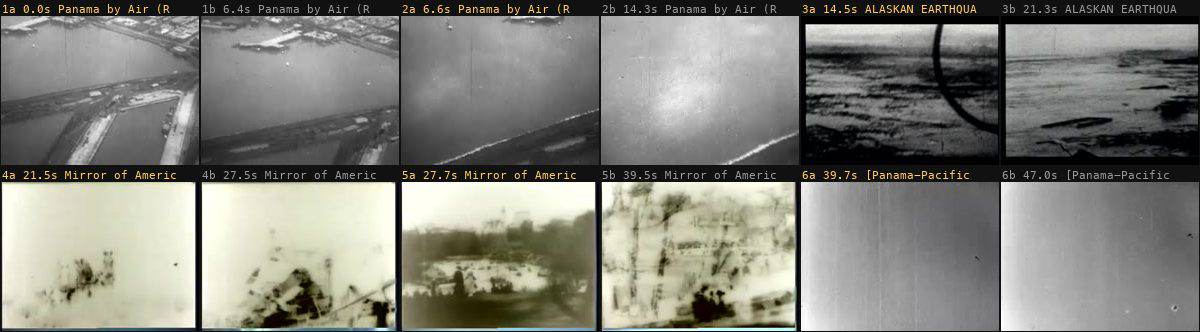
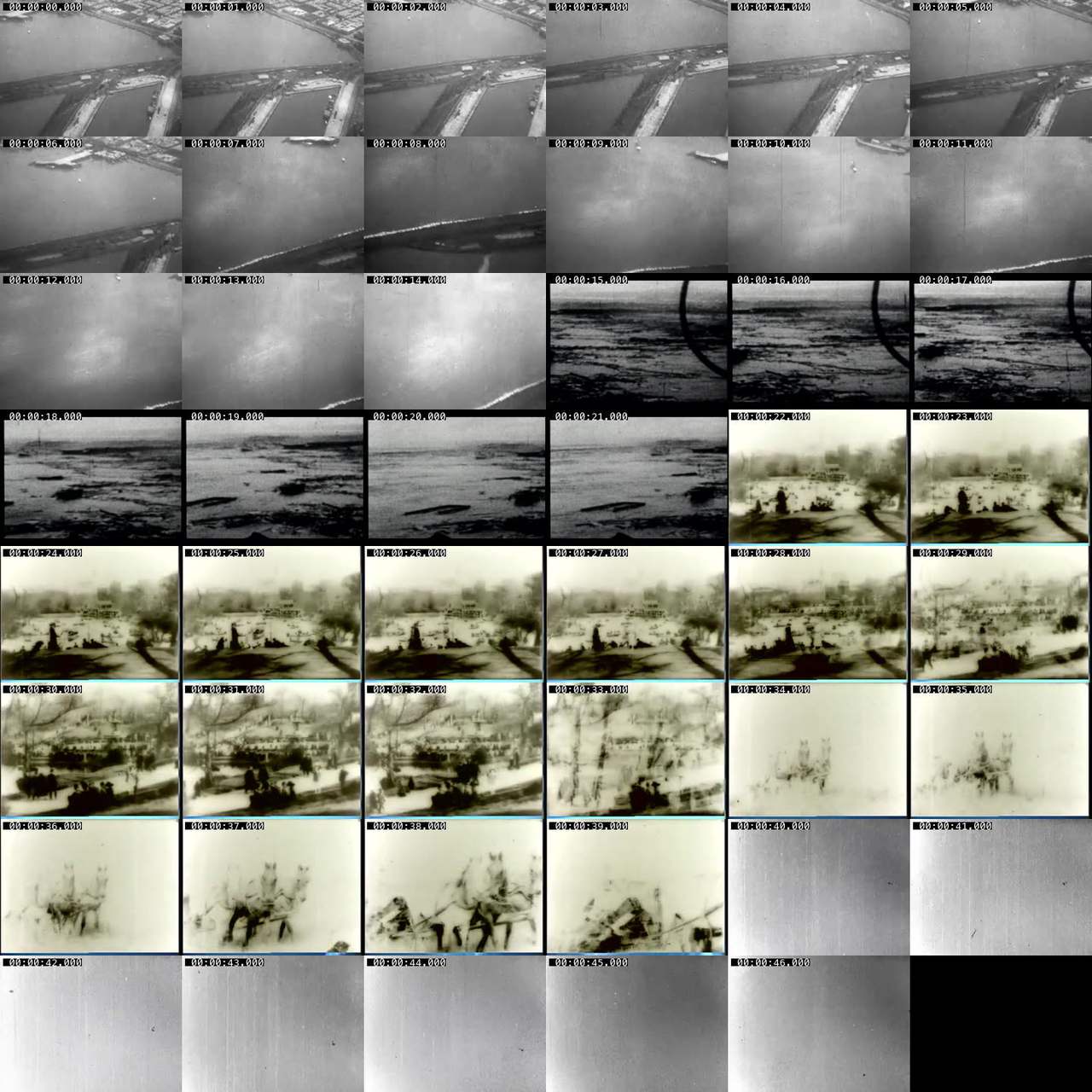
A 1914 aerial of a harbour holds until its grey water starts to read as emulsion. A 1966 earthquake film's black arc crosses a tidal flat. A decayed 1963 print of a harvester and of skaters in a park come back out of white. The film ends on a blank 1915 interval with its own noise raised.
10searches
8filmstrips looked at
6shots
1review rounds
1 The brief
A passage through film’s damaged edges, where scratches, light leaks, and blank intervals become terrain and the recorded world keeps surfacing.
First proof. Build a sixty-second passage from three recorded film surfaces with different visible defects. Establish a recognizable image before following a scratch or light boundary into the next fragment. Hold one surface long enough to reveal that the apparent landscape is a material carrier. Let a recognizable scene return, then end at a blank interval with its actual recorded noise or an identified original sound composition. Keep observed damage distinct from any generated extension.
Development boundary. A generated transition is a separate authored layer. The material-study proof does not establish a historical relationship between otherwise unrelated fragments.
The operator’s acceptance criteria
At least one important claim can be checked directly in the visible carrier.
Scale and handling remain legible at the delivery resolution.
The narrator distinguishes recollection, research and uncertainty.
The continuous examination develops through comparison rather than merely listing objects.
The final remaining trace changes the table from a neutral display into evidence of work.
2 The prompt
The method prompt for this run, followed by this film's inputs. Paste it into an agent with a shell, ffmpeg, a speech recognizer and image reading. It is a reconstruction of what the run did, written afterwards; the run itself began from a short request.
1,157 words
You are making one proof film for ALLWAYS (a cinema practice within PAELEO) from the Moving Image Archive (movingimagearchive.com; public-domain films, which the site says are free to reuse). You work as a hand editor.

"By hand" means: you search, you look at what came back, you listen, and you write every in-point, out-point, order, gain and reason yourself, in an edit list. Software renders the list; it never chooses a shot, a trim or a sound. Do not generate footage. Do not pick shots by similarity score. Do not run a pipeline that edits for you.

## Input

- `[FILM]` the title, concept, first proof and development boundary (below).
- `[OPERATOR]` the primary SCION operator and its acceptance criteria (below; the full prompt is at `operator.html#s<N>`).
- `[SOURCE SET]` the archive's search API: `POST https://www.movingimagearchive.com/api/search` with `{"query": "..."}` returns clips with `videoUrl`, `thumbnailUrl`, `startSeconds`, `endSeconds`, `sourceTitle`, `sourceYear`, `sourceSlug`. One request at a time, about 1.4 s apart; it rate-limits.
- `[DELIVERY]` one film, 4:3, with sound, no longer than the proof asks, plus the case-study folder described in `RUNS.md`.

## Process (do all of it, in order; keep what you make, including what fails)

1. **Read the proof.** Write the three to six specific things a viewer must be able to notice. These are what you will judge your own cut against.
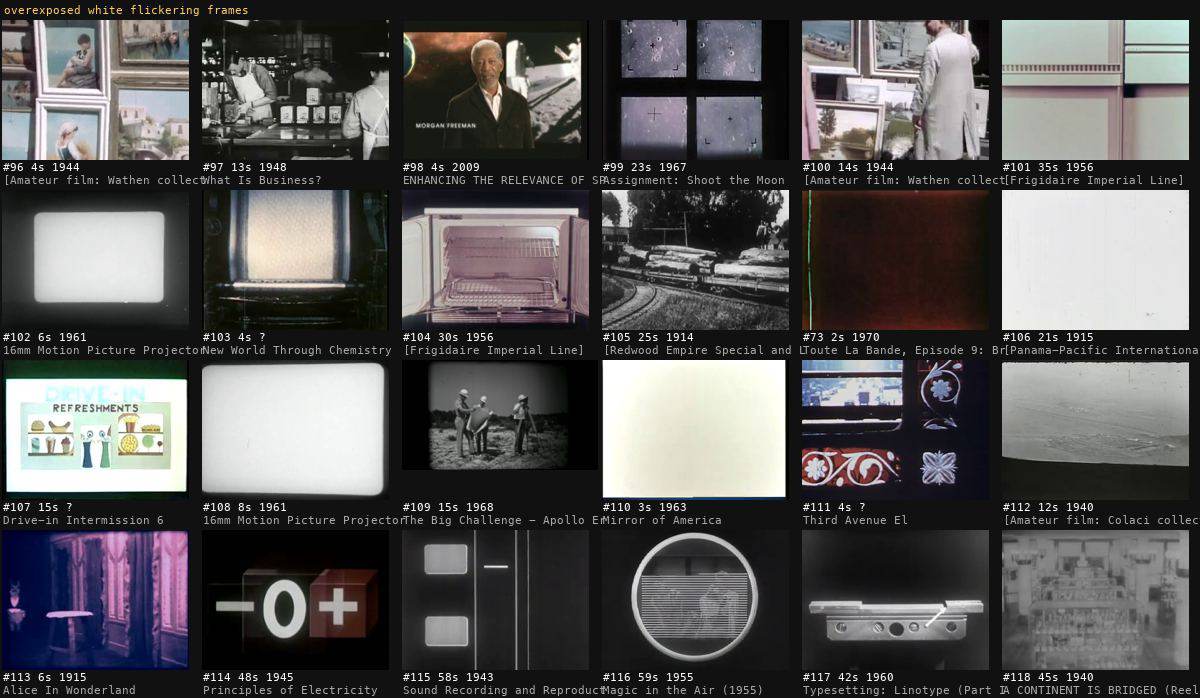
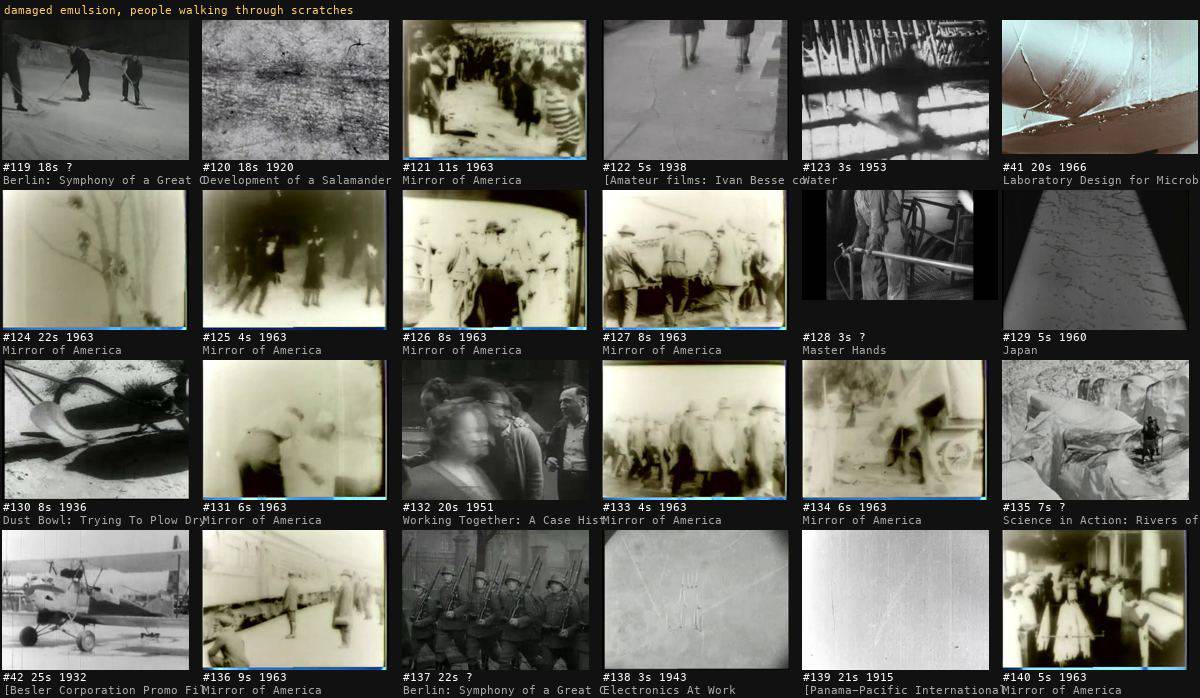
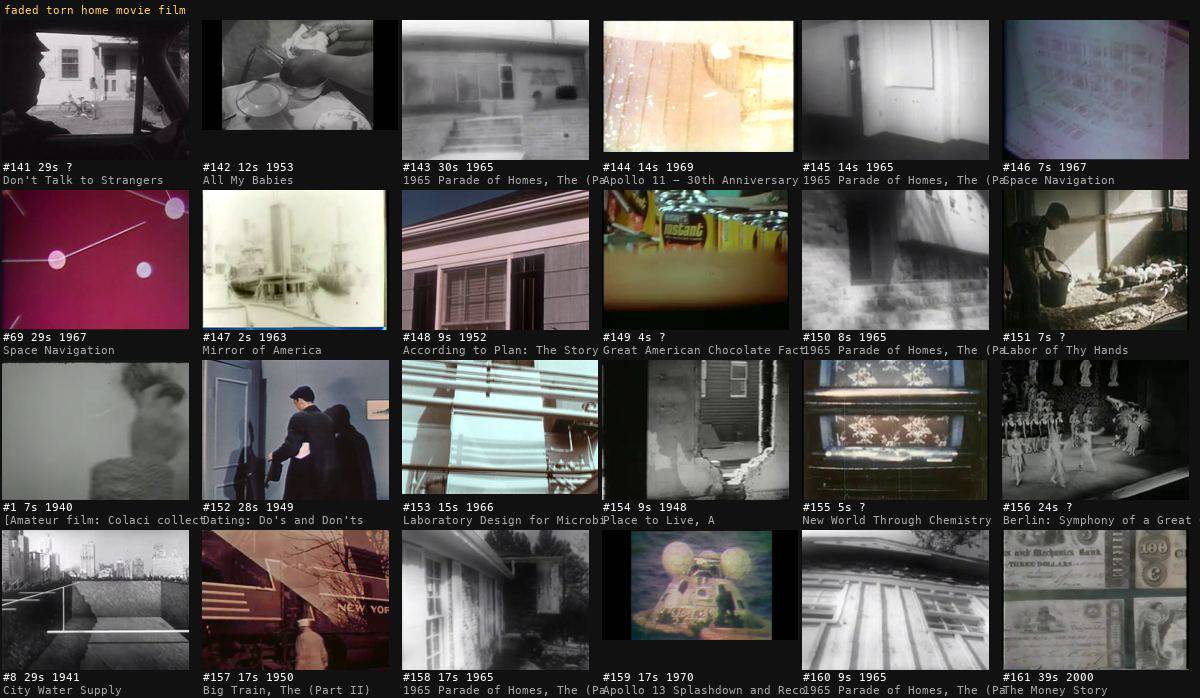
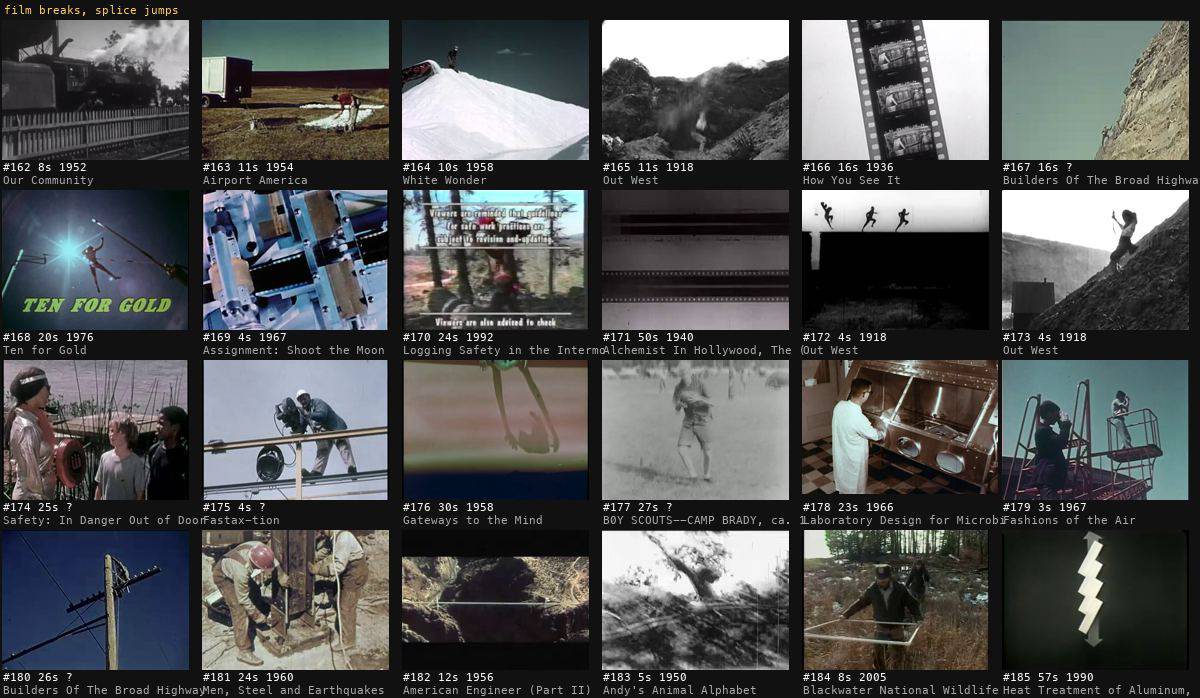
2. **Forage.** Write 8 to 14 searches in plain visible-action language ("a woman adjusts her hat, looking at herself"), not themes. Run each, save the results, and make one numbered contact sheet per query (thumbnail, #number, duration, year, title). Look at every sheet.
3. **Look closer.** For each candidate, fetch the clip and make a time-coded filmstrip with its waveform. Find where the action starts, completes, and what follows it. Note the native size and whether it has sound.
4. **Listen.** Transcribe candidates with word timings. Speech recognition invents words in hiss ("Thank you."). Check against the waveform and loudness before believing a word. An invented word is never evidence. If you cannot hear audio, say so in the case study and treat sound decisions as unverified.
5. **Write the edit list.** For each shot: clip number, in, out, gain, any sound taken from another clip (with its source), speed, hold, caption, and one sentence of reason that a reader could disagree with. Sound or captions from another source go in the ledger as such.
6. **Render, then check the render.** Make a contact sheet of every shot's head, middle and tail; transcribe the render; measure loudness per shot. Fix what you find. Known traps: a clip's closing cut can show up in your trim; holding a last frame can freeze the next shot of the source.
7. **Disclose derived layers.** If you remove, extend, generate, retime, mirror, or re-voice anything: keep the original, mark the derived layer on screen or in the ledger, and say what is unknown. Authored narration is labelled invented and synthetic.
8. **Blind critic.** Give a fresh agent only: a timecoded contact sheet of the final film, a transcript with loudness per 2 s, and the film's brief and acceptance criteria. Not your edit list, ledger, reasons or summaries. It names one specific event before it reads the brief. It returns a verdict (pass / reference stronger / inconclusive), the largest gap, up to three repairs each with a timecode and a checkable condition, and one strength to protect. It cannot hear: take no sound verdicts from it, and check its claims against the cut before obeying them.
9. **Repair what is true; leave what is wrong and say so.** If you changed the film, ask a new critic. Stop when you can say honestly what still falls short of the brief.
10. **Package** the case study per `RUNS.md`: searches and sheets, strips, the edit list with reasons, the ledger, the critic packets and verbatim reports, repairs, and what is open.

## Rules

- Status is not self-awarded. A film is "proof in progress" unless a blind critic passed it; "released" is for a person to say.
- Unknown dates and names stay unknown. Never imply two clips recorded the same event.
- Do not make assembled speech look like a speaker's own statement.
- Say what you could not perceive. A maker that cannot hear, or cannot see motion, must say so, because it changes what the cut proves.

## Tools (in `tools/`; Python 3, ffmpeg, Pillow, numpy)

- `forage.py <film> "query" ...` runs searches one at a time, writes `forage.json` and a contact sheet per query.
- `look.py <film> <n>[:step[:in:out]] ...` makes a time-coded filmstrip with waveform for clip #n.
- `hear.py <film> <n> ...` word timings (needs `mlx_whisper`, Apple silicon; substitute any word-timing ASR).
- `beats.py <film> <n> <in> <out>` motion-energy peaks, a helper for the eye.
- `cut.py <film>` renders `edl.json`; it chooses nothing. `pairs.py <film>` renders side-by-side pairs from `pairs.json`.
- `reel.py <film>` contact sheet of the rendered film, shot by shot.
- `packet.py <film>` builds what the critic gets.
- `erase.py` + `erase_plate.py` person removal for NOBODY HOME (SAM 2.1 tracked mask; replacement pixels from the same shot; unknowns listed). Set `SAM2_ROOT` to a folder with `models/sam2.1_hiera_small.pt`.
- `speak.py` authored narration with Kokoro-82M. `adopt.py` brings clips found in a local word index into a film's forage (set `CINEOSIS_LAB`).

---

## This film

**Title:** TERRA INCOGNITA (Material territories)

**Concept:** A passage through film’s damaged edges, where scratches, light leaks, and blank intervals become terrain and the recorded world keeps surfacing.

**First proof:** Build a sixty-second passage from three recorded film surfaces with different visible defects. Establish a recognizable image before following a scratch or light boundary into the next fragment. Hold one surface long enough to reveal that the apparent landscape is a material carrier. Let a recognizable scene return, then end at a blank interval with its actual recorded noise or an identified original sound composition. Keep observed damage distinct from any generated extension.

**Development boundary:** A generated transition is a separate authored layer. The material-study proof does not establish a historical relationship between otherwise unrelated fragments.

**Primary operator:** SCION 71 · Standard Gauge — The Carrier as Evidence. Full operator prompt: https://hartswf0.github.io/bolas/paeleo/allways/operator.html#s71
**Supporting:** SCION 73 · A Walk Through H — Narrated Passage Between Maps, SCION 113 · Learning to See — Learned Prior as Visible Transformation

**Operator's creative theorem:** Make the carrier of an image reveal work, standards and decisions hidden by ordinary projection. A stationary examination should build an argument through actual fragments and their histories, without needing to reconstruct the scenes they once carried.

**Acceptance criteria (from the operator):**
- At least one important claim can be checked directly in the visible carrier.
- Scale and handling remain legible at the delivery resolution.
- The narrator distinguishes recollection, research and uncertainty.
- The continuous examination develops through comparison rather than merely listing objects.
- The final remaining trace changes the table from a neutral display into evidence of work.
3 What was searched
One search at a time, in plain visible-action language. Each sheet is what came back: numbered thumbnails with duration, year and title. These are the images the maker looked at (or, where it could not, see the note below).
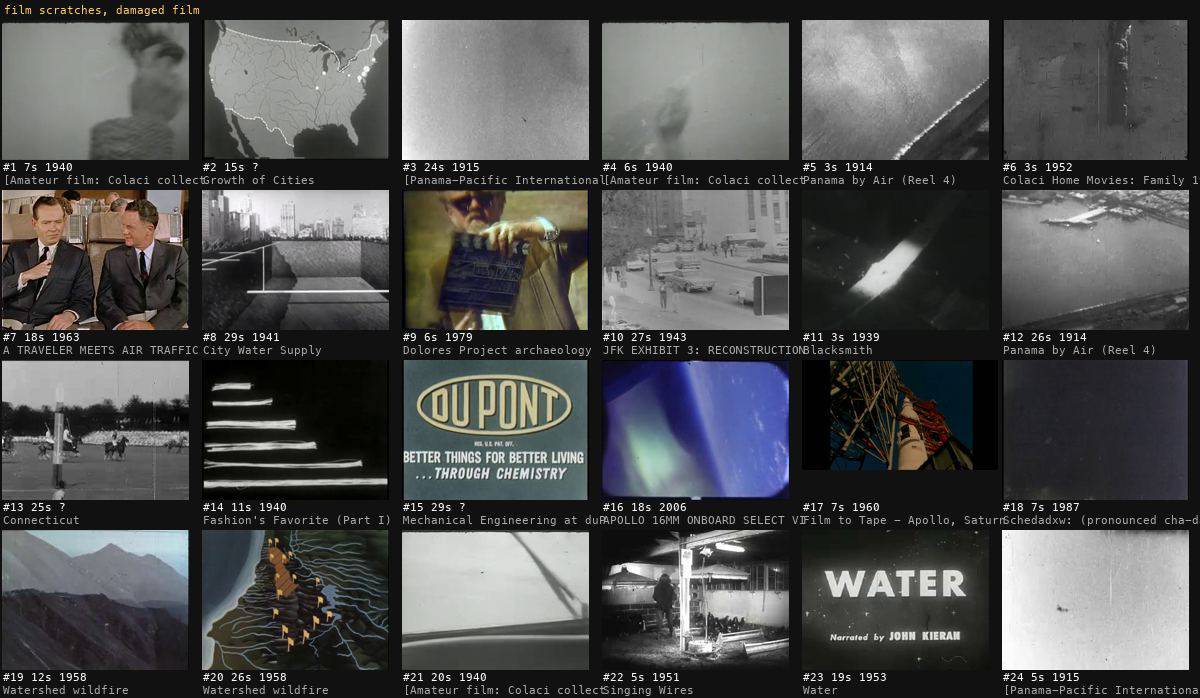
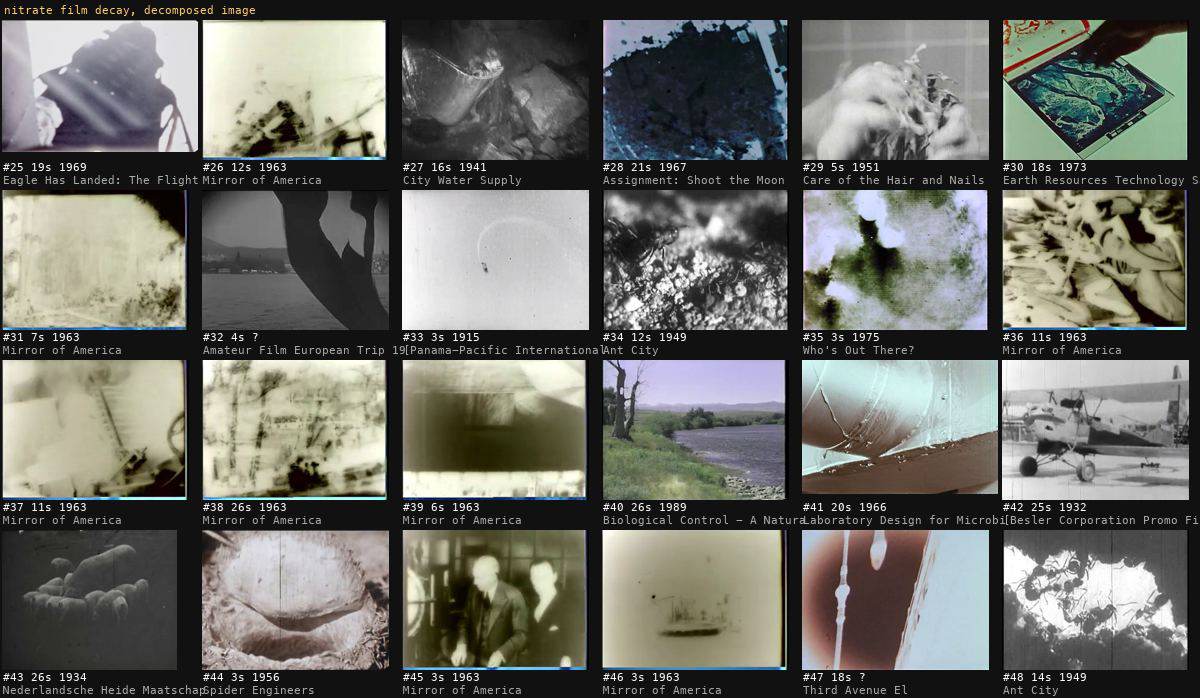
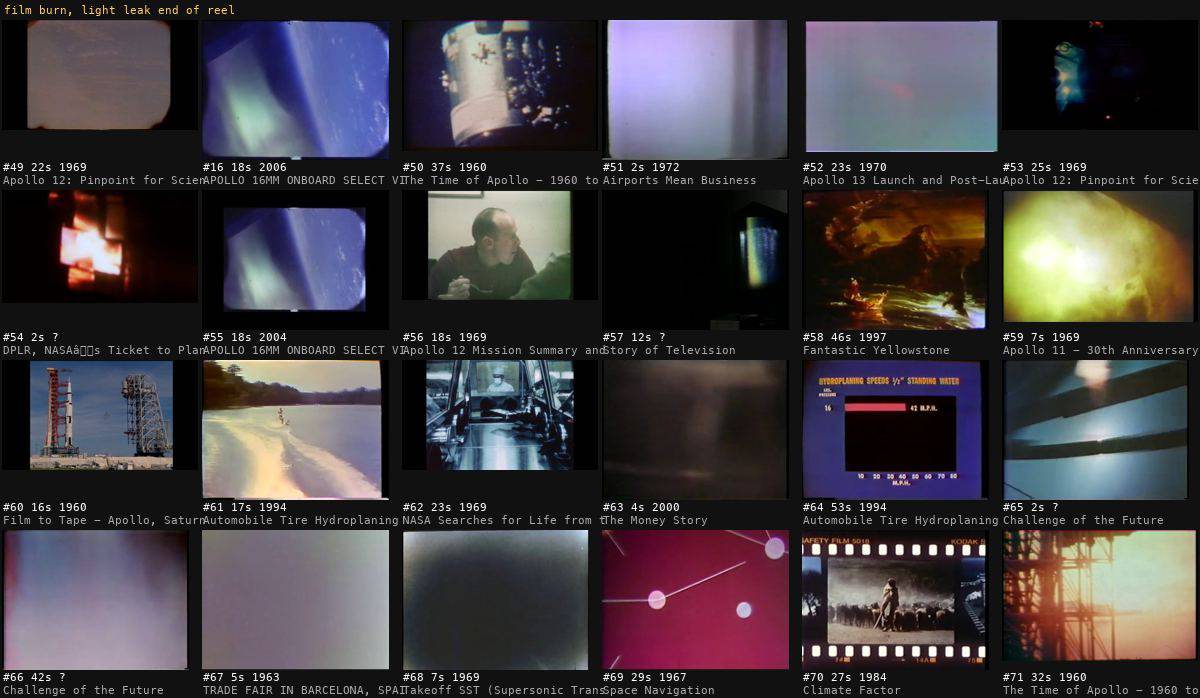
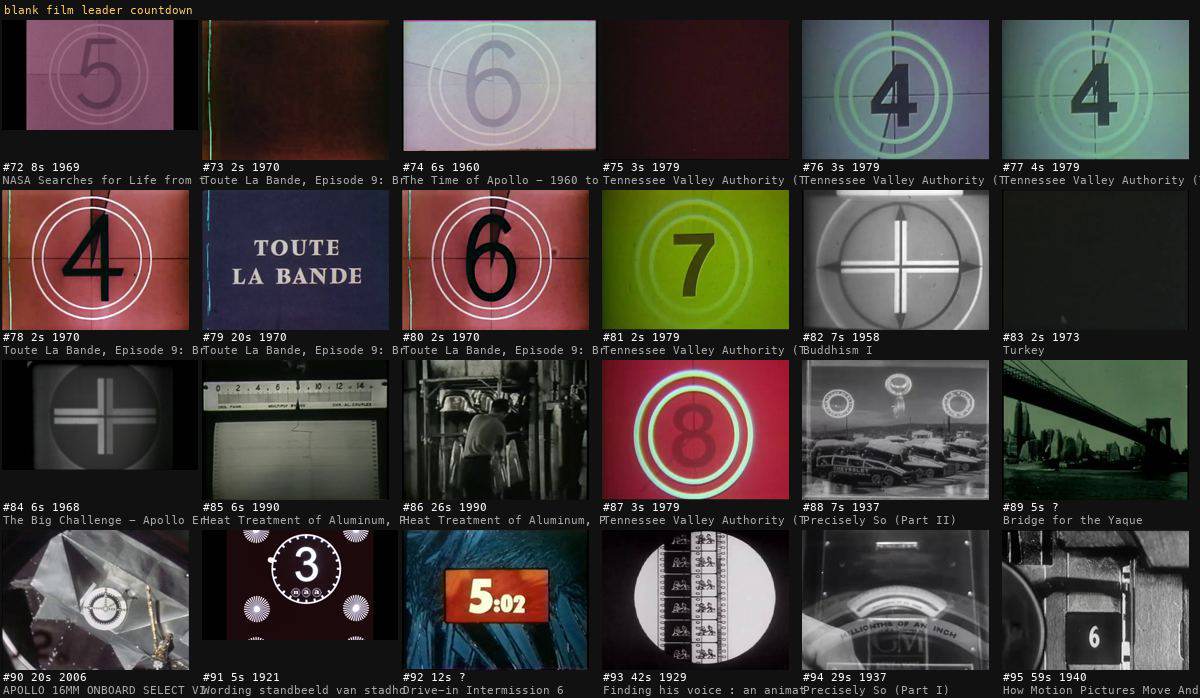
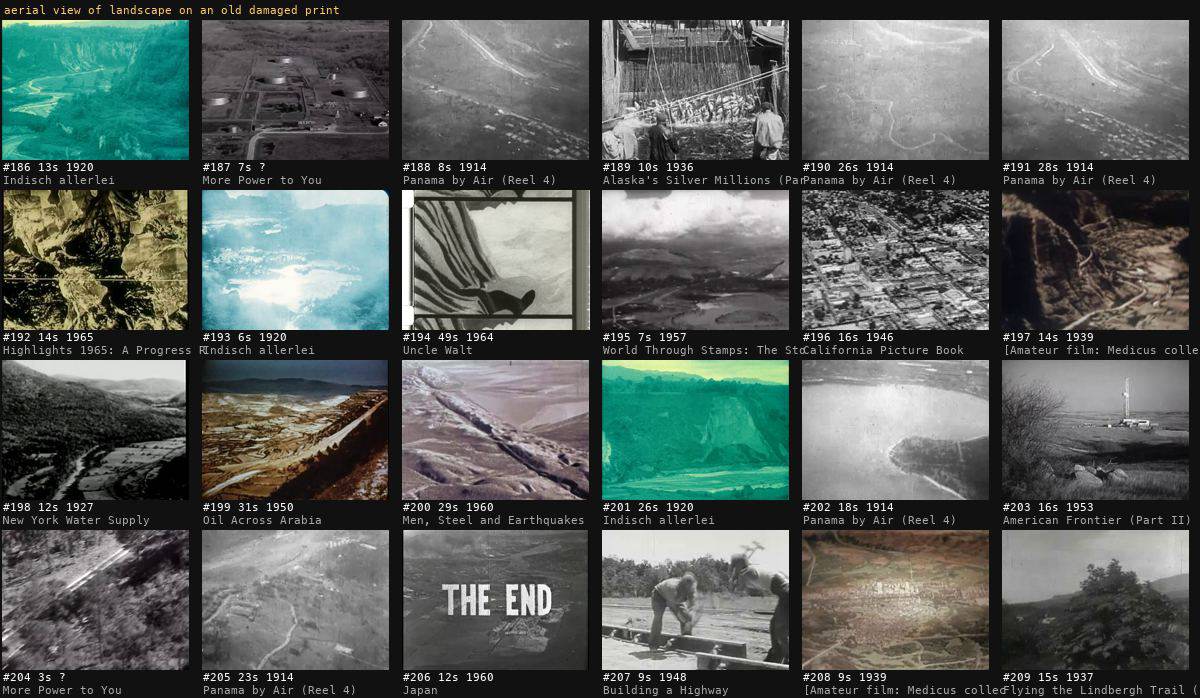
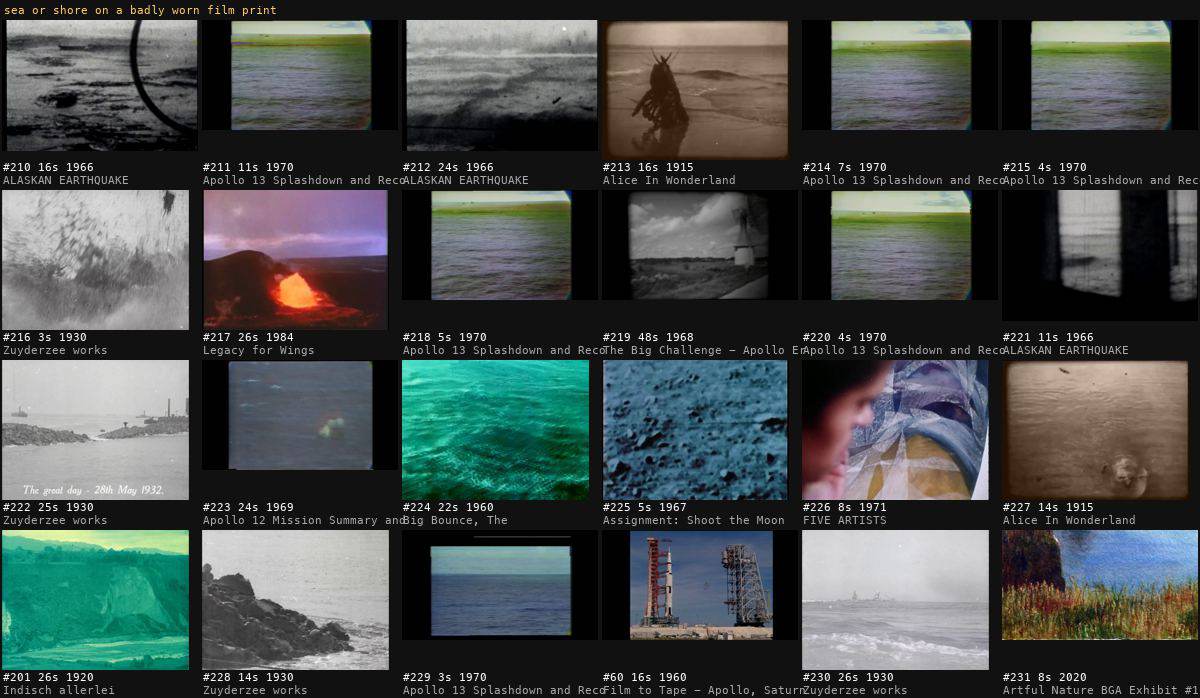
film scratches, damaged film · 24 resultsnitrate film decay, decomposed image · 24 resultsfilm burn, light leak end of reel · 24 resultsblank film leader countdown · 24 resultsoverexposed white flickering frames · 24 resultsdamaged emulsion, people walking through scratches · 24 resultsfaded torn home movie film · 24 resultsfilm breaks, splice jumps · 24 resultsaerial view of landscape on an old damaged print · 24 resultssea or shore on a badly worn film print · 24 results
4 What was looked at closely
A time-coded filmstrip and waveform for each candidate. Outlined strips are in the cut.
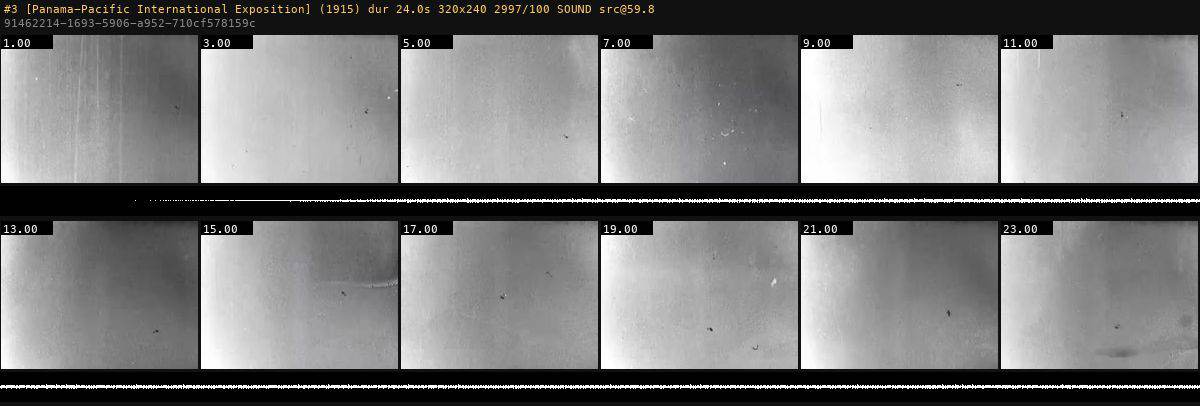
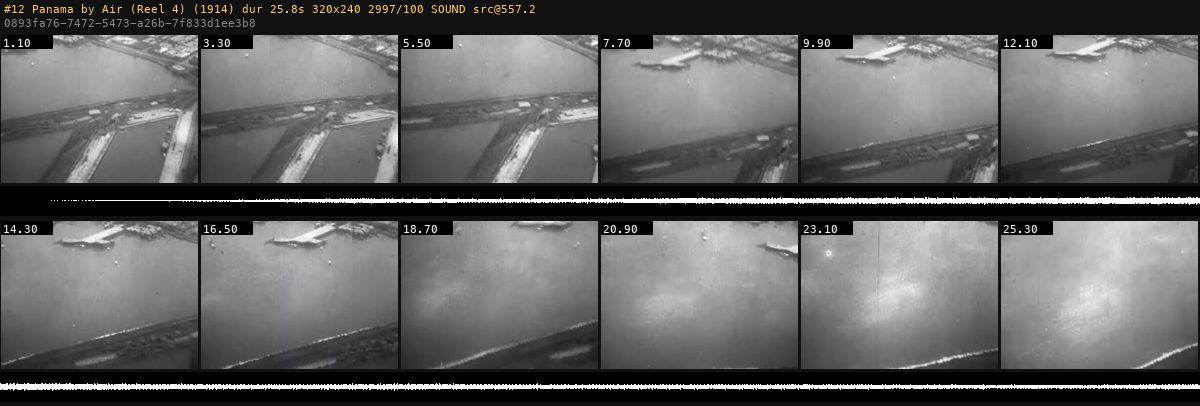
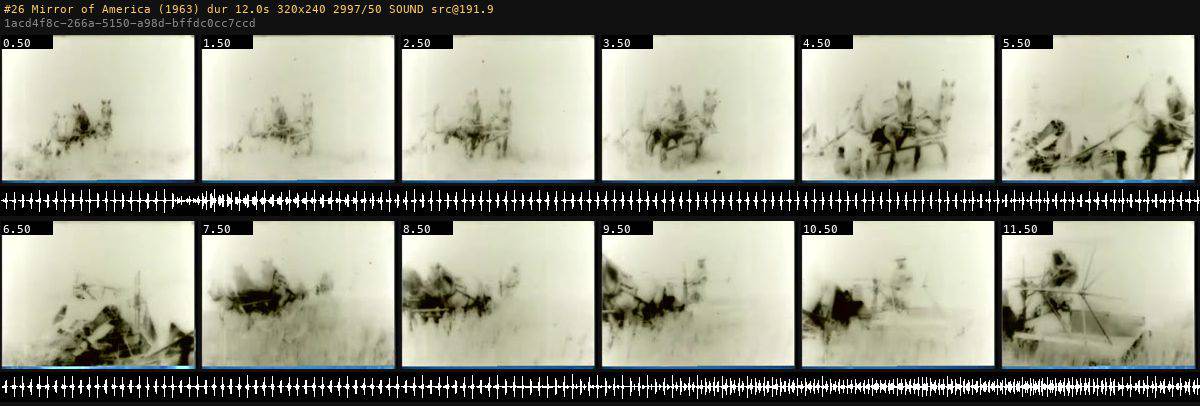
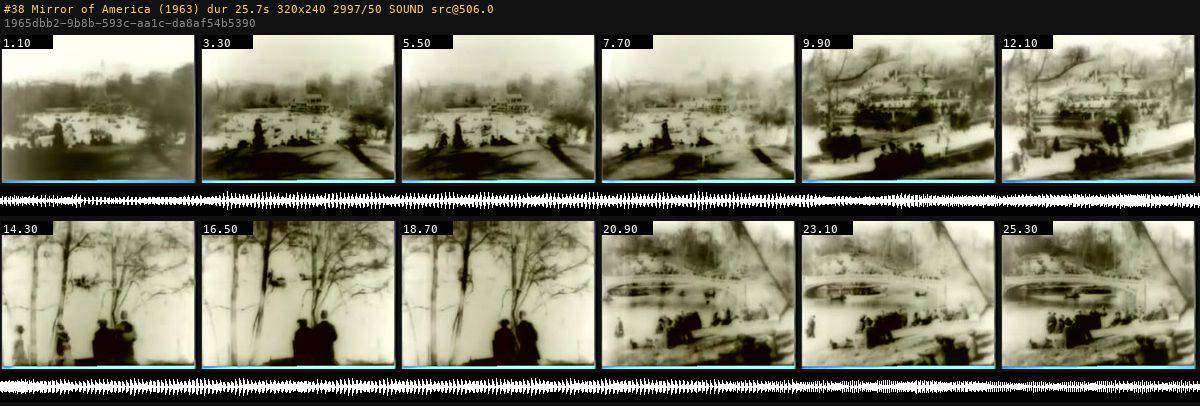
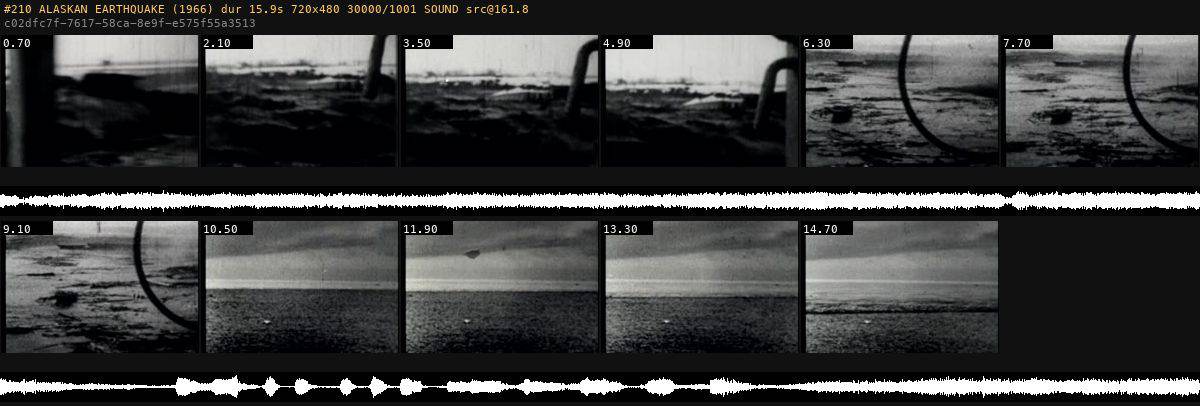
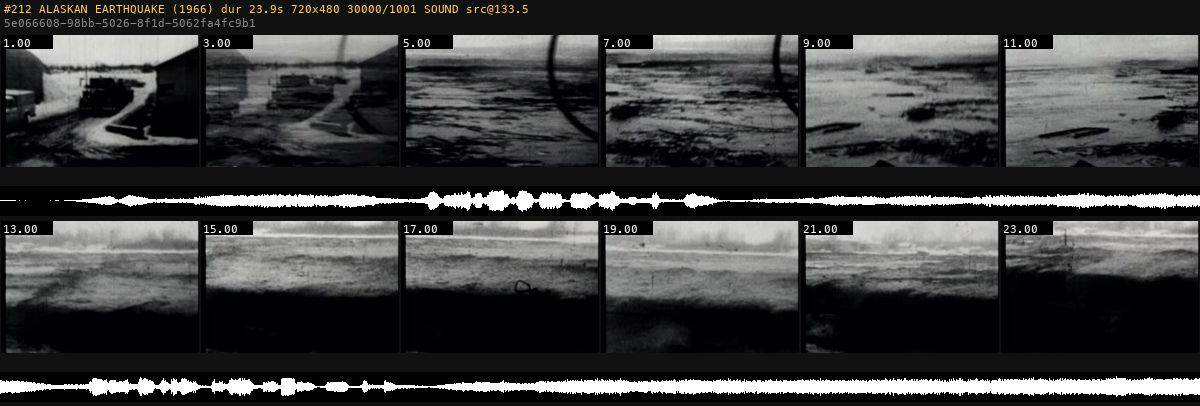
#3 [Panama-Pacific International Exposition] (1915) · in the cut (shot 6)#5 Panama by Air (Reel 4) (1914) · looked at, not used#12 Panama by Air (Reel 4) (1914) · in the cut (shot 1, 2)#26 Mirror of America (1963) · in the cut (shot 4)#33 [Panama-Pacific International Exposition] (1915) · looked at, not used#38 Mirror of America (1963) · in the cut (shot 5)#210 ALASKAN EARTHQUAKE (1966) · looked at, not used#212 ALASKAN EARTHQUAKE (1966) · in the cut (shot 3)
5 The cut
The finished film, shot by shot (first, middle and last frame of each):
The final cut as a contact sheet
Every shot, where it came from, and why it is here. Source seconds are in the original film. Links go to the archive's own copy of the clip.
same reel. The white shoreline stays and everything else becomes mottling. Held long enough that the sea starts to read as emulsion: the apparent landscape is the carrier.
following that bright edge to a different film, 1966, where a black arc crosses a tidal flat. Its narrator's Suddenly the whole harbor of Valdez is sucked dry is kept: he is describing an event, the picture is also describing its own surface.
end on a blank interval, 1915, with its own recorded noise raised: flecks and hairs and no picture.
6 Review
A fresh agent was given only a timecoded contact sheet of the film, a transcript with loudness, and the brief. Not the edit list, the ledger, or these reasons. It cannot hear.
Round 1 reference stronger
independent critic (fresh Claude Sonnet 5.5 agent). Its report, verbatim:
The report
VERDICT: reference stronger (inconclusive on sound; I cannot hear it).

Noticed before the brief: 0:14 to 0:15 hard cut from a bright, blown-out aerial of water to a black-bordered shoreline with a dark arc across the right edge. The ASR line "the whole harbor of Valdez is sucked dry" at 14.4-17.6 lands on it, but the sheet shows tidal flats and not a harbor. The picture does not clearly back the words. The loudness spike at 14-16s supports a narration or sound event there.

Largest gap: the brief asks for a recognizable scene to return after a held surface, and for a visible scratch or boundary to carry the viewer between fragments. The sheet shows three fragments joined by hard cuts, at 0:15 and 0:22. At 0:40 the film goes to a near-blank gray leader that holds for about 7s. The park scene from 0:22 (sepia, blurred, then dissolving into horses and carriage at 0:34-0:39) does not return, and nothing links the shots by a defect. The 0:40-0:46 blank has no readable recorded noise on the sheet. Its transcript is repeated "I can't" at near-silence, which is probably false ASR from hiss. Nothing on the sheet shows scale or handling, and no narrator separates recollection from research. The film is 47s against a 60s brief.

Repairs:
1. At 0:15 and 0:22, add an overlap of at least 8 frames in which a scratch or vertical line from the outgoing shot stays visible in the incoming one. Check by frame-stepping.
2. At 0:40, return to the park or carriage image before the blank. The same shot should appear at both 0:22-0:33 and about 0:39. The blank should then fall after it.
3. At 0:33-0:39, the ghosted horse image reads as a generated extension. Label it as such, or cut it.

Strength to protect: the held blank leader from 0:40 to 0:46, with its dust and scratches, reads as the film's own material.
Partly: the ghosted horse image is the source's own decayed print, and nothing in this film is generated, but the film never says so. The park and harvester shots were reordered so the park comes right before the blank interval. Scratch overlaps at the cuts were not made.
7 What happened
Repairs after review
Reordered so the park skaters come immediately before the blank interval.
What worked
Searches for damage (scratches, nitrate decay, light leaks, countdown leaders, worn shore prints) returned many Apollo film-to-video transfers; the useful ones were two decayed 1963 'Mirror of America' prints, a 1914 aerial and a 1915 blank.
Every source keeps its own sound. The blank's hiss is raised about 20 times so it can be heard as material.
What failed
The critic found no defect that carries the viewer from one fragment to the next. Cuts are hard cuts; scratch overlaps were not made.
The decayed prints read as generated to the critic. They are the sources' own damage and nothing in the film is generated, but the film says nothing about that.
What is still open
Overlaps of at least eight frames where a scratch from the outgoing shot stays in the incoming one.
A caption saying which damage is the source's.
8 Files
edl.jsonedit list: every in, out, gain and reason, as written
ledger.jsonledger: each shot traced to its source seconds


 Argon